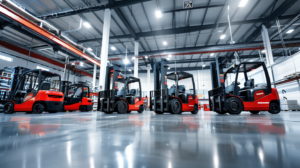
1) What a Rough Terrain Forklift Actually Is (and what it isn’t)
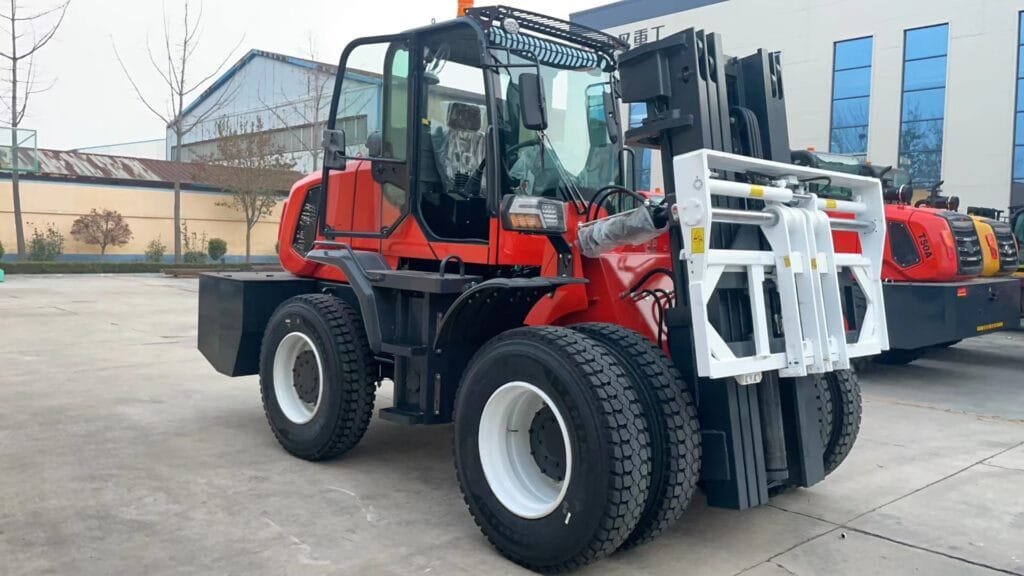
A rough terrain forklift is basically a forklift that’s built to drive where normal forklifts struggle: gravel, mud, sand, uneven soil, construction sites, farms, lumber yards, and outdoor storage areas.
A quick way to explain it in plain words:
- A warehouse forklift likes flat concrete and neat aisles.
- A rough terrain forklift is meant for “messy ground” and outdoor work.
But here’s the important part: not every machine with big tires is a true rough terrain forklift. The real ones are designed around three things:
- Traction (it can move without spinning out)
- Stability (it won’t tip when lifting on uneven ground)
- Durability (it doesn’t fall apart after a season of abuse)
When buyers compare rough terrain forklifts from China, the smart move is to ignore shiny paint and focus on these fundamentals. The rest is just decoration.
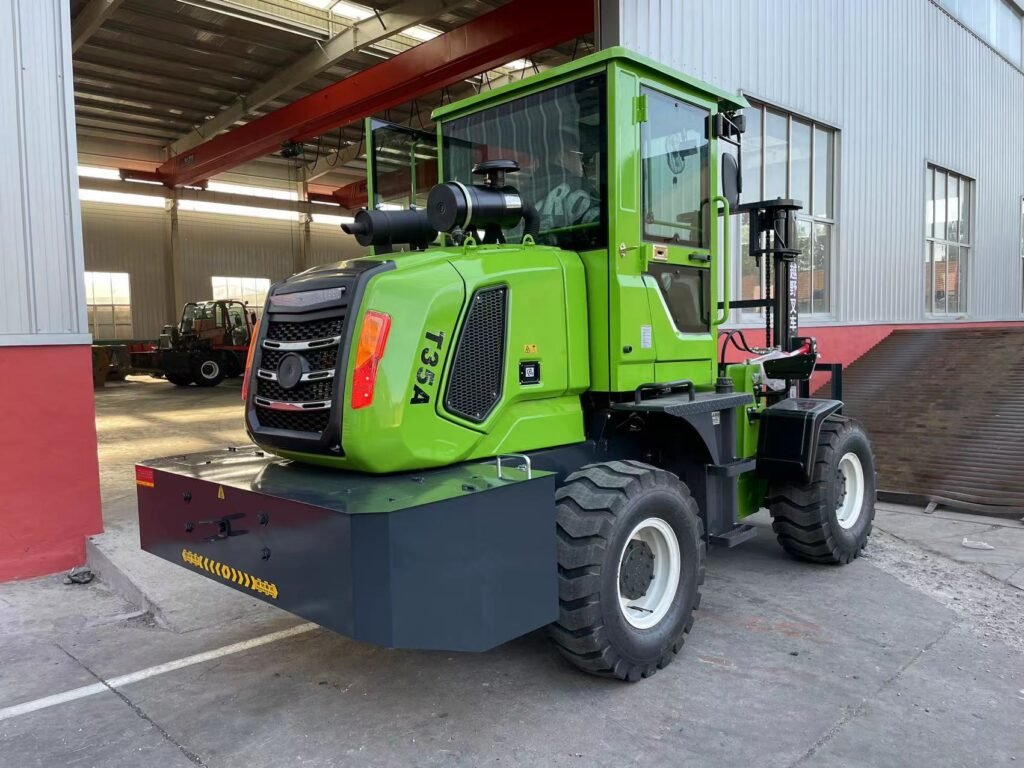
2) Where These Forklifts Work Best
Rough terrain forklifts are usually chosen for:
- Construction sites (blocks, bricks, rebar, pallets of cement)
- Farming and ranch work (feed, fertilizer, seed, fencing supplies)
- Lumber yards and stone yards
- Outdoor logistics yards
- Landscaping businesses
- Remote job sites with poor roads
And they are not the best fit for:
- Tight warehouse aisles (turning radius is bigger)
- Very smooth indoor floors where speed and precision matter more than ground ability
- Super-high lift heights like big container handlers (different category)
So the first decision is simple: if most work is outdoors on uneven ground, rough terrain is a match. If the work is mixed indoor/outdoor, some buyers choose a compact rough terrain model or a different machine class.
3) Key Feature #1: 4WD + Traction Systems That Don’t Quit
If the jobsite is soft ground, traction is everything.
3.1 2WD vs 4WD (what buyers often regret later)
- 2WD can be okay on hard-packed gravel or dry ground.
- 4WD is the safer bet for mud, sand, snow, slopes, or wet grass.
A lot of “budget” listings push 2WD because it’s cheaper. But when the forklift gets stuck with a load, the savings disappear fast—wasted time, towing, and sometimes damage.
3.2 Differential lock (small feature, big difference)
A forklift can have 4WD and still spin if one wheel loses grip. That’s where differential lock helps.
A good, buyer-friendly requirement is:
- 4WD + differential lock, especially for construction and farms.
3.3 Gradeability and real-world traction
Some spec sheets throw big numbers around. Instead of chasing marketing claims, a practical check is:
- Can it climb a slope with a load without wheel spin?
- Can it start moving again on a slope after stopping?
If the supplier can’t show a simple yard test video with a loaded pallet on uneven ground, that’s a signal to be cautious.
4) Key Feature #2: Tires, Ground Clearance, and “Real” Off-Road Ability
This is where rough terrain forklifts separate into “looks tough” and “is tough”.
4.1 Tires: pneumatic is common, but the details matter
Most rough terrain forklifts use pneumatic tires (air-filled) because they absorb bumps and grip better. But buyers should still ask:
- Tire size and tread pattern (deep lugs help in mud)
- Ply rating (stronger sidewalls reduce punctures)
- Rim and hub quality (weak hubs fail early on rough ground)
If the forklift will work around scrap, nails, or demolition waste, buyers often add:
- Heavy-duty tires, or foam-filled tires (depending on application)
4.2 Ground clearance: don’t buy a “belly dragger”
Ground clearance impacts whether the machine gets hung up on rocks, ruts, and site debris.
A practical buyer check:
- Look underneath—hydraulic lines, transmission housing, and belly plates should be protected.
- Ask for photos of the underside, not just showroom angles.
4.3 Approach/departure angles (quietly important)
On uneven ground, the forklift needs to climb onto piles or ramps without hitting the frame. Good design has:
- Better approach angle
- Better departure angle
- Protection for key components
These are the kinds of “invisible reliability” points that make a forklift feel solid after 2,000 hours—not just nice on delivery day.
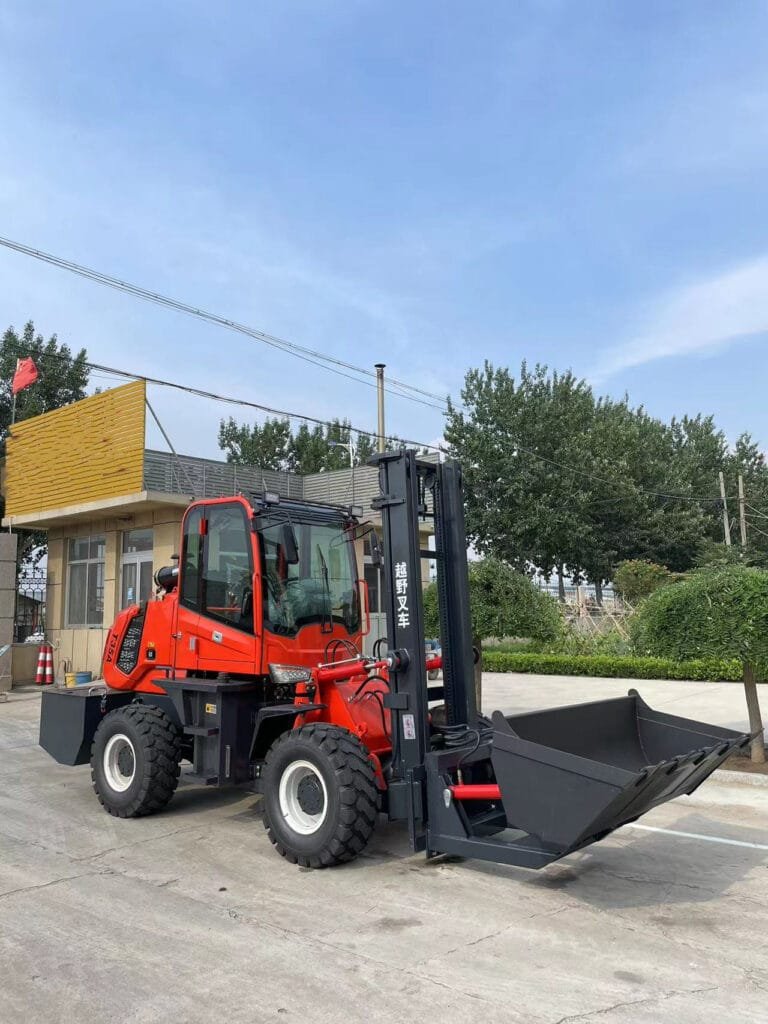
5) Key Feature #3: Stability and Load Handling (the part that saves lives)
This is the feature category that matters most, because stability failures can injure people and destroy goods.
5.1 Load capacity is not the whole story
A forklift rated at “3.5 ton” can still be dangerous if:
- The load center is wrong
- The mast flexes too much
- The rear axle oscillation is poorly designed
- The tires and frame allow too much sway
Buyers should always ask:
- Rated capacity at what load center?
- Does the supplier provide a load chart?
5.2 Wheelbase and center of gravity
In simple terms:
- Longer wheelbase and lower center of gravity generally help stability.
- But too long may reduce maneuverability.
A balanced design is the goal, not extreme numbers.
5.3 Axle design and “feel” on rough ground
Many rough terrain forklifts use an oscillating rear axle to keep wheels on the ground. The key is how it’s limited and damped.
What buyers can request:
- Video of lifting and tilting on uneven ground
- Video of driving with a load across ruts (slow and controlled)
- Confirmation of frame reinforcement at stress points (mast mounts, axle mounts)
A common factory checkpoint in better-built machines is a static load hold test:
- Lift a rated load to a set height and hold it for a defined period
- Check pressure drop, mast creep, hose seepage, and cylinder seal stability
It’s not fancy—but it’s the kind of test that prevents future “mystery hydraulic problems”.
6) Key Feature #4: Mast, Hydraulics, and Lift Controls (smooth vs. scary)
A rough terrain forklift doesn’t need to be fast. It needs to be predictable.
6.1 Mast types and visibility
Common mast types:
- Duplex (2-stage)
- Triplex (3-stage, better for higher lift with lower closed height)
Ask about:
- Mast roller quality and lubrication points
- Chain quality and protection
- Visibility through the mast (operator needs to see)
6.2 Hydraulic smoothness
“Jerky” controls make work slower and increase tipping risk. Good hydraulics feel:
- Smooth on lift and lower
- Smooth on tilt
- Stable under load without sudden drops
Buyers can request:
- Video showing slow lowering with a heavy load (no bouncing)
- Hydraulic valve brand or spec (not always a famous brand, but it should be consistent and serviceable)
6.3 Attachments and auxiliary hydraulics
Many rough terrain forklifts are used with:
- Side shifters
- Fork positioners
- Bale clamps (agriculture)
- Brick clamps (construction)
- Carpet poles, etc.
If attachments are planned, confirm:
- Auxiliary hydraulic lines from factory
- Flow/pressure compatibility
- Counterweight and stability impact (attachments change load center)
7) Key Feature #5: Engine, Transmission, and Cooling for Harsh Jobsites
This is where buyers often get surprised after import: the forklift runs fine in a clean demo yard, then overheats at a dusty jobsite.
7.1 Engine choices: diesel is common, but compliance matters
Most rough terrain forklifts use diesel engines for torque and durability. The buyer checklist should include:
- Emission standard required in the destination country/region
- Engine brand and service network availability
- Fuel system type (simple mechanical vs modern common rail)
- Cold-start capability (if relevant)
If exporting to Europe or North America, compliance can become the biggest deal—not the lifting capacity.
7.2 Transmission: torque converter vs hydrostatic
Both can work. The key is matching to job type:
- Torque converter: often strong for heavy pushing, steady work
- Hydrostatic: often smoother control and easier inching
Ask the supplier:
- What transmission type is used?
- Any history of overheating under load?
- What oil cooling system is included?
7.3 Cooling system and dust protection
For construction and agriculture, cooling needs to handle:
- Heat
- Dust
- Seeds/fluff
- Mud
Buyer-friendly features:
- Larger radiator capacity
- Easy-to-clean radiator access
- Protective screens
- Good airflow design
A simple “real-world” check:
- Ask for a video of cleaning access—if cleaning is painful, overheating will happen.
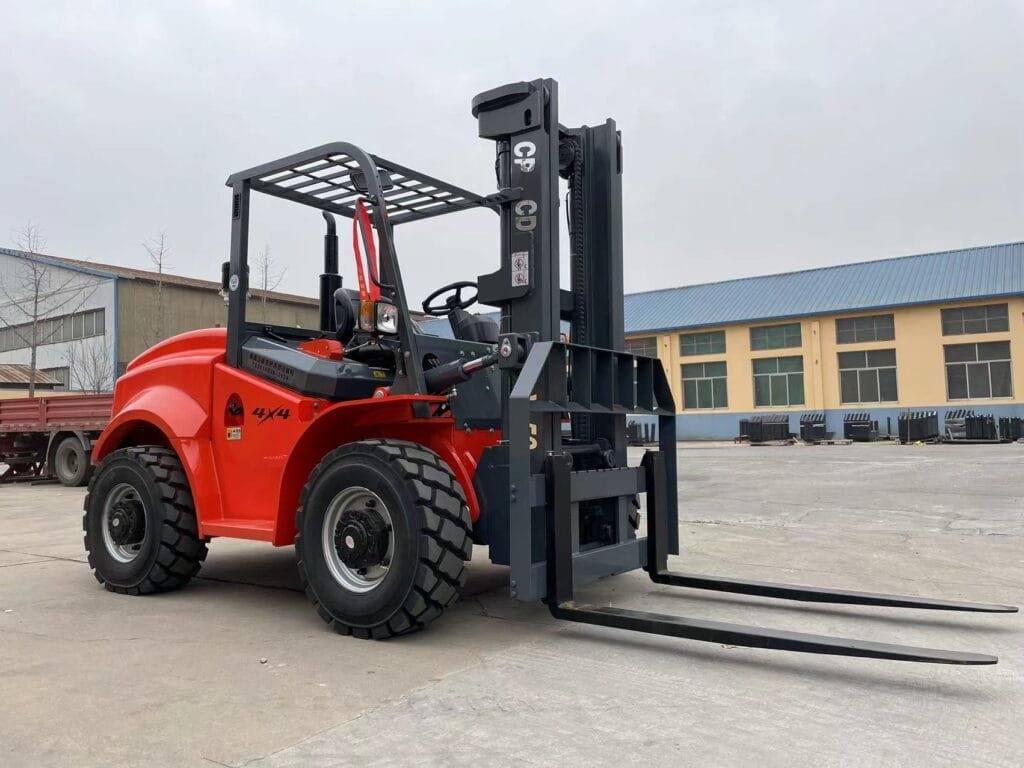
8) Key Feature #6: Operator Comfort (because fatigue causes accidents)
Comfort sounds optional—until the operator is doing 8–10 hours outside.
Key comfort features to look for:
- Suspension seat
- Clear visibility and good mirrors
- Ergonomic joystick/levers
- Low vibration and reduced noise
- Good cabin sealing (if enclosed cab)
- Heater/defroster options (cold regions)
- Strong work lights for early/late shifts
Comfort improves productivity and reduces mistakes. That’s not “luxury”—it’s profit.
9) Key Feature #7: Safety Features to Demand (not “nice to have”)
Rough terrain forklifts work in unpredictable environments. Safety should be treated like a required spec.
Minimum safety expectations:
- ROPS/FOPS (rollover and falling object protection, depending on local rules and application)
- Seat belt and seat belt reminder
- Parking brake reliability and slope holding
- Emergency shutoff
- Backup alarm and lights
- Non-slip steps and handholds
- Load backrest
- Overhead guard strength and weld quality
A smart procurement approach is to request a safety feature list in writing, as part of the purchase contract, not just in chat messages.
10) Key Feature #8: Serviceability, Parts, and After-Sales Support
This is where a “good price” can turn into a long-term headache.
10.1 Easy service access
Look for:
- Easy access to filters
- Clear routing of hoses and wiring
- Grease points that can actually be reached
- Simple daily checks (oil, coolant, air filter)
If routine maintenance is hard, operators skip it. Then failures start.
10.2 Spare parts package (highly recommended for imports)
For overseas buyers, a starter spare parts kit is often a must:
- Filters (oil, fuel, air)
- Belts
- Hoses
- Seal kits for common cylinders
- Brake components
- A few sensors and switches
- Tire repair essentials (depending on region)
10.3 Documentation quality
Ask for:
- Parts manual with exploded diagrams
- Service manual
- Electrical/hydraulic schematics
- Clear serial number and component identification
“Paperwork quality” is a good predictor of “support quality”.
11) Certifications and Compliance: How to Avoid Paper Problems
This is a sensitive topic for importers because certificate fraud does happen in the market.
What to do instead of trusting a PDF:
- Verify the certificate with the issuing body where possible
- Match certificate model numbers to the nameplate and serial range
- Confirm engine emission documents match the actual engine model
- Put certificate requirements into the contract as a condition of shipment
If the destination market is strict (EU/UK/NA), compliance planning should happen before production, not after the machine is finished.
12) Factory Quality: What to Inspect (and what to ignore)
A good inspection plan focuses on the parts that create expensive failures.
12.1 Welds and structural areas
Inspect:
- Mast mounting area
- Axle mounting brackets
- Counterweight and frame connections
- Overhead guard structure
Look for:
- Consistent bead profile
- No undercut or porosity visible
- Good reinforcement plates where stress concentrates
12.2 Hydraulics: leaks today become failures tomorrow
Check:
- Cylinder rod finish
- Hose routing protection (no rubbing points)
- Valve block cleanliness
- Pressure test results or hold test process
Many stronger factories run a simple routine:
- Hose leak check after pressure build
- Cylinder hold test
- Final “loaded function test” before packing
12.3 Assembly consistency and torque discipline
This is “invisible reliability”. Better factories use:
- Torque markings
- Standardized torque tools
- QC checklists at each station
12.4 Paint and cosmetics (keep this in the right place)
Paint quality matters for corrosion resistance, but it should not be the only focus. A shiny machine with weak structure is still weak.
13) Common Configurations and How to Choose the Right One
Here’s a practical way to select specs without overthinking.
If the job is mostly construction materials outdoors:
- 4WD + differential lock
- Strong cooling package
- Simple, durable transmission
- Good lighting
- Side shifter (often worth it)
If the job is farm/ranch work:
- 4WD
- Good tires for soft ground
- Attachment readiness (bale clamp, etc.)
- Easy cleaning access (dust and seeds)
- Comfortable seat and controls
If the job is yard logistics with mixed surfaces:
- Balance turning radius and stability
- Consider enclosed cab if weather is harsh
- Focus on parts availability and service simplicity
14) Typical Import/Procurement Risks (and how to de-risk them)
Overseas buyers usually worry about four things:
- Quality consistency
- Certification risk
- Delayed shipment (missed sales season)
- Weak after-sales support
A simple de-risk plan looks like this:
- Factory audit (even a short video audit is better than none)
- Pre-production spec lock (written configuration list)
- Mid-production check (photos/videos of key assemblies)
- Pre-shipment inspection with a checklist focused on structure, hydraulics, safety, and documentation
- Spare parts kit agreed before shipment
- Clear warranty terms and response time expectations
This approach is common among experienced importers because it reduces “surprises after arrival”.
15) Why Some Buyers Prefer China (and how to buy without regret)
China can be attractive for rough terrain forklifts because:
- Broad manufacturing base and flexible configurations
- Competitive pricing
- Faster customization (cab options, tires, attachments, branding)
- Scalable production for dealers
But the winning formula is not “buy the cheapest.” It’s:
- Buy from a supplier that can prove process control, documentation, and support.
This is also why many buyers stick with factories that already export to strict markets and have stable production systems. For example, brands like Nicosail are known in compact equipment for exporting to Europe, North America, and Australia with structured production lines and customizable configurations—exactly the kind of factory discipline buyers should look for when sourcing any heavy equipment category. The point is not that every buyer needs the same brand, but that the same quality habits (clear QC checkpoints, consistent assembly, export documentation discipline, and parts support planning) are what make an import deal feel safe.
FAQ
Q1: Are rough terrain forklifts from China reliable?
They can be—if the design is solid and the factory controls build quality consistently. Reliability usually comes down to structure, hydraulics, cooling design, and parts support more than the country label.
Q2: Is 4WD always necessary?
If the machine will work on mud, sand, slopes, snow, or wet grass—4WD is strongly recommended. For hard-packed yards with mild unevenness, 2WD may be acceptable, but it’s a bigger risk.
Q3: What’s the biggest mistake buyers make when importing?
Focusing too much on the spec sheet and too little on compliance documents, inspection plan, and spare parts readiness.
Q4: What inspection items catch the most problems?
Structural weld areas, hydraulic leak/hold performance, mast operation under load, braking on slopes, and documentation matching (nameplate ↔ certificate ↔ engine model).
Q5: Which features improve resale value for dealers?
4WD, enclosed cab options, strong lighting package, recognizable engine compliance, and a clean parts/manual package.
Q6: Should a spare parts kit be purchased with the first order?
Yes, in most overseas cases. It prevents small issues (filters, hoses, sensors) from becoming long downtime events.
Q7: How can certificate fraud be reduced?
Verify certificate authenticity, match model/nameplate details, and make compliance documents part of the contract conditions.
Summary
Rough terrain forklifts from China can be a strong choice when the buying decision is based on the right fundamentals: traction (4WD + diff lock), true off-road readiness (tires + clearance), stability under load, smooth hydraulics, jobsite-ready cooling, real safety features, and service/parts support. The most successful buyers treat the purchase like a system—machine configuration + factory quality habits + inspection plan + documentation + spare parts—so the forklift performs well long after it arrives, not just on the day it’s unloaded.