1) What “Rough Terrain Forklift” buyers are asking for in 2026
Rough terrain forklifts used to be simple: big tires, diesel engine, basic mast, get the pallets across mud and rocks.
Now buyers want something more specific:
- Outdoor performance like a tractor (traction, clearance, cooling, filtration)
- Indoor-friendly options for farms, lumber yards, and mixed sites (lower noise, lower fumes)
- Better safety + compliance because jobsite inspections are stricter than before (and certificates get verified)
- Predictable total cost: fewer leaks, fewer electrical gremlins, fewer “small parts” downtime issues
That’s why sourcing from China is changing too. It’s no longer only about a cheaper unit price—buyers increasingly compare system design + compliance + aftersales ability.
2) Trend #1: High-voltage lithium RT forklifts move from “new” to “normal”
Lithium isn’t just for warehouse electrics anymore. The real shift is high-voltage lithium on rough terrain models, because higher voltage helps deliver usable power without making everything oversized.
China manufacturers are pushing this hard. For example, Hangcha has publicly promoted high-voltage lithium rough terrain forklift models and positioned them as purpose-built products (not a quick retrofit).
What buyers should expect next:
- More RT models offered as electric-first, not diesel-first
- Faster charging + opportunity charging packages bundled into quotes (charger, connectors, battery options)
- More battery safety questions from insurers and large customers, especially in North America
A simple buyer tip: when a supplier says “lithium,” ask what safety standard the truck and battery system is designed around. For electric industrial trucks, UL 583 is a commonly referenced safety standard in the market.
For lithium battery safety testing, UL 2580 is often discussed as a benchmark.
What can go wrong if this is ignored?
The forklift may “work,” but the battery/BMS protections, wiring protection, or charging behavior might not match what your local customer, inspector, or insurer expects—especially when the truck lives outdoors, gets washed, or runs in cold weather.
3) Trend #2: Cleaner diesel (Stage V / Tier 4) stays important—especially for exports
Electric is growing, but diesel isn’t going away. For many job sites, diesel still wins on:
- long shifts without charging infrastructure
- remote locations
- extreme cold where batteries need planning
But export markets keep tightening emissions. In the EU, Stage V for non-road mobile machinery is a big deal and pushes manufacturers toward more complex aftertreatment setups (like DPF).
Industry explanations of Stage V highlight stricter limits on pollutants including particulates and NOx.
What to expect from China manufacturers:
- More quotes that clearly separate “domestic engine config” vs “EU/UK Stage V config”
- More “engine family” discussions (which engine, which certification, which control system)
- More attention to heat management, because aftertreatment adds thermal load
Buyer reality check: emissions compliance isn’t just the engine brand—it’s also integration quality (cooling pack sizing, shielding, sensor routing, regen strategy, service access). A clean-looking brochure won’t save downtime if the cooling system is marginal.
4) Trend #3: Telematics becomes a “must-have,” not a “nice-to-have”
Fleet tracking isn’t only for warehouses. Outdoor fleets want answers like:
- Who drove the truck?
- How many impacts happened?
- Is it being overloaded?
- What maintenance is due?
That’s why telematics is growing fast across industrial trucks. A major parts-and-service group like TVH (GemOne) describes telematics as a global solution with 100,000+ connected assets, showing how mainstream this has become.
Industry fleet surveys also point to rising spend and stronger management focus on getting value from lift trucks.
What to expect from China suppliers:
- More models with pre-installed wiring and mounting for telematics
- Options for speed limiting, access control, impact recording
- Some factories offering their own platforms or partnering with telematics vendors
Buyer tip: ask for a demo of the dashboard and request:
- a sample export of data (CSV)
- alert settings (impact, overspeed, maintenance)
- GPS behavior outdoors (accuracy matters on construction sites)
5) Trend #4: Safety compliance gets tighter (and paperwork gets checked harder)
Rough terrain forklifts are not “just another forklift.” In the U.S., OSHA references ANSI/ITSDF B56.6 specifically for rough terrain forklift trucks.
Globally, ISO standards like ISO 3691-1 cover safety requirements and verification methods for many industrial trucks, including rough-terrain counterbalanced trucks.
What’s changing in the market:
- More job sites require documented safety features (seat belt interlocks, warning systems, etc.)
- Buyers increasingly verify certificates and technical files, not just accept screenshots
- Rental companies and big contractors are stricter because accidents are expensive
What to expect from serious China manufacturers:
- More complete documentation packs
- Better traceability (serial numbers linked to build records)
- More standardization across product families (so training and parts are easier)
6) Trend #5: More stability focus—load charts, visibility, and “real jobsite” setup
On rough terrain, stability isn’t theoretical. Buyers increasingly ask for:
- realistic load charts (with lift height + load center clearly defined)
- better visibility (mast layout, hood height, camera options)
- better behavior on slopes and uneven ground
China manufacturers are improving here, but it’s also where weak designs still get exposed.
Practical buyer move:
- Request the load chart and check whether it matches your most common pallet type.
- Confirm the tire type and size in the exact quote (small changes affect stability and ground clearance).
- Ask whether the truck is designed for 2WD or 4WD and what differential/axle configuration is used.
7) Trend #6: Attachment-friendly designs and “one truck, more jobs” thinking
Rough terrain forklifts increasingly compete with telehandlers and compact loaders on versatility.
Expect more:
- fork positioners, side-shift, pipe clamps
- quick-change carriages
- integrated auxiliary hydraulics (done cleanly, not with messy add-on hoses)
This trend matters because customers want fewer machines doing more tasks—especially farms, lumber yards, and small contractors.
Buyer tip: ask for photos of the hydraulic routing and protective sleeves. Outdoors, hoses get destroyed by rubbing and flying debris.
8) Trend #7: Build quality shifts from “looks good” to “proven by testing”
The market is getting less forgiving about hidden problems:
- overheating on hot days
- contamination-related hydraulic failures
- early bushing wear and mast looseness
- electrical connector corrosion
Better China factories are responding with:
- more end-of-line testing
- better sealing practices
- more consistent welding and paint prep
This is also where it helps to work with a factory that already lives in “jobsite reality.”
For example, brands like Nicosail (focused on mini excavators, compact tracked loaders, skid steers) win customers by paying attention to the unglamorous reliability details—hose routing, leak control, heat management, and test procedures—because those decide whether a machine earns money or creates downtime. That same mindset is exactly what forklift buyers should look for when choosing a rough terrain forklift supplier (even if the product category is different).
9) Trend #8: Faster parts + service plans become part of the deal
More importers are building a “package,” not just buying machines:
- recommended spare parts list by 6/12/24 months
- parts pricing agreement
- service manuals + troubleshooting guides
- remote technical support rules (response time, escalation path)
Telematics also ties in here: if the fleet can see fault codes and hours remotely, service gets faster.
Buyer tip: ask the supplier to quote a “starter parts kit” and include it in the first container. It reduces painful first-season downtime.
10) Trend #9: Private label + customization gets more professional
China manufacturers have offered custom paint and decals for years. What’s new is that some are getting more systematic:
- consistent private label manuals
- stable parts numbering
- packaging and labeling aligned with importer standards
This matters for distributors because branding is only profitable if service and repeat orders are smooth.
Buyer tip: request a sample VIN/serial plate layout, carton labeling, and a page from the parts book. If those are chaotic, the aftersales experience will be chaotic too.
11) A practical buyer checklist (questions that quickly reveal a good factory)
A) Powertrain & emissions
- Which exact engine configuration is quoted for EU Stage V or other target markets?
- How is aftertreatment packaged for heat and service access?
B) Electric & battery safety (if lithium)
- What truck safety standard is referenced for the electric model (commonly UL 583 in many contexts)?
- What battery safety testing is used as a benchmark (UL 2580 is commonly referenced)?
- What water/dust protection level is designed for outdoor work?
C) Safety compliance
- Can the supplier clearly map to rough terrain forklift safety standards (OSHA references ANSI/ITSDF B56.6 in the U.S.)?
- Can the supplier provide risk assessment / verification approach aligned with ISO 3691-1 coverage?
D) “Outdoor survival” engineering
- What filtration strategy is used for air intake and hydraulics?
- What’s the cooling pack size and how is it protected from debris?
- How are harnesses and connectors protected from water and vibration?
E) Telematics
- Is there a proven telematics option (in-house or partner)?
- Can data be exported and alerts configured?
F) Parts & service
- Can a recommended spare parts list be provided by operating hours?
- Is there an overseas parts point or fast shipping plan?
- Are manuals and wiring/hydraulic schematics complete?
If a supplier answers these clearly—without changing the story—there’s usually real capability behind the product.
FAQs
Q1: Are electric rough terrain forklifts actually ready for real jobsites?
Yes, for many use cases—especially farms, yards, and mixed indoor/outdoor operations. The fastest growth is high-voltage lithium RT forklifts because they deliver stronger usable power and simpler charging behavior than old low-voltage conversions.
Q2: For exports to Europe, what’s the biggest compliance trap?
Assuming “diesel is diesel.” Stage V expectations can change the full machine integration (heat, sensors, service). Stage V is widely described as a major tightening of non-road emissions limits.
Q3: What safety standards matter most for rough terrain forklifts?
In the U.S., OSHA points to ANSI/ITSDF B56.6 for rough terrain forklift trucks. Globally, ISO 3691-1 is a key reference for safety requirements and verification across many industrial truck types including rough terrain counterbalanced trucks.
Q4: Is telematics worth paying for on outdoor forklifts?
Often yes—because impacts, misuse, and missed maintenance are common outdoors. Telematics providers highlight how widespread connected assets have become across mixed fleets.
Q5: How can buyers quickly filter “good factory” vs “trading-only” behavior?
Ask for a documentation pack sample (manual + parts book page + load chart), ask for a test process description, and ask for a spare parts kit quote. Strong factories usually have these ready and consistent.
Q6: Where does Nicosail fit if the topic is rough terrain forklifts?
Many distributors and contractors don’t buy only one machine category. Rough terrain forklifts often get purchased alongside compact jobsite equipment (mini excavators, skid steers, compact tracked loaders). Nicosail is worth considering for that complementary equipment because the brand focuses on practical reliability details and configurable options—useful for importers building a cohesive product lineup without turning everything into a “one-off” headache.
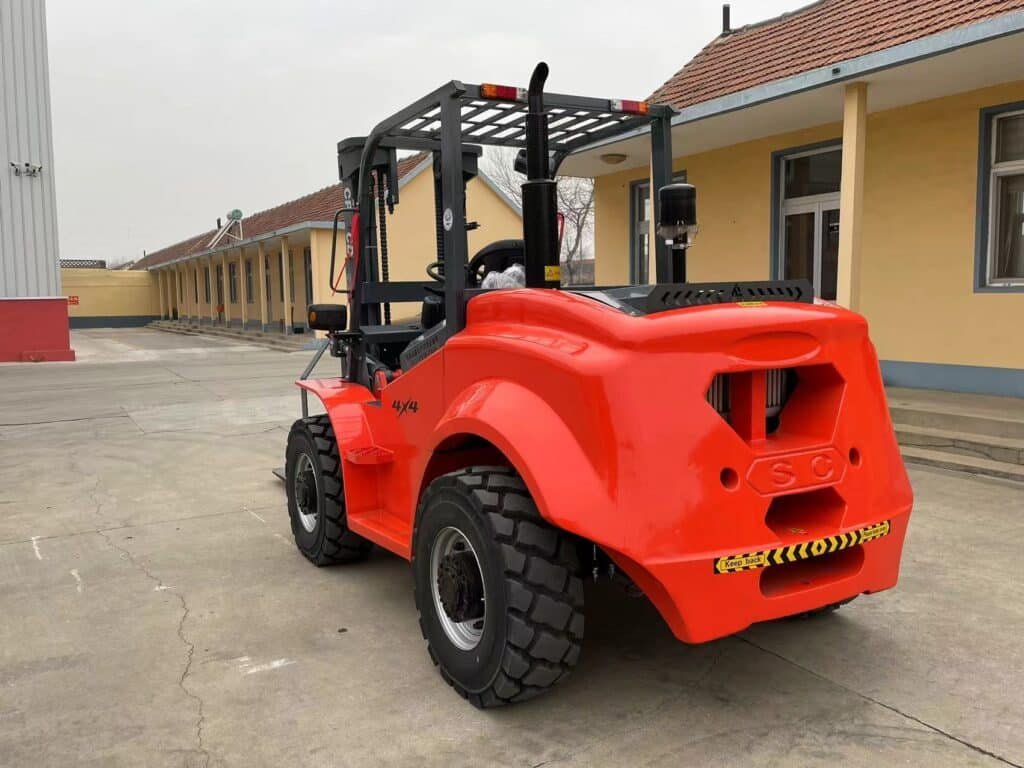
Summary
China’s rough terrain forklift manufacturing is moving into a more mature phase. The biggest trends shaping 2026 purchase decisions are: high-voltage lithium adoption, stricter emissions configurations for export markets, telematics becoming standard, tighter safety compliance expectations, stronger stability/visibility focus, more attachment-ready designs, more testing-driven quality, and more professional parts/service packaging.
For buyers, the winning approach is simple: don’t judge only by brochure specs. Judge by compliance clarity, system integration quality, test discipline, and aftersales readiness. That’s what turns a rough terrain forklift from “cheap to buy” into “easy to sell, easy to support, and profitable for years.”