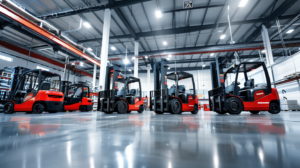
1. Why Rough-Terrain Forklifts from China Are a Big Opportunity
Rough-terrain forklifts (RTFs) are not just “forklifts with big tires.” They are the workhorses on:
- Construction sites
- Lumber yards
- Farms and vineyards
- Stone and brick yards
- Remote projects with bad or no pavement
Demand is strong in Europe, North America, and Australia because:
- Job sites are getting tighter and more complex
- Contractors want flexible machines that can handle pallets, bundles, crates, and bulk materials on uneven ground
- Rental companies like them because they are easy to understand and easy to rent out
Chinese manufacturers have caught up quickly in this area. A well-chosen Chinese rough-terrain forklift can:
- Land at a very attractive cost compared to Western brands
- Give healthy margins after rebranding and local support
- Pay back quickly in rental applications
But there is a big “if” here: only if common mistakes are avoided.
The rest of this guide goes through those mistakes one by one, in simple language, with practical ways to avoid them.
This article is written mainly for B2B buyers, dealers, rental companies, and importers who are planning to bring in rough-terrain forklifts from China under their own brand or as part of a fleet.
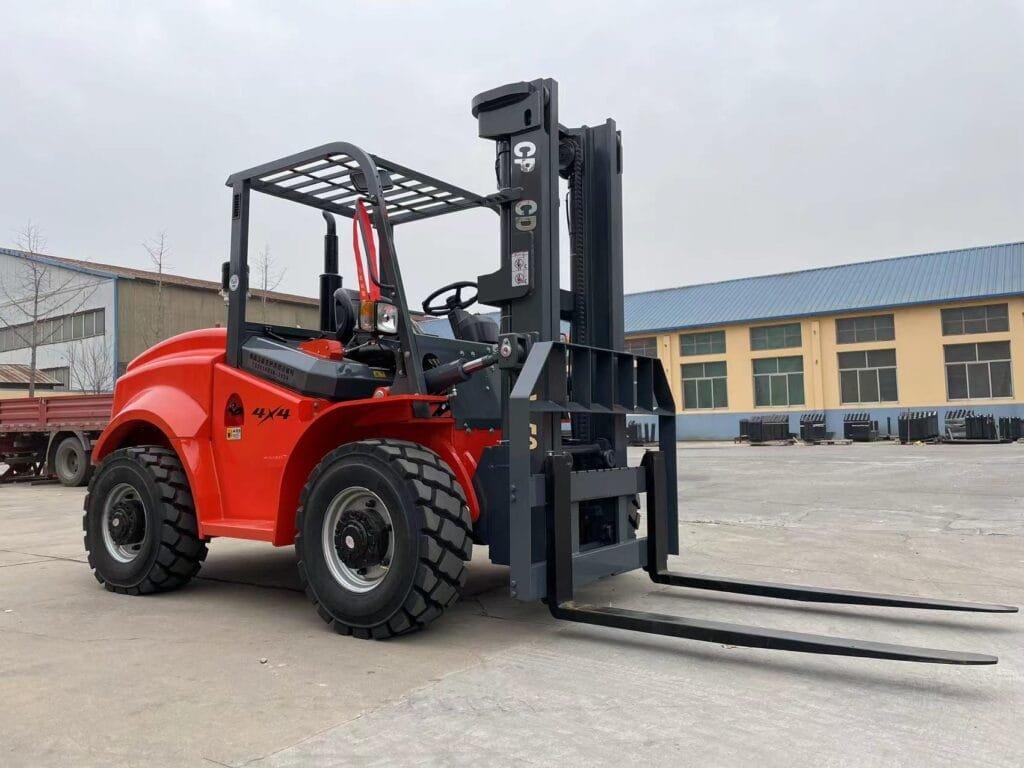
2. Mistake #1 – Chasing the Lowest Price and Ignoring Total Ownership Cost
This is the classic trap.
Many buyers open a conversation with Chinese suppliers like this:
“What is your best price for a 3-ton rough-terrain forklift?”
So the supplier responds in the only way they know will grab attention: they cut cost:
- Lower-tier engines
- Unknown hydraulic brands
- Thin steel in key structures
- Weak axles and cheaper tires
- Minimal paint and corrosion protection
On paper, the forklift still looks like a 3-ton rough-terrain machine. In real life, it:
- Breaks more often
- Consumes more fuel
- Rusts faster in wet climates
- Costs a fortune in downtime and repairs
Instead of only looking at ex-works or FOB price, smart importers look at total ownership cost:
- Fuel usage
- Frequency of breakdowns
- Cost and lead time for spare parts
- Residual value in the used market
- Impact of downtime on rental income
A forklift that is 5–10% cheaper at purchase but fails twice as often is never truly cheaper.
3. Mistake #2 – Treating Rough-Terrain Like a “Normal” Warehouse Forklift
A rough-terrain forklift is closer to a small off-road machine than a simple warehouse truck.
Key differences that many buyers ignore:
- Chassis strength must handle uneven ground and constant twisting
- Mast structure must stay stable when the machine is leaning or in ruts
- Axles and steering must take heavy loads with big tires
- Brakes must work reliably in mud, dust, and slopes
If a buyer only looks at:
- Rated capacity (e.g., 3 tons)
- Lift height (e.g., 4 m or 6 m)
- Engine power on paper
…then it is almost guaranteed that something important will be missed.
When talking with the factory, questions should sound more like:
- “What is the ground clearance under the axle and chassis?”
- “What is the maximum slope for safe operation?”
- “Is it 2WD or 4WD? Any differential lock?”
- “What kind of axles and brakes are used?”
Reliable off-road equipment factories, like those building mini excavators and compact loaders (for example, brands such as Nicosail), think in terms of off-road duty cycles and not just data sheets.
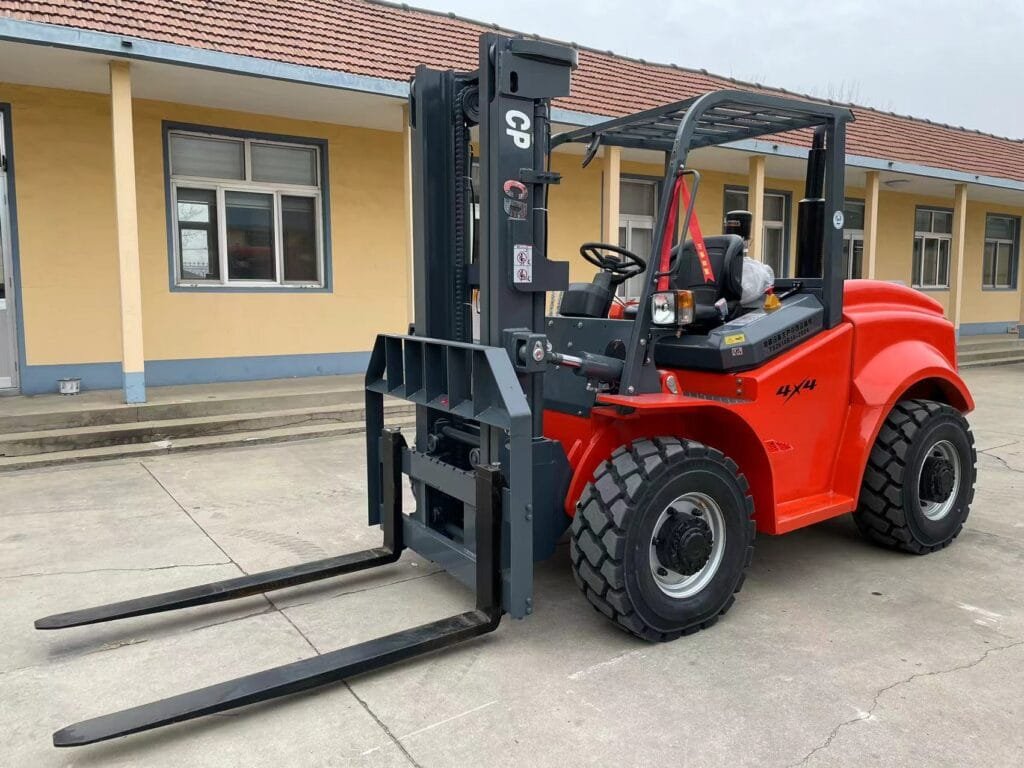
4. Mistake #3 – Not Verifying Real CE / OSHA / Emission Compliance
For Europe, CE compliance is not optional; it is a legal requirement. For North America, OSHA-related requirements and engine emission regulations (EPA Tier 4 / Stage V in many cases) matter a lot.
Typical mistakes:
- Accepting a generic CE certificate that does not list the forklift model
- Ignoring the difference between engine CE and machine CE
- Assuming any diesel engine is fine to sell in a strict emission market
Best practices:
- Ask for the Declaration of Conformity listing the exact model series.
- Make sure the engine brand and model meet your local emission stage.
- Check that the data plate and documents from the factory match advertised specs.
A serious manufacturer will have no problem sharing:
- Scans of certificates (without hiding key information)
- Engine emission approval documents
- CE conformity documents in proper format
Certificates are not just paper; they are your legal shield if an accident happens.
5. Mistake #4 – Confusing Trading Companies with Real Manufacturers
In China, there are:
- Real factories with welding lines, assembly lines, test tracks
- Trading companies that buy forklifts from all kinds of small workshops
- Hybrid companies that have their own lines but also outsource certain models
Trading companies are not automatically bad. Some manage quality very well. But buyers need to know who is actually building the machine.
If a trading company switches factory to save a few dollars, your “same model” may silently change:
- Different axles
- Different mast design
- Different hydraulic parts
- Different electrical system
Result: parts no longer fit, and your service team is lost.
Good questions to ask:
- “Can you share photos or videos of your production lines?”
- “Do you own the factory, or are you using partner factories?”
- “Are serial numbers tracked to a specific production plant?”
Brands like Nicosail, for instance, clearly position themselves as factories for mini excavators and compact loaders, with their own production lines. That type of structure makes technical control and traceability much easier, even when they cooperate on complementary products like rough-terrain forklifts.
6. Mistake #5 – Vague Specifications and “Surprise” Downgrades
A very common story:
- Buyer asks for a quote for 3-ton rough-terrain forklifts.
- Supplier sends a nice PDF with photos.
- Specs are general: “strong mast,” “famous brand engine,” “high quality axles.”
- First container arrives; engine brand is not what was expected; mast rails are thinner; tires are lighter duty.
Why? Because nothing in writing blocked the supplier from “optimizing” some components.
Avoid this by being painfully specific:
- Engine brand and model
- Rated capacity at specific load center (e.g., 3000 kg @ 500 mm)
- Mast type and height, with and without side shift
- Tire size, ply rating, and pattern (R4, agricultural, etc.)
- Hydraulic pump type and main valve brand
- 2WD vs 4WD and type of axle
- Cabin vs overhead guard, heater, wiper, work lights
Everything that matters on site needs to be clearly listed on:
- The quotation
- The Proforma Invoice
- The purchase contract
Without this, there is room for “creative interpretation.”
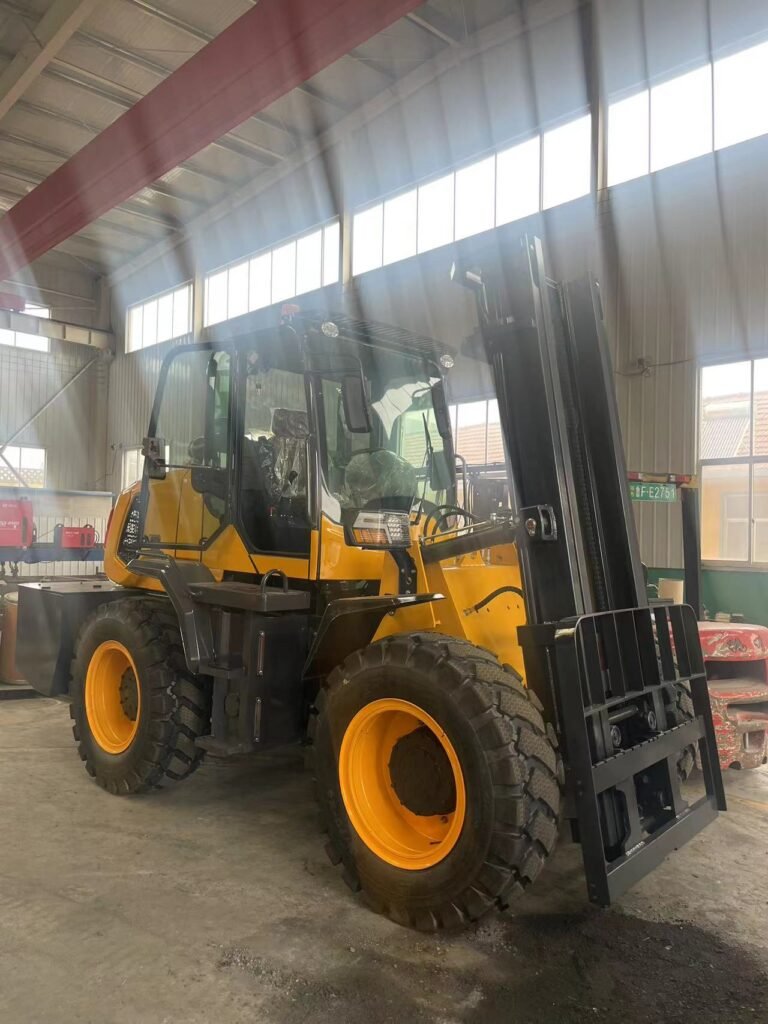
7. Mistake #6 – Ignoring Stability, Load Charts, and Mast Safety
Rough-terrain forklifts often work on slopes and uneven ground. Stability is life-critical.
Common errors:
- Only looking at nominal capacity (e.g., 3 ton)
- Ignoring load center (500 mm vs 600 mm makes a big difference)
- Not asking for a load chart
- Not checking how much derating happens at maximum lift height and tilt
Practical tips:
- Request the official load chart for each mast option.
- Check capacity at maximum lift height and at full forward tilt.
- Ask how the manufacturer tests stability (tilt tests, slope tests, etc.).
A forklift may lift 3 tons on flat concrete at low height. That does not mean it is safe lifting 2 tons on a muddy slope at full height. The dealer or rental company will carry the real-world risk, so the stability story must be crystal clear.
8. Mistake #7 – Underestimating Terrain, Tires, and Ground Clearance
The word “rough-terrain” covers a lot:
- Soft farmland
- Muddy construction sites
- Gravel yards
- Snow and ice in winter
Not matching machine configuration to real terrain is a classic mistake.
Key points:
- Tire type and size – Industrial, agricultural, or special patterns?
- Ply rating / load rating – Thin tires on a “3-ton” machine may fail early.
- Ground clearance – Under the front axle, rear axle, and chassis.
- 2WD vs 4WD – Some jobs absolutely need 4WD and differential lock.
When discussing with suppliers:
- Describe the real job sites your customers work on.
- Ask for field photos or videos of the same model working on similar terrain.
- Clarify if chains, foam filling, or wider tires are needed for specific regions.
Factories with experience in off-road equipment (like those that already build mini excavators and compact track loaders) generally pay more attention to ground clearance, underbody protection, and hose routing, which also matters on rough-terrain forklifts.
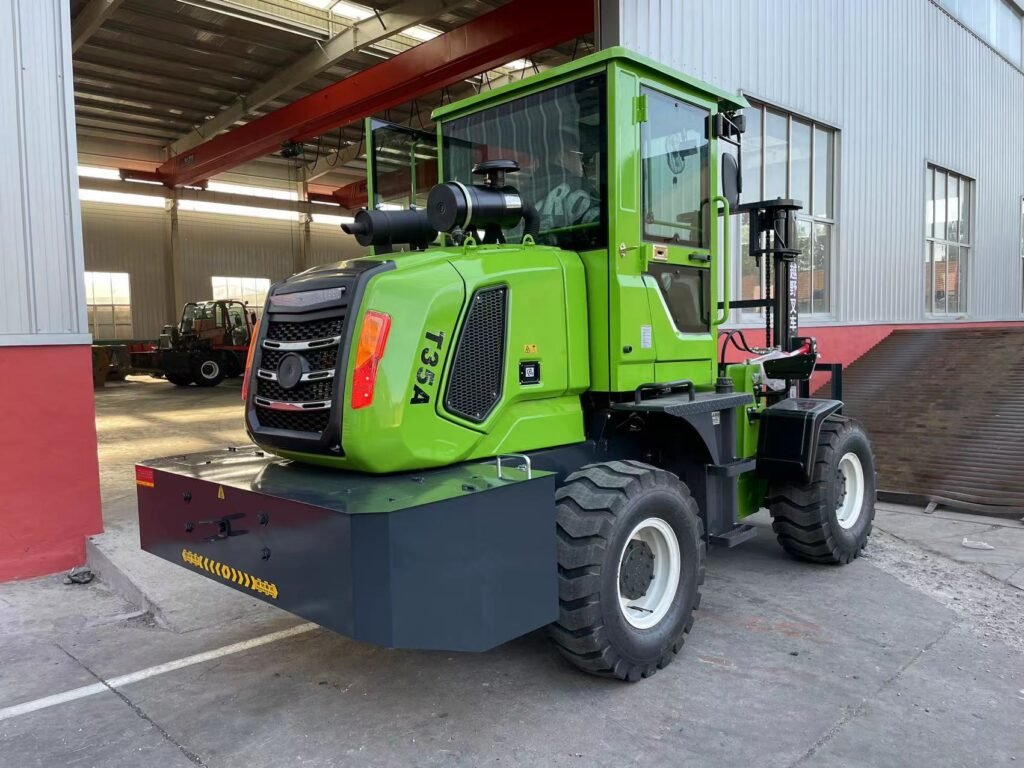
9. Mistake #8 – Weak Pre-Shipment Inspection (Or None at All)
Some buyers skip inspection because:
- They “trust” the supplier
- They want to save a few hundred dollars
- They are in a hurry to ship
This often turns out to be more expensive later.
A simple, structured pre-shipment inspection can catch:
- Wrong engine or mast installed
- Paint defects, rust, transport damage inside the factory yard
- Hydraulic leaks at cylinders, hoses, or valves
- Missing tools, documents, or attachments
- Safety decals or labels in the wrong language
Options:
- Send someone from your team (ideal if volume is high)
- Hire a third-party inspection company in China
- Ask the factory for a detailed final test report plus live video and photos
Good factories are proud to show their final inspection process. Many already test every machine on a test track, check all functions, and record measurements. Using their system plus your own checklist gives strong protection before the container doors are closed.
10. Mistake #9 – Forgetting About Spare Parts and After-Sales
Rough-terrain forklifts usually work in harsh conditions. Things will wear out or get damaged. If the importer has no parts plan, machines can sit dead on customers’ jobs, and reputation drops fast.
Typical issues:
- No filter kits in stock
- No seals or hoses for common leak points
- No spare tires or rims
- No lift chains or mast rollers
- Long lead time from China for small but critical items
Best practice:
- Build a starter parts kit with each first container:
- Filters (engine oil, fuel, air, hydraulic)
- Common seals and O-rings
- Pins and bushings for steering and mast
- Brake pads or shoes
- A few sets of tires and rims
- Keep a simple parts list from the factory with part numbers and drawings.
Factories that already handle international after-sales for mini excavators and loaders, like Nicosail, are typically quite structured in parts planning and can help design practical starter kits for rough-terrain forklifts as well.
11. Mistake #10 – Misunderstanding Freight, Incoterms, and Hidden Landing Costs
Another painful area: landing cost turns out 15–25% higher than expected because only the FOB price was considered.
Important elements:
- Incoterms: FOB, CIF, CFR, DAP, DDP – each shifts responsibilities and costs
- Sea freight (which can vary a lot)
- Local port charges at the destination
- Customs duties and taxes
- Domestic inland trucking
- Handling, unloading, and storage
To avoid surprises:
- Decide which Incoterm fits your control level (many serious buyers prefer FOB or CIF).
- Ask your own forwarder for a detailed quote, not just rely on the supplier’s number.
- Calculate a full cost per unit, including everything up to your yard.
Only then can a realistic sales price and margin be set.
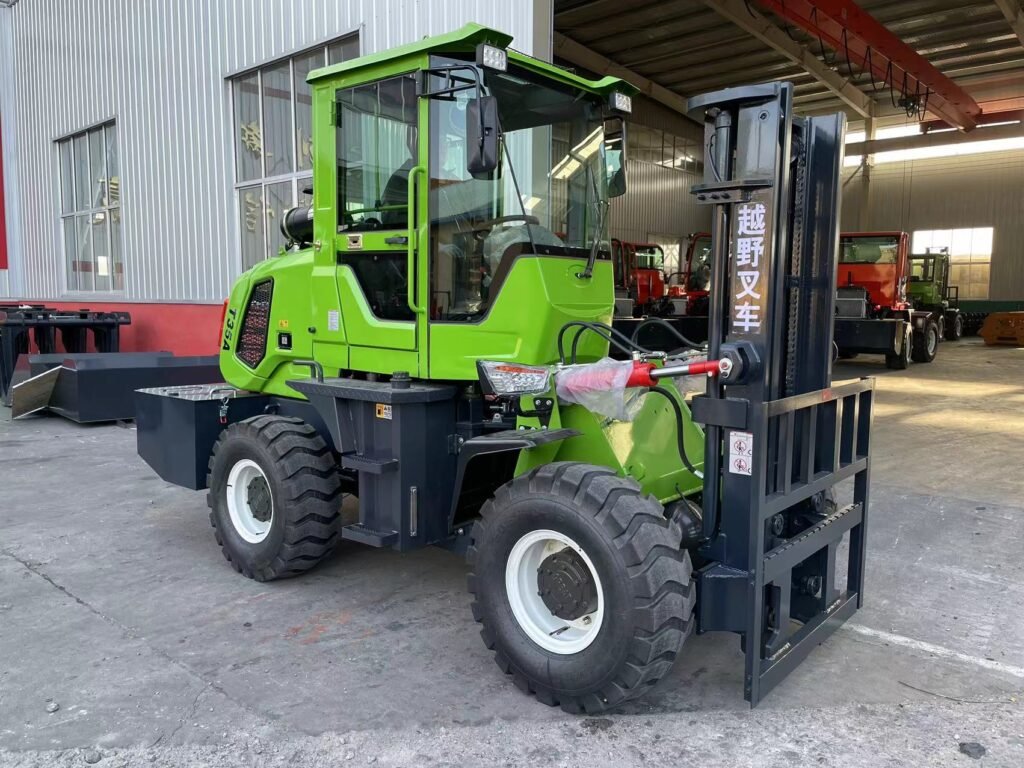
12. Mistake #11 – No Plan for Branding and Documentation
Many importers plan to sell rough-terrain forklifts under their own brand. That’s a good strategy, but it must be built into the project from day one.
Things that often get forgotten:
- Custom colors and paint layout
- Logos and decals on mast, counterweight, and cabin
- Model nameplates with correct information and your brand
- Operation manuals and maintenance guides in local language
- Warranty booklet or digital record system
If branding is an afterthought, the first batch may arrive looking like a random mix of colors and stickers. That does not help build a serious brand.
Factories with strong OEM experience – like Nicosail in the mini excavator and compact loader field – already handle:
- Color customization
- Decal design and printing
- Branding of manuals and labels
The same workflow can usually be used for rough-terrain forklifts with minor adjustments.
13. Mistake #12 – Ordering Too Late and Missing Peak Season
Production and shipping take time:
- Production cycle for forklifts: often 30–60 days, depending on options and volume
- Sea freight: 3–6 weeks in many routes, plus customs and inland trucking
- Possible delays: holidays, port congestion, engine supply, container shortages
If the order is confirmed in May for a summer construction boom, the machines might arrive when the season is already slowing down.
Good practice:
- Look at your local peak season 6–9 months ahead.
- Reserve production slots with the factory early.
- Consider placing rolling orders (e.g., one container every 2–3 months).
Factories that manage multiple product lines (mini excavators, skid steers, compact loaders, rough-terrain forklifts) usually have booking systems for production capacity. Getting into that schedule early makes life easier.
14. Mistake #13 – Poor Communication and No Single “Owner” of the Project
Importing machinery is not like buying T-shirts. There are technical specs, legal requirements, logistics, after-sales, and branding all mixed together.
Common problems:
- Too many people on the buyer’s side talking to the supplier with different messages
- Changes in specs not recorded in writing
- Misunderstanding about who approves drawings and manuals
To avoid this, many successful importers:
- Appoint one project owner internally (could be a procurement manager)
- Use a simple specification sheet shared with the supplier and updated whenever something changes
- Confirm everything important by email or other written form
Good Chinese factories are used to this process. They like having a clear contact who can make decisions and keep information consistent.
15. Mistake #14 – Skipping Testing with Real Jobs and Real Operators
Even if everything looks good on paper and in the yard, real-world use can reveal surprises:
- Operators find the controls uncomfortable.
- Visibility is poor with certain mast heights.
- Machine struggles in deep mud with a full load.
- Some small component fails under particular local conditions (cold, heat, dust).
Wise dealers and rental companies:
- Keep the first 1–2 machines as demo or rental units.
- Put them to work with trusted customers in real jobs.
- Collect feedback on comfort, performance, fuel consumption, and minor issues.
Then this feedback is used to:
- Fine-tune future orders (options, tires, mast, cabin, etc.)
- Improve documentation and training for customers
- Give structured feedback to the factory so they can tweak the design if needed
Factories that already use field feedback loops for other equipment (like mini excavators) usually respond well to this kind of structured input on forklifts too.
16. Mistake #15 – Changing Suppliers Every Container
Some buyers jump from one supplier to another each year chasing a slightly lower price. This almost always destroys long-term profit.
Hidden costs of constantly switching:
- Different parts, different manuals, new training each time
- No consistency in appearance and model naming
- Lost goodwill from factories (no priority in production or R&D)
- Difficult to build a serious reputation with end users or rental customers
In contrast, building a long-term partnership with one main manufacturer brings:
- Better payment terms over time
- Priority in production slots during peak season
- Customized models for your market
- Joint marketing, training, and product development
A factory brand like Nicosail, for example, focuses on long-term cooperation with distributors and rental companies on earthmoving and compact equipment. The same logic applies when working with a stable manufacturer on rough-terrain forklifts – both sides win when there is consistency.
17. How a Factory Brand Like Nicosail Can Help Avoid These Traps
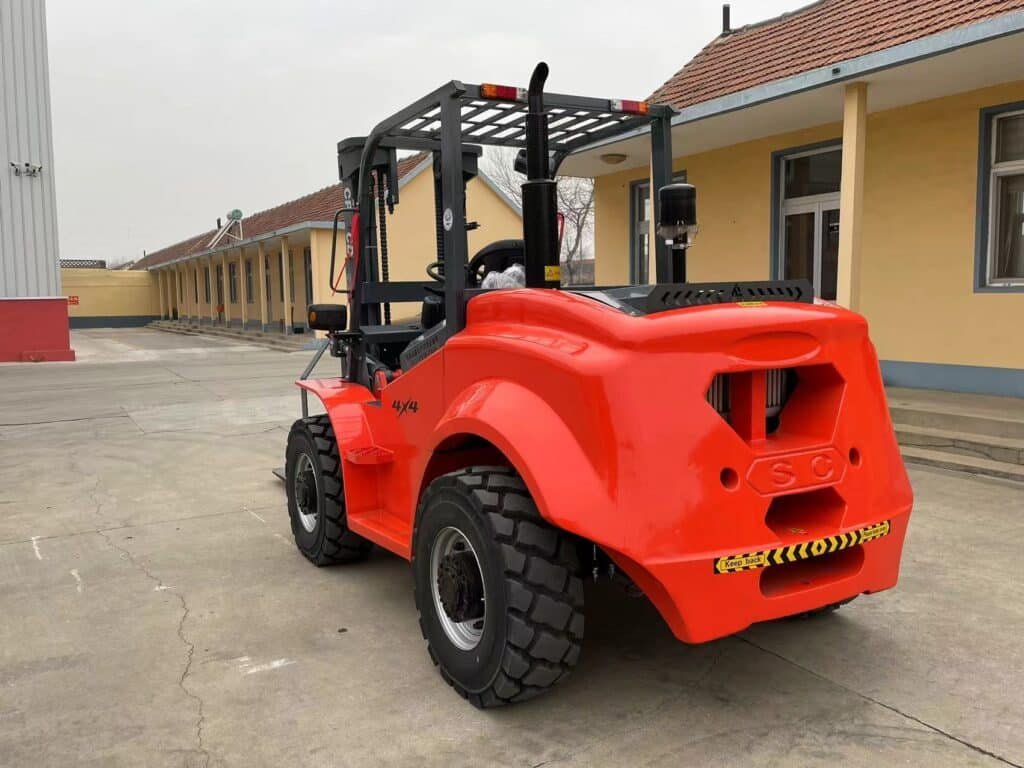
Even though Nicosail is mainly known for mini excavators, compact tracked loaders, and skid steer loaders, the way it works with international partners gives a useful blueprint for rough-terrain forklift importing too:
- Factory background, not just trading – multiple production lines, clear workflows for welding, painting, assembly, and final testing.
- OEM and branding experience – used to custom colors, logos, and documentation for distributors in Europe, North America, and Australia.
- Focus on off-road reliability – experience in matching hydraulics, chassis, and working gear to tough job sites.
For an importer planning to build a business around rough-terrain forklifts, working with a manufacturer that already understands:
- Western quality expectations
- Certification and documentation needs
- After-sales and spare parts planning
…is a huge advantage, whether that partner is Nicosail or another similar-level factory.
The core message: look for a partner with real factory capability, transparent processes, and long-term thinking, not just a nice price sheet.
18. FAQs About Importing Chinese Rough-Terrain Forklifts
Q1. Are Chinese rough-terrain forklifts reliable enough for professional rental fleets?
Many are, yes – but quality varies a lot. Reliability mainly depends on:
- The factory’s design and welding quality
- The choice of engine, axles, and hydraulics
- How seriously the manufacturer tests each machine before shipment
Buyers who choose a serious factory, specify components clearly, and perform proper inspection usually get machines that hold up well in rental and construction work.
Q2. What is a normal lead time from order to shipment?
For standard configurations, lead time is typically:
- Around 30–45 days after deposit for regular batches
- Longer if there are special options, custom colors, or very large orders
During busy seasons or when engines are in short supply, lead time can extend. It is safer to plan at least 2–3 months from order confirmation to machines arriving in your yard.
Q3. How many units should be in the first order?
Technically, many factories accept 1 unit. But for serious importing:
- A 20-foot container often carries 2–4 rough-terrain forklifts depending on size.
- A 40-foot container can carry more and spreads freight cost better.
Many dealers start with 2–6 units, keep one as a demo/rental machine, and sell or rent the rest to test market response.
Q4. How to be sure the forklift really meets CE or local safety requirements?
Steps:
- Ask for the full Declaration of Conformity listing the exact model.
- Confirm that the data plate, manuals, and warning labels are in the right language and units.
- Check that safety features (seat belt, overhead guard, alarms, lights) are installed as required.
- If needed, consult a local safety expert or notified body for a review.
Serious factories are used to this and will cooperate with documentation requests.
Q5. What engine brands are better for imported rough-terrain forklifts?
There is no single “best” engine, but common and practical choices include:
- Well-known international brands with local service networks in your country
- Engines that clearly meet your emission regulations (Stage V, Tier 4, etc.)
- Models with good fuel economy and proven reliability in construction or agricultural machinery
Sometimes Chinese engine brands are also acceptable when local fuel quality and regulations allow it, but support must be checked carefully.
Q6. How to handle spare parts and service for new machines?
Recommended steps:
- Order a starter spare parts package with the first container.
- Keep a digital parts catalog from the factory with clear diagrams.
- Train at least one technician locally on basic service and troubleshooting.
- Set up a simple system for warranty claims with photos and serial number tracking.
Over time, monitoring which parts move fastest will help adjust stock levels and save cost.
Q7. Is it necessary to visit the factory in person?
Not strictly necessary, but very helpful, especially for:
- Validating that the manufacturer really exists and has proper facilities
- Discussing technical details face to face
- Building trust and understanding with the production and engineering teams
For buyers who cannot travel, live video calls, factory tour videos, and third-party audits are good alternatives.
Q8. Can rough-terrain forklifts be fully customized to a unique design?
Completely unique designs are expensive and slow. However, many practical customizations are easy:
- Colors and decals
- Cabin options (enclosed, heater, fan, air conditioning)
- Lights, beacons, and mirrors
- Attachments such as sideshift, fork positioners, or special forks
Most importers get excellent results by customizing appearance and options, while keeping the core structure standard.
19. Final Summary
Importing Chinese rough-terrain forklifts can be a very profitable business for dealers, rental companies, and distributors – but only if common mistakes are identified and avoided early.
Key takeaways:
- Don’t chase the lowest price; focus on total ownership cost and reliability.
- Treat rough-terrain forklifts as true off-road machines, not just forklifts with big tires.
- Verify real certificates and emission compliance; paperwork must match reality.
- Know whether you are dealing with a factory or a trader, and how stable the supply chain is.
- Lock down clear specifications for engines, masts, tires, hydraulics, and safety features.
- Pay attention to stability, load charts, and ground clearance for real job sites.
- Never skip pre-shipment inspection and a basic spare parts plan.
- Understand all landing costs from factory gate to your yard.
- Plan branding, documentation, and seasonality from the very beginning.
- Build a long-term partnership with a capable manufacturer instead of switching suppliers every time.
Working with a factory-based brand that already has strong experience in off-road compact equipment – such as Nicosail with its mini excavators and compact loaders – gives a clear advantage: better communication, stronger OEM support, and a mindset that puts reliability and long-term cooperation first.
Handled in a structured way, importing Chinese rough-terrain forklifts becomes less of a gamble and more of a controlled, scalable business that supports healthy margins and a strong reputation in your local market.