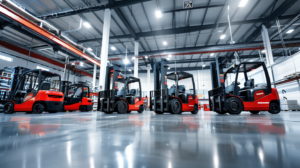
1) What “Off-Road Forklift” really means (and why it matters)
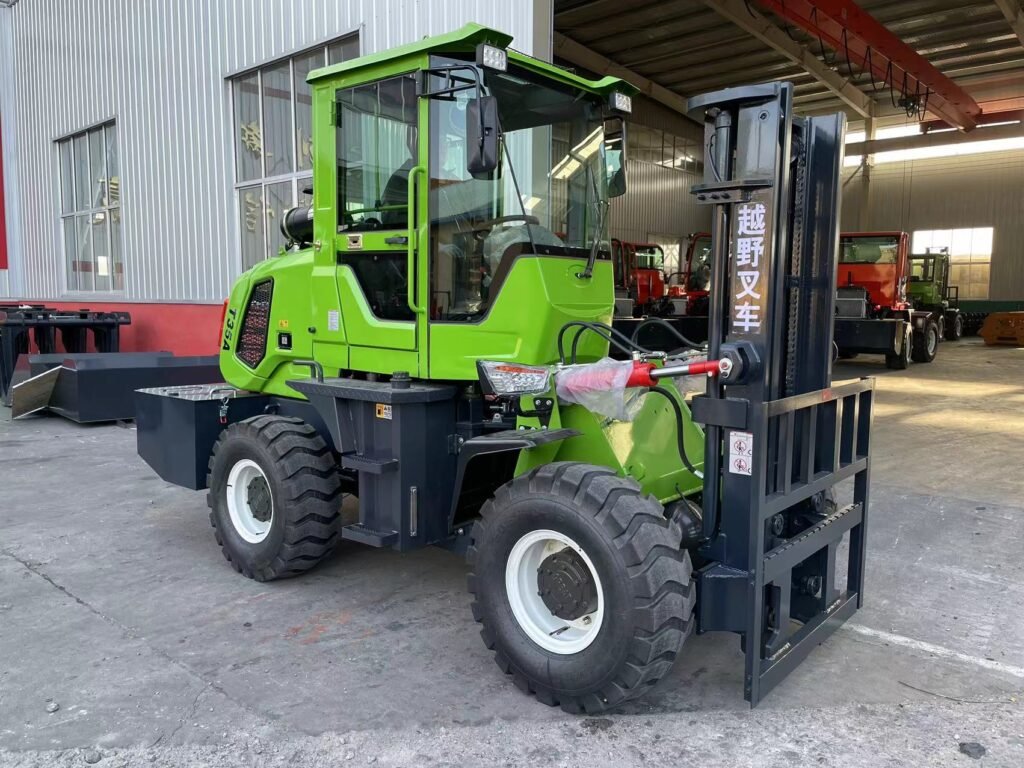
When people say “off-road forklift,” they usually mean rough terrain forklifts: forklifts designed to drive on unimproved ground—mud, gravel, ruts, timber waste, brick chips, soft soil, or a yard that’s never been paved.
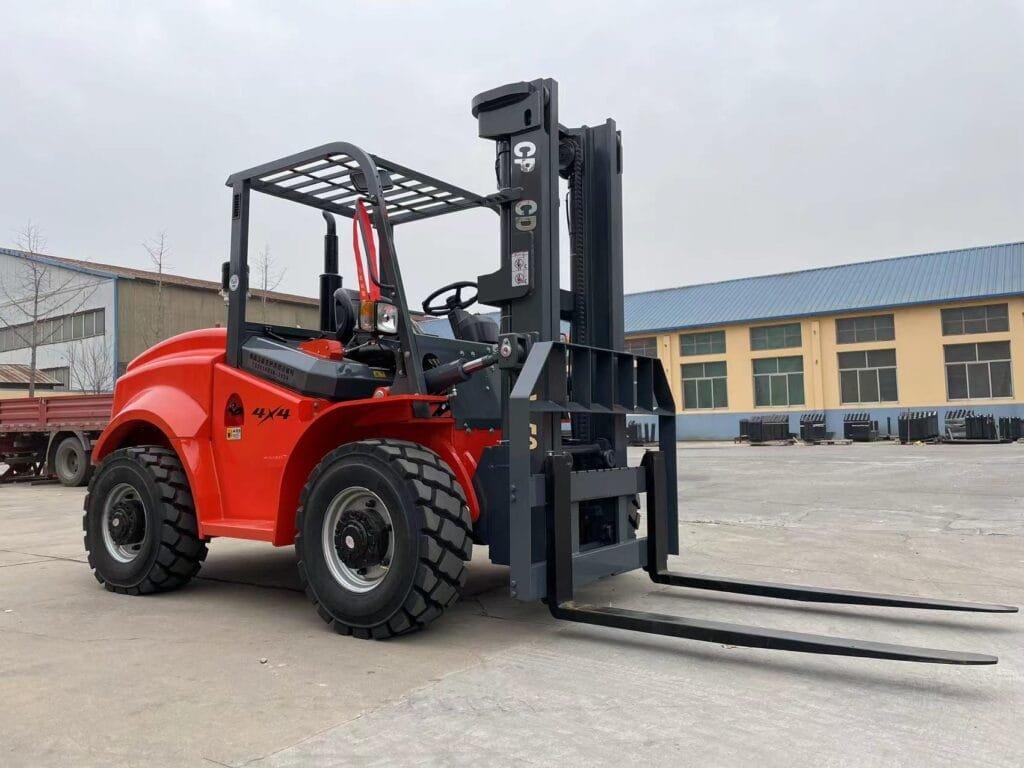
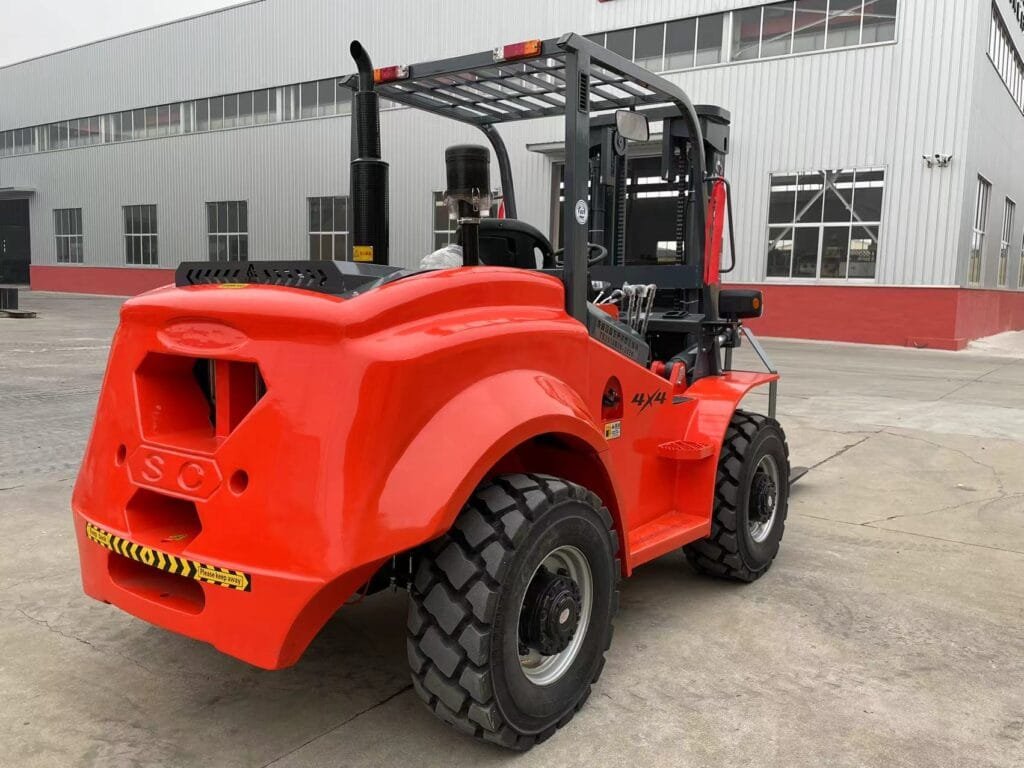
A regular warehouse forklift can look strong on paper, but in real yards it gets stuck, spins tires, and beats itself to death. A true rough terrain forklift typically brings:
- 4WD or 2WD with big drive tires
- higher ground clearance
- aggressive tread / pneumatic tires
- stronger chassis + axles
- cooling and filtration built for dust and heat
Hangcha, for example, lists 270 mm ground clearance on a 3.0t 4WD rough terrain model—numbers like that are part of what separates “yard-capable” from “yard-stuck.”
2) The 3 job sites: sawmills vs brickyards vs farms (very different needs)
Sawmills / lumber yards
This is a traction and stability war.
- Ground: wet bark, sawdust, mud, uneven timber waste
- Loads: long, sometimes awkward, often off-center
- Big risk: tipping when carrying high or on side slopes
What matters most: 4WD traction, stability, visibility, cooling, and smart attachments.
Brickyards / block plants
This is a dust and puncture war.
- Ground: brick chips, sharp debris, compacted soil
- Loads: heavy pallets, repetitive cycles, short turns
- Big risk: tire damage, overheating, and hydraulic leaks from dust contamination
What matters most: filtration, radiator protection, tire strategy, and reliable mast/tilt system.
Farms / agricultural yards
This is a “multi-job” war.
- Ground: soft soil, slopes, gravel roads, wet grass
- Loads: feed pallets, fertilizer big-bags, bales, crates, fencing materials
- Big risk: choosing a machine that’s too heavy for the soil or too tall for barns
What matters most: weight distribution, tire footprint, turning radius, and the right lift height.
3) Quick sizing: 2.5t / 3.5t / 5t—what fits your yard
2.5–3.0 ton class
Best for:
- farms with soft ground
- small sawmills
- mixed yards with narrow lanes
Watch-outs:
- many “3 ton” jobs are actually 3 ton only at a certain load center; long lumber changes the math fast.
3.5 ton class (the sweet spot)
Best for:
- most sawmills
- most brickyards
- most farms doing pallet + bale work
Why it’s popular:
- enough capacity without becoming a “yard tank”
- easier transport and container planning than 5 ton
5.0 ton class
Best for:
- heavy brickyards (dense product)
- big lumber handling
- operations that need stability and brute force
Real-world clue: HELI’s CPCD50 rough terrain line is commonly listed at 5t nominal capacity in spec databases.
4) The 12 specs that decide whether it’s “tough” or “trouble”
If buyers only compare rated capacity and price, problems usually show up in the first busy season. These are the specs that actually decide success:
1) Drive type: 4WD vs 2WD
- 4WD is the safe choice for sawmills and farms.
- 2WD can work on brickyards if the ground is firm and maintained, but it’s still easier to get stuck.
2) Differential lock (or limited-slip)
For real mud, a diff lock is a game-changer. LiuGong’s rough terrain offering highlights 4WD off-road transmission with differential lock and directly calls out lumber, farms, and forestry work.
3) Ground clearance
Higher clearance helps avoid “belly-out” on ruts.
Example reference point: Hangcha notes 270 mm ground clearance on a 3.0t 4WD rough terrain model.
4) Tires (this is where many yards win or lose)
- Deep-tread pneumatic: best traction for sawmills/farms
- Foam-filled pneumatic: brickyards love it (puncture resistance)
- Solid: puncture-proof, but can lose grip and ride comfort off-road
5) Mast type and free lift
- Duplex is simple and strong
- Triplex gives more height in tight spaces (barn doors, sheds)
- Free lift helps when working under low roofs
6) Steering geometry + turning radius
Tight turning reduces cycle time. But don’t chase “super tight” if it compromises axle strength.
7) Cooling package
Sawmills and brickyards clog radiators. Look for:
- wide fin spacing
- easy-clean screens
- proper shrouding (so the fan actually pulls air through the core)
8) Filtration (air + hydraulic)
Dust kills engines and hydraulics. A yard machine should make filter service easy and frequent.
9) Underbody protection
Brake lines, hoses, wiring—off-road debris loves these parts. Skid protection is cheap insurance.
10) Operator station comfort
Comfort sounds “soft,” but it’s productivity.
- visibility to fork tips
- simple controls
- suspension seat
- good lighting (early morning lumber loads are real)
11) Hydraulic stability (tilt & lift feel)
Jerky tilt and lift wastes time and breaks pallets. Smooth control is usually a sign of better valve tuning and hose routing.
12) Parts ecosystem in your target market
A forklift is not a “one-time product.” It’s a parts relationship.
Choose a brand with:
- dealers or parts channels near you
- common engine options
- clear parts manuals
5) Best Chinese rough terrain forklifts by application
Important note (so expectations are clean): “Best” here means best fit + best risk control for import buyers—brands with established lines, identifiable specs, and a track record in export markets. Exact model codes vary by market and year.
A) Best picks for sawmills / lumber yards
1) Hangcha 3.0–3.5t 4WD rough terrain class (counterbalance)
Why it fits sawmills:
- designed as rough terrain product line
- practical ground clearance (Hangcha cites 270 mm on 3.0t 4WD rough terrain)
- widely distributed globally (easier parts and support than “no-name”)
Realistic buyer tip:
- ask for fork carriage options and “lumber-friendly” add-ons (see attachments section).
Also note Hangcha positions itself as an experienced forklift maker (51 years stated on its corporate site), which generally correlates with more mature parts and documentation systems.
2) LiuGong CLG2035H-RT4 (rough terrain forklift line)
Why it fits sawmills:
- LiuGong explicitly markets this rough terrain model for lumber, farms, and forest industries
- highlights 4WD and differential lock for passability
Best use case:
- buyers wanting a more “modern spec story” for marketing (useful for distributors), especially where electric options are becoming a talking point (this model is listed as electric on the LiuGong Europe page).
3) HELI CPCD50 rough terrain (for heavier lumber work)
Why it fits sawmills:
- 5t class helps with heavy packs and stability
- widely recognized Chinese forklift brand (HELI promotes 65+ years experience on its official site)
- common in spec references at 5t nominal capacity
Best use case:
- sawmills that routinely handle heavier packs and want “less drama” with rear stability and axle load.
B) Best picks for brickyards / block plants
1) Hangcha 3.5t rough terrain 4WD diesel
Why it fits brickyards:
- repetitive pallet handling + rough ground
- brickyards benefit from a “tough, compact” 4WD counterbalance design (Hangcha’s North American arm describes 5,000–7,000 lb 4WD rough terrain forklifts as tough and compact)
Buyer angle:
- if sales season is tight, existing dealer networks and recognizable model families reduce downtime risk.
2) HELI rough terrain 5t class (CPCD50-type)
Why it fits brickyards:
- 5t capacity is useful when product is dense and pallets are heavy
- heavy-duty tires and axle capacity matter more than “nice options”
A reality check:
- brickyards run hot and dusty. If the radiator screen design is weak, it becomes a daily cleaning job. That’s not a “maybe,” it’s a guarantee.
3) Electric rough terrain option (where dust + indoor/outdoor mix matters)
LiuGong’s CLG2035H-RT4 is positioned as an electric rough terrain forklift with off-road driveline features like differential lock.
This can make sense when:
- there is indoor loading near doors
- noise restrictions exist
- the site wants lower daily “engine maintenance time”
C) Best picks for farms
1) Hangcha 2.5–3.5t rough terrain range (2WD or 4WD depending on soil)
Hangcha publishes multiple rough terrain classes (2WD and 4WD, 1.5–3.5t ranges) in its rough terrain lineup.
Farm-friendly reasons:
- easier to spec the right size (not overbuy)
- fits mixed farm jobs (pallets + bales + tools)
2) LiuGong rough terrain line (especially if slope/traction is a constant issue)
Again, the “high ground clearance + strong passability + diff lock” messaging isn’t just marketing—it’s exactly what farms struggle with.
3) When a farm actually needs a telehandler (don’t force a forklift)
Some farms need reach, not just lift. That becomes a telehandler discussion (boom machine) rather than a classic counterbalance forklift. If the job is stacking high bales or loading over obstacles, a forklift can become the wrong tool fast.
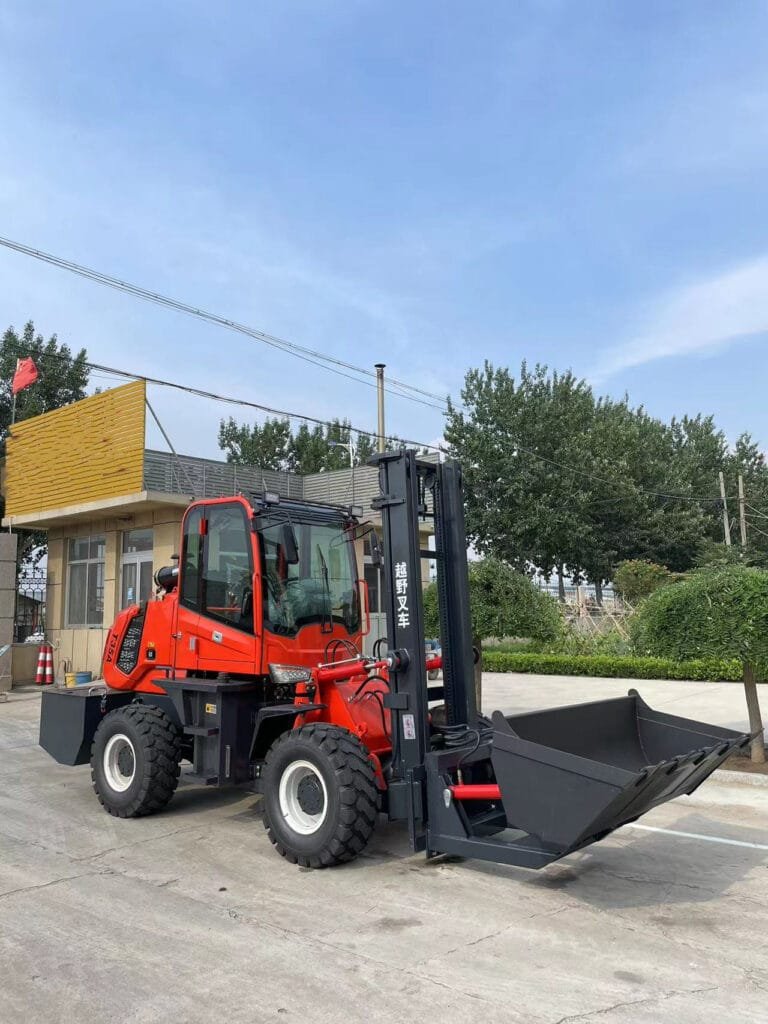
6) Electric vs diesel off-road forklifts: when each one wins
Diesel wins when:
- the yard is truly muddy and remote
- refueling must be instant
- the forklift runs long hours without predictable breaks
Electric wins when:
- work is mixed indoor/outdoor
- there are noise or emissions constraints
- operators prefer smoother control and lower daily checks
The key is not “electric vs diesel” as a debate. It’s: does the site have the charging discipline and infrastructure to make electric reliable? If not, diesel is usually the safer business choice.
7) Attachments that pay for themselves (and the ones that cause headaches)
Worth it for sawmills
- Fork positioner: speeds handling different pack widths
- Side shift: saves constant repositioning
- Load backrest: helps keep lumber stable
Worth it for brickyards
- Side shift is almost mandatory for tight pallet alignment
- Consider foam-filled tires to reduce punctures
Worth it for farms
- Bale clamp / bale spear (only if loads are truly bale-focused)
- Quick-attach carriage if swapping tools often
Common mistake
Buying a fancy attachment but not upgrading:
- auxiliary hydraulics
- hose protection
- carriage class rating
That’s how a “useful option” becomes a constant leak and downtime problem.
8) Certifications & safety: what buyers should ask for (EU/NA focus)
For buyer confidence (and legal compliance), it helps to anchor requests to well-known standards:
- ISO notes that ISO 3691-1 covers safety requirements for industrial trucks and includes rough-terrain counterbalanced trucks in its scope.
- In North America, ANSI/ITSDF B56.6 is the rough terrain forklift safety standard; OSHA’s powered industrial truck standards page references B56.6 for rough terrain forklift trucks.
Practical procurement requests that reduce fraud risk:
- ask for the exact certificate number, issuing body, and matching model designation
- request nameplate photos (truck + engine) before shipping
- require a short factory test video showing lift, tilt, steering, and travel
9) A no-nonsense supplier vetting + pre-shipment inspection checklist
Supplier vetting (fast and effective)
- Ask for the full spec sheet, not a marketing brochure.
- Ask for spare parts list + pricing (filters, hoses, brake parts, mast rollers).
- Ask for lead time in writing and what causes delays (engine supply, axle supply, paint line schedule).
- Request photos of:
- mast weld areas
- axle housing
- hydraulic hose routing under the chassis
- radiator screen and access
Pre-shipment inspection (what actually catches problems)
- Cold start video (no warm-up tricks)
- Lift full height, hold for leaks and drift
- Tilt forward/back under load (or simulated load)
- 4WD engagement test on uneven surface
- Brake test (service brake + parking brake)
- Steering full lock both sides, check for hose rubbing
- Look for:
- hydraulic sweating around fittings
- loose harness clips
- radiator fins already bent (poor packing or handling)
10) Shipping, spares, and aftersales: how to prevent “cheap becoming expensive”
Container planning
Rough terrain forklifts are bulky. Ask early:
- can it ship with mast lowered?
- are wheels removable?
- what is the loading plan and lashing points?
Spares strategy (non-negotiable for importers)
At minimum, bundle:
- full filter set (engine + hydraulic)
- belts, hoses in common failure zones
- brake wear parts
- mast wear parts (rollers, chain items)
- seal kits for key cylinders
After-sales communication
A forklift failure in peak season is a trust test. Put this in the contract:
- response time for parts identification
- exploded parts diagram availability
- warranty claim process (photos/video + decision time)
Where Nicosail fits
Many distributors and fleet buyers don’t sell “one machine.” They sell a yard solution.
A rough terrain forklift often pairs naturally with compact equipment:
- a mini excavator for trenching and drainage work around muddy yards
- a compact tracked loader for moving waste, bark, or loose aggregates
Brands like Nicosail (focused on mini excavators, compact tracked loaders, and skid steer loaders) can complement an off-road forklift in mixed fleets—especially when buyers want a consistent supplier approach to documentation, packing standards, and parts planning across multiple machine types.
FAQ
1) Is 2WD ever enough for an off-road forklift?
Sometimes, yes—mainly on brickyards with firm ground and good maintenance. For sawmills and farms, 4WD is usually the smarter buy because conditions change daily.
2) What capacity is “most practical” for these three industries?
For many importers and end users, 3.5 ton is the best balance. It covers most pallet work and many lumber/farm loads without becoming too heavy for soft ground.
3) What’s the fastest way to spot a “fake rough terrain” forklift?
Look for clues like low ground clearance, small tires, no underbody protection, weak cooling access, and no mention of 4WD/diff lock options. True rough terrain lines make those features easy to identify.
4) Diesel or electric for brickyards?
If the yard has indoor loading, noise limits, or a push toward lower emissions, electric can be attractive (LiuGong markets an electric rough terrain option with off-road driveline features).
If charging discipline is uncertain, diesel is usually safer.
5) What safety standards matter for North America?
Rough terrain forklifts commonly align with ANSI/ITSDF B56.6, and OSHA references that standard in its powered industrial truck standards list.
6) How can certificate fraud risk be reduced when importing?
Require matching model codes across:
- certificate
- nameplate
- sales contract
Then verify issuing bodies and ask for traceable documentation plus factory test records.
Summary
The “best Chinese off-road forklift” depends less on brand slogans and more on jobsite reality:
- Sawmills need traction, stability, cooling, and smart lumber-handling attachments.
- Brickyards need dust protection, heat management, and a tire strategy that survives sharp debris.
- Farms need the right size and footprint for soft ground, plus simple reliability.
For many buyers, the safest shortlist starts with established Chinese manufacturers and identifiable rough terrain product lines—especially Hangcha (broad rough terrain lineup and clear ground-clearance claims on 4WD models) , HELI (common 5t-class rough terrain offerings and long-established brand presence) , and LiuGong (rough terrain models marketed directly for lumber/farm/forestry use with 4WD and differential lock messaging).
Get the specs right, inspect before shipment, stock the right spares, and the forklift stops being a gamble—and starts being a predictable profit tool.