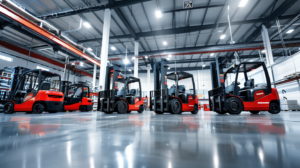
The Impact of Electric Forklifts on Warehouse Space Utilization
Warehouse space is expensive. Expanding a building takes time, costs money, and usually creates extra pressure on staffing, inventory flow, and daily operations. That is why more warehouses are asking a very practical question: can the right forklift help create more usable space without changing the building itself? In many cases, yes. Electric forklifts do not magically make a warehouse bigger, but they often help operators use the same space in a smarter way. The main reasons are simple: tighter turning, narrower aisle options, better access to high racks, cleaner indoor use, and more flexible charging setups. OSHA also notes that electric-powered forklifts are most commonly used indoors in warehouses, and it classifies electric narrow-aisle trucks as a dedicated category of lift truck.
The key point is this: warehouse space utilization is not only about how many square meters or square feet a building has. It is about how much of that space can actually be used for storage and movement without creating congestion, safety problems, or wasted travel time. A wide aisle that looks safe on paper may still waste space. A charging room that eats up valuable floor area may quietly reduce storage capacity. A forklift that cannot turn well at aisle ends may force the whole layout to stay wider than necessary. Good space utilization is really a balance between storage density, travel flow, safe clearances, and uptime. OSHA’s warehouse guidance also stresses safe clearances, unobstructed aisles, and operator training, which shows that “usable space” and “safe space” must always be planned together.
Why electric forklifts often change the layout math
1) Smaller working footprint in tight areas
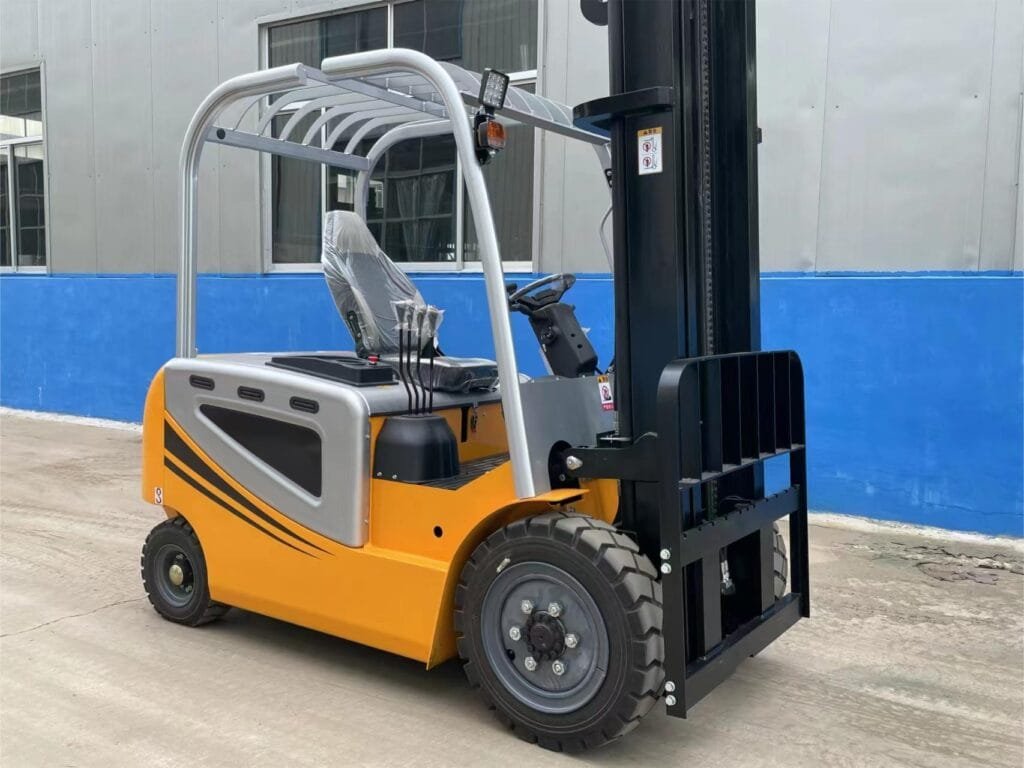
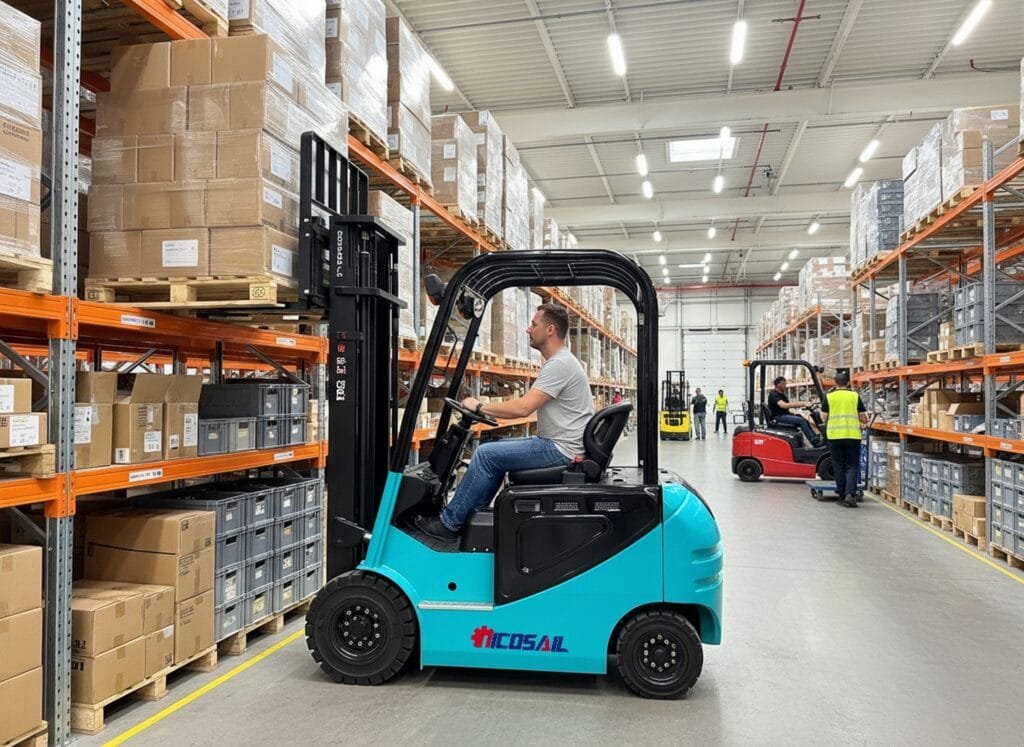
One of the biggest advantages of many electric forklifts is maneuverability. This is especially true for 3-wheel electric forklifts and other compact electric models built for indoor work. Toyota says a 3-wheel electric forklift has a shorter turning radius than a comparable 4-wheel 48V model, with about 140 mm difference, and a compact 3-wheel can reduce the turning radius even further. Yale also highlights the extremely tight turning radius of its 3-wheel electric design. Put simply, when a truck turns tighter, the warehouse does not need to give away as much space at aisle ends, rack corners, and loading positions. That extra space can then be used for pallet positions, staging lanes, or safer pedestrian separation.
For a buyer, this matters more than it may seem at first glance. Two forklifts with the same rated capacity can have very different real-world effects on layout design. One truck may fit the building; the other may force wider turns, wider crossings, and more dead space. This is why serious warehouse planning should always look at the truck’s real working dimensions with load, not only brochure capacity. A machine that turns tighter can improve the flow around docks, end-of-aisle turns, and replenishment zones without changing the whole building.
2) Narrow aisles are where electric trucks really start to shine
This is where electric forklifts make a much bigger jump in space efficiency. OSHA’s truck classifications include Class II electric motor narrow-aisle trucks, which already tells the story: narrow-aisle warehouse work is strongly tied to electric equipment. Reach trucks, order pickers, turret trucks, and other electric warehouse trucks are built specifically for tighter rack layouts than standard counterbalance forklifts. That means more of the building can be used for racking and less of it is lost to travel space.
Manufacturers describe this very clearly. Raymond says its very narrow aisle solutions can run in aisles that are less than half the width required by conventional forklifts, and it says some facilities may unlock up to 80% more existing storage space through narrow-aisle design. Crown says its reach trucks are designed for narrow aisle, rack storage, and high-bay environments, and notes that in many warehouses access to previously unused top racks can create about 15% more pallet positions. Those are supplier claims, not universal promises, but they show why electric warehouse trucks can change storage density so dramatically when the layout is designed around them.
3) Better use of vertical space
A lot of warehouses are not short of floor area first. They are short of usable cubic space. In plain English, the building still has air above the racks, but the current equipment cannot safely and efficiently use it. This is another place where electric warehouse trucks help. Reach trucks and VNA trucks are built for rack storage and higher stacking work, so they let operators grow upward instead of outward. Crown’s reach truck range is aimed directly at high-bay storage, and Raymond frames VNA equipment as a way to grow vertically without expanding horizontally.
That changes the conversation from “Do we need a bigger warehouse?” to “Are we using the current warehouse properly?” For many distributors, spare-parts warehouses, e-commerce operations, retail back-end storage, and component stock rooms, the answer is often no. There may still be room to add rack levels, tighten aisle planning, and improve slotting. An electric forklift alone does not do all that work, but it is often the machine that makes that redesign possible.
4) Cleaner indoor operation means fewer space penalties indoors
OSHA says electric-powered forklifts are commonly used indoors in warehouses and describes them as quiet and generally non-polluting. By contrast, OSHA warns that internal-combustion forklifts used indoors can create indoor air quality hazards, especially in enclosed areas. This matters for space utilization because indoor warehouse design is not only about where the racks go. It is also about where the trucks can operate comfortably and safely for long periods. Electric forklifts fit that indoor environment better.
In practical terms, cleaner indoor operation can support denser indoor workflows. It can make it easier to run trucks close to storage, picking, and packing activity without the same concerns tied to combustion fumes. It also reduces the pressure to design indoor operations around engine exhaust behavior. That does not mean safety planning becomes optional. It still matters a lot. But it does mean electric forklifts usually fit modern indoor warehouses more naturally, especially where people, stock, and trucks are all sharing the same building all day.
Why battery choice matters more than many buyers expect
A lot of people hear “electric forklift” and think only about the truck. In real warehouse planning, the battery system can change space utilization almost as much as the truck itself.
Lead-acid batteries: workable, but they ask for space
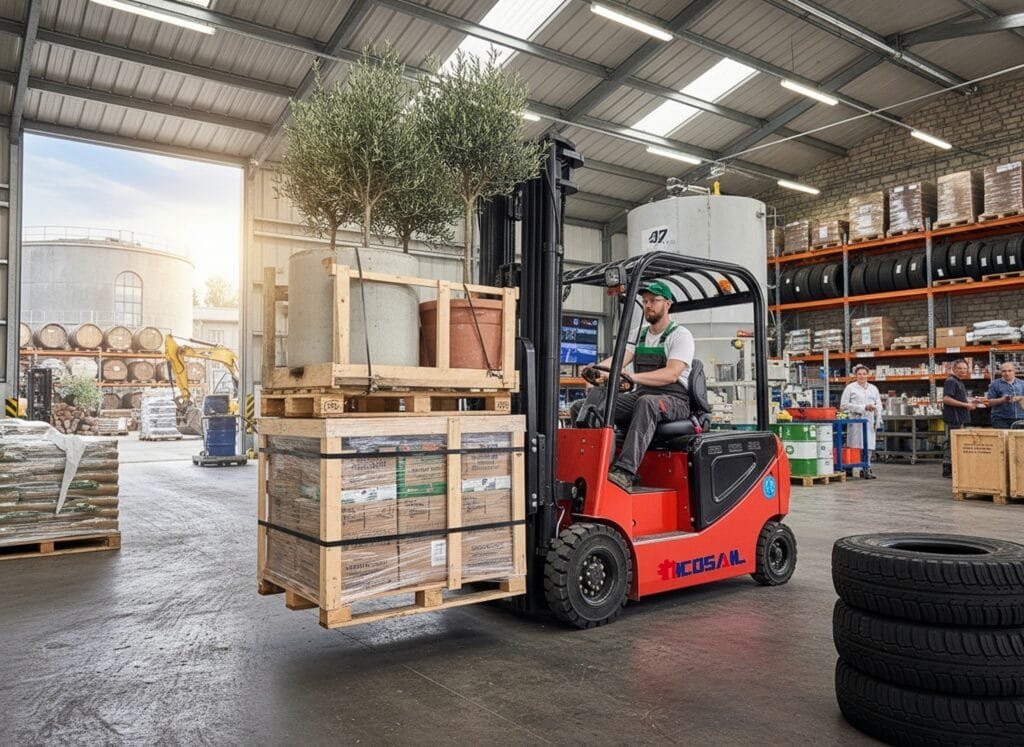
Lead-acid electric forklifts can absolutely work well, and many warehouses still use them. But the support area around them often takes more space than buyers expect. OSHA’s warehouse guidance says battery charging areas need proper positioning, fire extinguishers, protective equipment, eyewash and shower access for battery acid exposure, equipment for servicing batteries, and adequate ventilation to disperse fumes from gassing batteries. Hyster also notes that lead-acid batteries emit fumes that require ventilation during charging. In simple terms, lead-acid systems do not just need a charger. They often need a real charging area with safety infrastructure around it.
That charging zone is part of the warehouse footprint, whether it is counted on the sales drawing or not. It can take away space that might otherwise be used for pallet storage, value-added work, or better aisle flow. On multi-shift sites, extra batteries and battery handling can add even more pressure. So when a buyer compares two electric forklift offers, the better question is not only “What is the truck price?” It is also “How much warehouse space will the energy system consume over the next five years?”
Lithium-ion systems: often a better fit for space efficiency
This is where lithium-ion changes the picture. Crown says its lithium-ion system supports opportunity charging during breaks and shift changes, can handle one or multiple shifts with no need for extra batteries, and requires no special battery rooms. Its material also says lithium-ion eliminates battery swapping, watering, and special battery rooms. Toyota says opportunity charging lets the battery stay in the truck and use breaks, lunch periods, and shift changes to top up power. Jungheinrich similarly says lithium-ion does not need special charging spaces with ventilation and supports fast intermediate charging during downtime.
For warehouse space utilization, that is a big deal. When the battery stays in the truck, battery changing zones shrink or disappear. When charging can be distributed around the facility, a warehouse may not need to sacrifice a large dedicated battery room. When ventilation needs are lower, the support space around charging can also become simpler. That does not mean every lithium-ion project is plug-and-play. Power supply, charger location, heat control, and safety rules still matter. But from a layout point of view, lithium-ion often supports a cleaner, leaner use of floor space than lead-acid in indoor warehouse applications.
Which warehouse zones benefit the most
Racking aisles
This is the most obvious one. Narrow-aisle electric trucks let operators reduce aisle width and increase the percentage of the building used for storage. If the warehouse is already full and pallet positions are the main pain point, this is usually the first place to study. Reach trucks and VNA trucks are often much more effective here than standard electric counterbalance models.
Aisle ends and cross-aisles
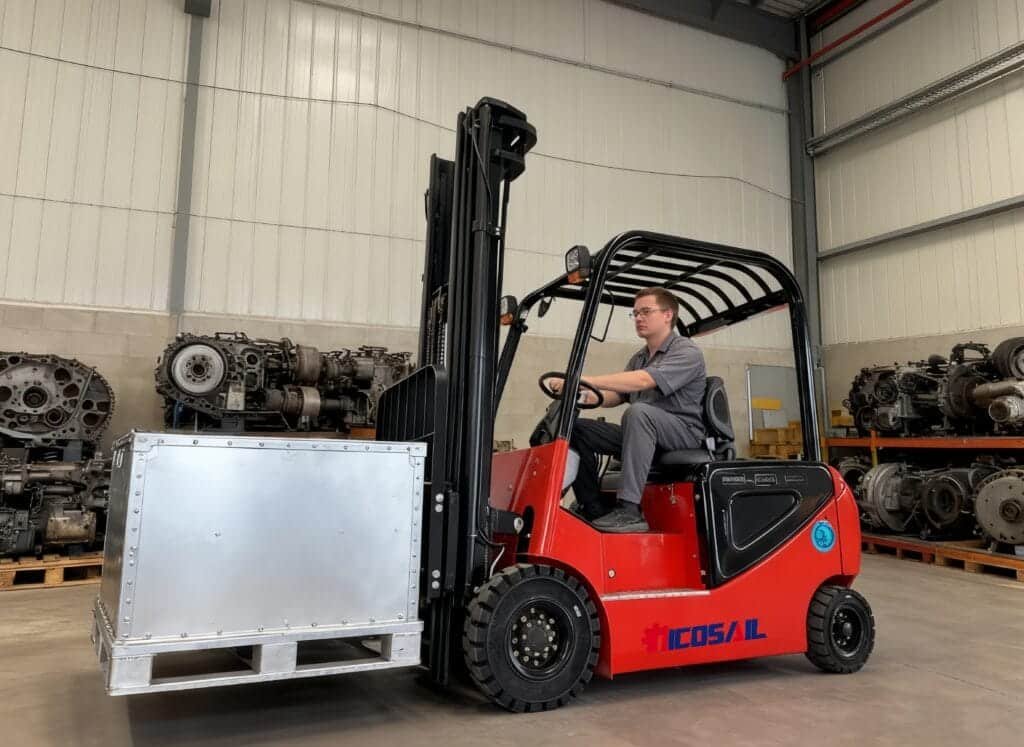
This area is often overlooked. Tighter-turning electric forklifts can reduce wasted space at the end of racks and in cross-traffic points. That may not sound dramatic, but across a full warehouse, those small layout gains add up. Better turning can also reduce awkward reversing, repeated repositioning, and congestion in busy intersections.
Charging and support space
A poorly planned charging area quietly eats into warehouse productivity. Lead-acid systems may require more dedicated support space, safety equipment, and ventilation. Lithium-ion often allows a more distributed and compact charging approach. In some operations, that change alone can free up space for extra racks, staging lanes, or packing work.
High-bay storage zones
When a warehouse has height available but struggles to use it well, electric reach trucks and VNA solutions can make the top levels productive again. That is one of the most attractive ways to improve space utilization because it adds pallet positions without increasing the building footprint.
How to choose the right electric forklift for space-saving work
A common buying mistake is thinking any electric forklift will automatically save space. That is not how it works. The truck type must match the warehouse job.
A 3-wheel electric counterbalance forklift is often a smart choice when the warehouse needs good indoor maneuverability, flexible dock work, and tighter turning in shared-use areas. It is a practical option when space is tight but the operation still wants a general-purpose truck. Toyota and Yale both position 3-wheel electrics around maneuverability and tight turning.
A reach truck is usually the better answer when the main goal is denser rack storage and higher lift performance in narrow aisles. Crown directly links reach trucks with narrow aisle, rack storage, and high-bay use. For many warehouses, this is where the real storage-density gain starts.
A VNA truck or turret truck is the serious high-density option. This is for warehouses that want to push aisle width down hard and use more of the building height. Raymond’s description of VNA trucks working in aisles less than half the width of conventional forklifts shows why these trucks are so important in cube-focused warehouse design.
For buyers working with an equipment partner, this is where practical support matters. A factory-minded supplier such as Nicosail should be willing to talk through turning radius, actual aisle fit, working height, charger placement, service access, and long-term operating cost, not just hand over a price list. Good buying decisions start with layout truth, not brochure excitement.
What electric forklifts do not fix by themselves
Electric forklifts can improve warehouse space utilization, but they do not solve every problem.
They do not fix poor slotting. If slow-moving and fast-moving items are mixed badly, travel paths stay messy. They do not fix damaged floors, weak racking, or unsafe clearances. OSHA still requires proper aisle clearances, unobstructed passages, and trained operators. So if a building is disorganized, switching to electric equipment helps less than people expect.
They also do not remove the need for planning around safety. Narrow aisles are great for storage density, but they demand discipline. Operators must be trained on the truck type and on the conditions of the actual workplace. Pedestrian routes, rack protection, charging safety, and travel rules still matter every day. A tighter layout only works well when the operation is controlled well.
A practical buyer checklist before placing an order
Before ordering an electric forklift to improve space utilization, these are the questions that really matter:
First, what is the real working aisle width with the actual load?
Do not ask only for unloaded truck dimensions. Ask how the machine behaves with the pallet size, load length, and turning pattern used in the warehouse. A truck that looks compact on paper can still waste space in real work.
Second, is the goal better maneuverability, denser racking, or both?
If the main pain point is general movement in tight areas, a 3-wheel electric may be enough. If the goal is adding pallet positions, a reach truck or VNA solution may be the better answer.
Third, what battery system fits the building?
Lead-acid and lithium-ion change the support area in very different ways. Charging space, ventilation, battery handling, and downtime should all be reviewed before the purchase decision is made.
Fourth, can the warehouse really use more height safely?
There is no point buying a high-reach solution if the rack design, floor condition, or stock discipline cannot support it. The equipment and the storage system must match.
Fifth, is operator training part of the project or an afterthought?
OSHA is very clear that forklift operators must be trained on the vehicle type and workplace conditions. This matters even more when layouts get tighter and more space-dense.
FAQ
Do electric forklifts always save warehouse space?
No. They often create better space utilization, but only when the truck type matches the layout goal. A standard electric counterbalance truck may improve maneuverability, but narrow-aisle and VNA gains usually come from reach trucks, order pickers, or other Class II electric warehouse trucks.
Are 3-wheel electric forklifts good for small warehouses?
Yes, often. Their tighter turning radius makes them a strong option for indoor warehouses with tight corners, end-of-aisle turns, and shared-use spaces. But they are not the same thing as a true narrow-aisle reach truck.
Is lithium-ion better than lead-acid for warehouse space utilization?
In many cases, yes. Lithium-ion can reduce or eliminate battery swapping, simplify charging layout, and avoid the same kind of dedicated battery-room setup associated with lead-acid systems. That can free up valuable floor space.
Can electric forklifts help avoid warehouse expansion?
Sometimes. Supplier guidance from Raymond and Crown shows that narrow-aisle and high-bay electric solutions can significantly increase usable storage space in existing buildings. But the result depends on the rack layout, building height, floor condition, and stock profile.
Are electric forklifts always better indoors?
For many warehouse applications, yes. OSHA says electric forklifts are most commonly used indoors and notes they are quiet and generally non-polluting, while internal-combustion forklifts can create indoor air quality hazards in enclosed areas.
What should a distributor or importer ask a supplier before buying?
Ask about real turning radius, working aisle width with load, rack compatibility, battery type, charger location, safety requirements, service access, and parts support. A serious supplier should help confirm layout fit, not only quote price.
Final thoughts
The impact of electric forklifts on warehouse space utilization is real, but it is not just about replacing diesel or LPG with batteries. The real value comes from what the electric truck allows the building to do: tighter turns, narrower aisles, better use of height, cleaner indoor operation, and more flexible charging layouts. For some warehouses, that means smoother traffic flow. For others, it means more rack positions without expanding the building. For high-density operations, it can completely change the storage equation.
The smartest buyers do not ask only, “How much does the forklift cost?” They ask, “How much usable warehouse space will this forklift create or protect?” That is the question that leads to better layouts, better uptime, and better returns. And that is also the kind of practical, no-nonsense discussion buyers should expect from a reliable equipment partner like Nicosail: clear advice, honest fit analysis, and solutions that help the customer choose the right machine instead of simply the cheapest one.