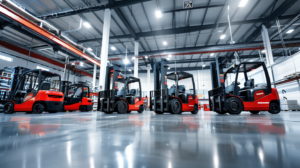
1. What Counts as a “Rough Terrain Forklift” – And Why Import from China?
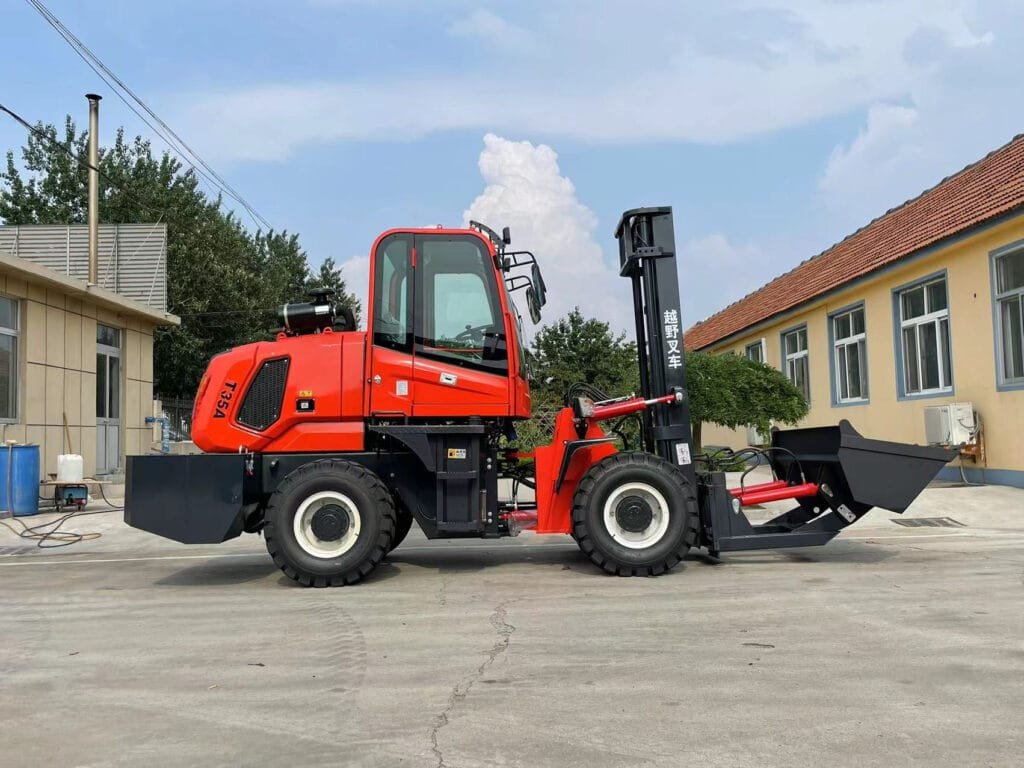
In this article, “rough terrain forklift” means a self-propelled forklift with:
- High ground clearance
- Large off-road tyres (often 4×4)
- Reinforced mast and chassis
- Designed for construction sites, farms, timber yards, quarries, etc.
These machines work where a normal warehouse forklift would get stuck or unsafe: gravel yards, muddy job sites, sloped ground, and soft soil.
Importing from China is attractive because:
- Purchase price is typically 20–40% lower than big Western brands.
- Spec range: 2.5–10 ton rough terrain forklifts, diesel or LPG, manual or powershift, often with custom mast height and attachments.
- Private label options: logos, colours and model numbers can be customised for dealers.
But the machines still have to pass Australian safety, compliance and biosecurity rules, otherwise saving on purchase price can quickly be wiped out by port delays, fines, or modifications on arrival.
2. Key Australian Rules You Must Follow
Forklifts are treated as “plant” under Australian WHS laws. That means designers, manufacturers, importers and suppliers all have a duty to make sure the forklift is, as far as reasonably practicable, without risks to health and safety.
2.1 Work Health & Safety (WHS) duties
Safe Work Australia’s guidance on industrial lift trucks makes it clear that:
- Importers and suppliers must ensure the plant (forklift) is safe by design and construction.
- They must also provide information, instructions and training material (manuals, load charts, warning labels) down the chain to the end user.
For an importer, that usually means:
- Getting technical documentation from the Chinese factory (spec sheet, drawings, test reports).
- Making sure the forklift is designed and tested against relevant Australian Standards.
- Ensuring the machine is supplied with English manuals and safety decals.
2.2 Australian Standards (AS 2359 series)
The main standard series for forklifts is AS 2359 – Powered industrial trucks. State WHS regulators and guidance material keep referring to this series as the benchmark for safe design and use.
Important parts include:
- AS 2359.1 / 2359.7 – General requirements and specific types
- AS 2359.2 – Use of work platforms on forklifts
Tariff concession orders for forklifts imported into Australia even specify conformity with AS 2359.7, which shows how seriously the standard is treated.
For rough terrain forklifts, buyers should check that the Chinese supplier can:
- Show test reports or declarations that critical items (brakes, stability, rated capacity, mast strength) meet AS 2359 (or equivalent ISO standard clearly mapped to AS 2359).
- Provide load charts and capacity ratings in a format compatible with AS 2359.
2.3 Plant & design registration
Some types of plant need design registration with state regulators before use. For example, certain items in Western Australia must have the plant design registered before the plant itself can be registered.
Whether a particular rough terrain forklift model needs design registration depends on local rules (e.g. mine use, work platforms, special attachments).
Good practice for importers:
- Ask the forklift supplier for a stable model designation, drawings and test data.
- Check with the relevant state regulator (e.g. WorkSafe WA, Access Canberra) whether that forklift design requires registration in the state where it will work.
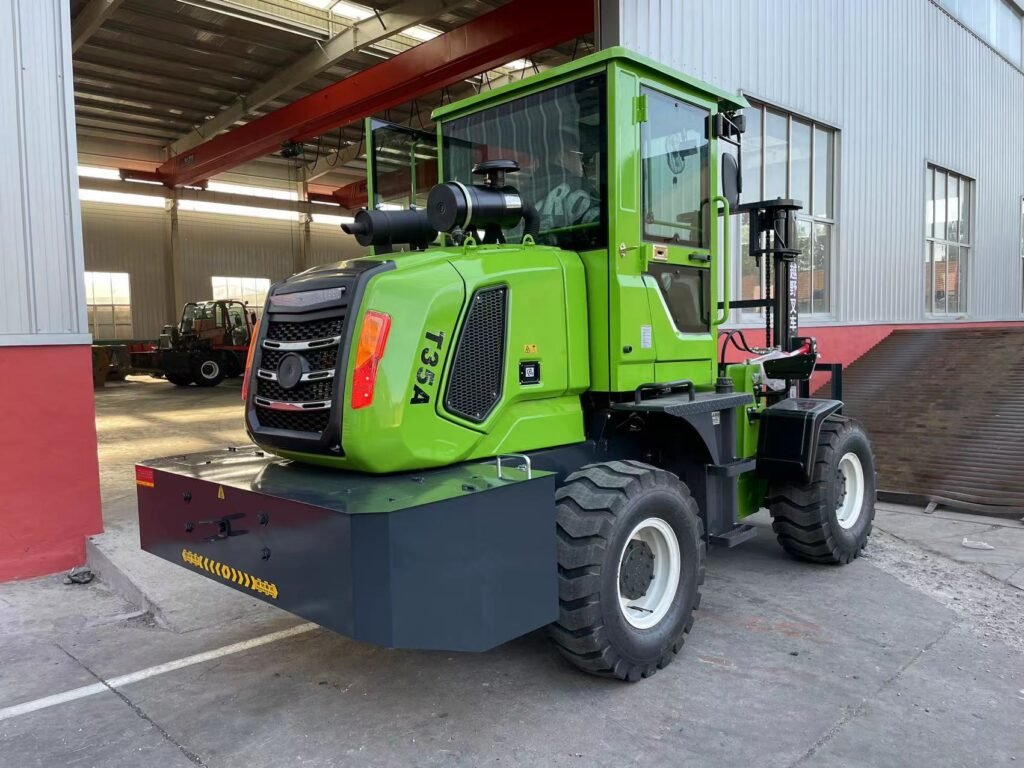
3. Biosecurity: The Number One Reason Forklifts Get Stuck at Port
Australia is extremely strict on biosecurity for imported machinery. The Department of Agriculture, Fisheries and Forestry (DAFF) requires all machinery to arrive free from soil, seeds, plant and animal material.
Key points:
- Used or even “factory demo” forklifts are treated as high risk.
- DAFF officers can order re-cleaning, fumigation, or even re-export of contaminated machinery at the importer’s expense.
- Many used machines also require import permits and specific cleaning evidence.
For rough terrain forklifts, risk is higher because:
- Oversized off-road tyres and deep treads trap soil and seeds.
- Under-chassis, axles and masts have pockets where mud accumulates.
Smart importers usually:
- Prefer brand-new machines for a first import, because biosecurity handling is simpler.
- Make cleaning part of the purchase contract, with detailed photos before loading.
- Check conditions in BICON, the Biosecurity Import Conditions system, for the exact forklift category and whether an import permit is required.
4. Customs, Tariff and GST: What You Actually Pay
4.1 HS code and duty rate for forklifts
Forklifts, including rough terrain types, generally fall under:
- HS 8427 – Fork-lift trucks; other works trucks fitted with lifting or handling equipment
China’s export references show HS 842720 (diesel or other non-electric forklift trucks) as the typical heading, with preferential duty rates for Australia under the China–Australia FTA.
Australia’s current tariff schedule lists a 0% base customs duty rate for HS 8427 in many cases.
So for many rough terrain forklifts imported directly from China with the correct Certificate of Origin, the import duty is effectively 0%, though this should always be confirmed with a customs broker for the specific model and HS sub-heading.
4.2 How 10% GST is really calculated
Even when duty is 0%, importers still pay GST.
The Australian Border Force and ATO explain that GST is 10% of the “Value of Taxable Importation (VoTI)”, which is made up of:
- Customs value of the goods (usually FOB price, converted to AUD)
- Plus international freight to Australia
- Plus insurance for that freight (if not already in freight cost)
- Plus any customs duty (often 0% for HS 8427 from China)
So GST is charged on CIF + duty, not just the machine price.
4.3 Other hidden charges to expect
Apart from duty and GST, importers should budget for:
- Port and terminal fees
- Customs broker / clearance fees
- Biosecurity inspection fees and any extra cleaning ordered by DAFF
- Local transport from port to yard
- Marine insurance (strongly recommended for high-value machinery)
- If buying used: steam cleaning / quarantine wash on arrival, if pre-cleaning is not accepted.
5. Step-by-Step: Importing Chinese Rough Terrain Forklifts into Australia
Here’s a simple process that many Australian dealers and contractors follow.
Step 1 – Define what the forklift actually needs to do
- Capacity at required lift height (e.g. 3.5T @ 4.5 m)
- Terrain (hardstand, gravel, clay, farm tracks)
- Daily working hours and climate (heat, dust, coastal corrosion)
- Attachments (side shift, fork positioner, bale clamps, etc.)
This spec will guide the choice of model from the Chinese factory.
Step 2 – Shortlist compliant suppliers
Look for Chinese manufacturers who:
- Export regularly to Australia, Europe or North America (these markets demand stronger compliance).
- Can show CE, ISO, or AS 2359-mapped test reports and stable product design.
- Provide English manuals, wiring diagrams and hydraulic schematics.
- Have clear warranty terms and parts support.
A factory like Nicosail, which already builds machines for rough terrain conditions and exports compact equipment to developed markets, tends to understand these requirements and can customise tyres, masts and safety options for Australian use.
Step 3 – Lock in technical and compliance details in the contract
Before any deposit is paid, the purchase contract should clearly state:
- Exact model, engine type, transmission, mast height, tyre type, etc.
- Compliance targets: e.g. “designed and tested to AS 2359 or equivalent ISO standard”.
- Safety items included: ROPS/FOPS cab structure, seat belt, OPS/seat presence system, load back-rest, mirrors, lights, reversing alarm and camera if needed.
- Biosecurity cleaning requirement: machine to be shipped completely clean, with grease drained from exposed pockets and protective covers used over tyres and under-chassis.
- Documentation list:
- Commercial invoice and packing list
- Bills of lading
- Certificate of Origin (China–Australia FTA form)
- Quality inspection report
- English operator and service manuals
- Spare parts list
Step 4 – Check BICON and arrange any permits
Before the forklifts leave China:
- Use BICON to confirm import conditions for the exact kind of machinery and whether an import permit is required for new or used units.
- If import permits are needed, apply early.
Step 5 – Choose shipping method and Incoterms
For rough terrain forklifts (heavy and bulky), importers often use:
- Ro-Ro (roll-on/roll-off) for running machines
- Flat rack or open-top containers for oversized units
- Standard 20/40ft containers if mast and cab height allow
Incoterms decision:
- FOB China Port – importer controls sea freight and insurance; good for experienced importers with trusted forwarders.
- CIF Australian Port – supplier arranges freight and insurance; importer still handles customs and local charges.
Step 6 – Pre-arrival: line up customs broker and quarantine wash options
A local customs broker can:
- Confirm correct HS code and duty rate for the forklifts.
- Lodge import declarations electronically.
- Coordinate with DAFF for inspections.
For used or high-risk units:
- Arrange a quarantine wash contractor at or near port, in case DAFF orders cleaning.
Step 7 – On-arrival inspections and compliance check
Once the forklift is released from biosecurity and customs:
- Check the machine against the purchase spec and AS 2359-style safety points: brakes, steering, mast operation, capacity plate, safety labels.
- If the forklift will operate in a state requiring plant registration or design registration, ensure all paperwork is ready to lodge.
- Apply local decals (emergency contacts, traffic rules, company logo) and do a risk assessment for the specific worksite.
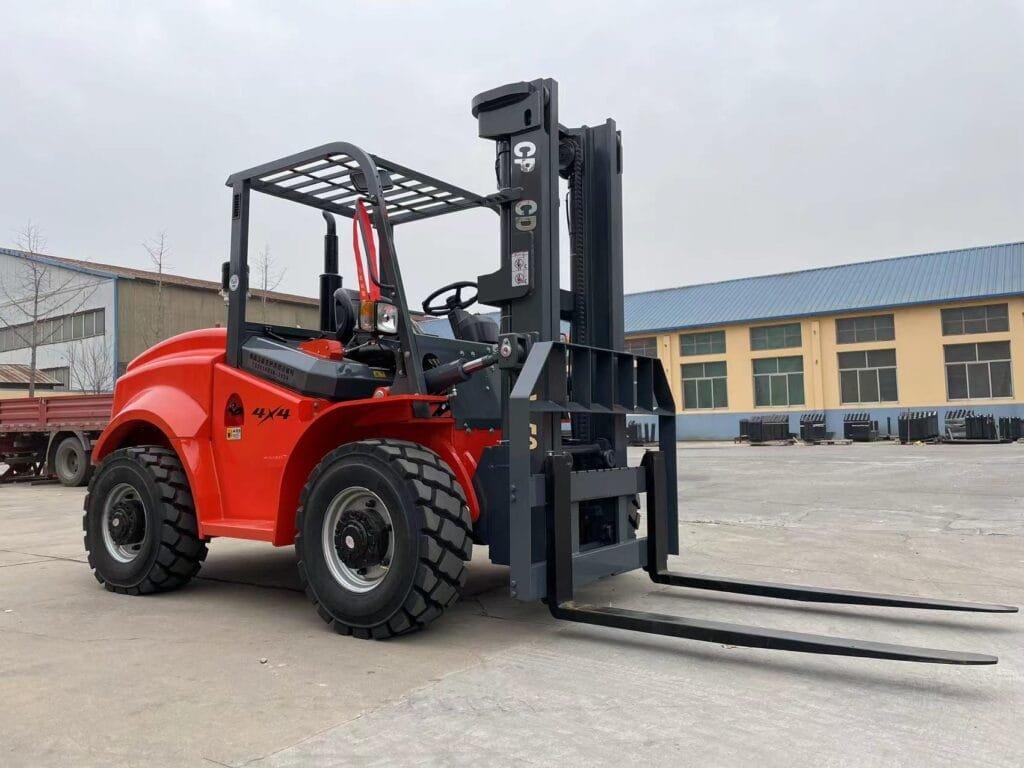
6. Choosing the Right Chinese Supplier (and Where Nicosail Fits In)
There are hundreds of factories in China that can build a rough terrain forklift. The difference is not only price, but:
- How stable the design is over years
- How seriously the factory takes welding quality, hydraulic cleanliness, and testing
- Whether they understand developed-market compliance (WHS duties, documentation, traceability)
A supplier like Nicosail, which already specialises in mini excavators and compact tracked loaders for Europe, North America and Australia, is used to:
- Working with distributors and rental companies that re-brand machines.
- Providing custom paint and branding without compromising the underlying specification.
- Designing for rough job sites – strong chassis, protected hoses, heavy-duty axles – which is exactly what a rough terrain forklift needs.
When evaluating any supplier (including Nicosail), smart importers usually ask for:
- Welding and frame information
- Type of steel used
- WPS or weld procedures
- How the chassis and mast are stress-tested
- Hydraulic system details
- Pump brand and rating
- Valve brand
- Burst pressure and filtration arrangement
- Quality control on final assembly
- End-of-line (EOL) test reports
- Oil cleanliness standards
- Leak testing procedures
Rough terrain forklifts work hard: repetitive shocks, side loads, peak hydraulic pressures. If those invisible details are not controlled, the machine may look fine at delivery but start leaking or cracking within the first year.
7. Technical Checklist: Making Sure the Forklift Passes Aussie Compliance
Without going too deep into engineering language, here is a practical checklist that distributors and contractors can use when importing Chinese rough terrain forklifts.
7.1 Safety and stability
- Capacity plate clearly shows:
- Rated capacity at various lift heights and load centres
- Model and serial number
- Seat belt and operator presence system (OPS) that cuts travel or hydraulics if the operator leaves the seat – aligned with modern safety expectations in AS 2359 guidance.
- ROPS/FOPS cab or canopy to protect from rollover and falling objects (especially on construction and farm sites).
- Overhead guard built with adequate section thickness and proper welding.
- Mast tested for bending and torsion, with roller clearance properly adjusted.
7.2 Controls and visibility
- Controls labelled in English, with clear direction arrows.
- Reversing alarm and work lights for low-light operation.
- Mirrors or camera to cover blind spots around the mast and counterweight.
7.3 Brakes, steering and tyres
- Dual-circuit service brakes and parking brake with enough holding capacity on slope (this is part of AS 2359 testing).
- Steering system free from excessive play.
- Off-road tyres with adequate tread depth and load rating; bead and rim specification appropriate for the machine weight and speed.
7.4 Hydraulics and electrics
- Main lift circuit pressure compatible with cylinder and hose ratings.
- Hoses routed and clamped to avoid chafing, especially around mast and tilt cylinders.
- Proper overload relief valves and, when needed, load-holding valves on tilt and lift circuits.
- Electrical system fused and loomed; battery properly secured and vented.
7.5 Documentation
- Operator manual in English (not machine-translated).
- Service manual with torque specs, hydraulic diagrams and oil recommendations.
- Spare parts book for future ordering.
- For fleet customers: basic maintenance checklist tied to local WHS expectations.
Nicosail and similar factories that focus on export business usually already have these documents in place; it is still worth checking every item before shipping.
8. Cost Example: Landed Cost of a Chinese Rough Terrain Forklift in Australia
The exact numbers will vary, but here’s a simple, realistic example to see where the money goes.
Example assumptions
- 3.5T rough terrain forklift from China
- FOB China port price: USD 32,000
- Sea freight + insurance to Australia: USD 2,800
- Exchange rate: 1 USD = 1.50 AUD (example only)
- Duty rate under HS 8427 from China: 0% (assuming FTA and correct HS application)
Step 1 – Convert to AUD
- Goods (FOB): 32,000 × 1.50 = AUD 48,000
- Freight + insurance: 2,800 × 1.50 = AUD 4,200
Step 2 – Customs value and duty
- Customs value (usually close to FOB in AUD): 48,000
- Duty at 0%: 0
Step 3 – Calculate VoTI (Value of Taxable Importation)
VoTI = customs value + freight + insurance + duty
≈ 48,000 + 4,200 + 0 = AUD 52,200
Step 4 – GST
- GST = 10% of VoTI = AUD 5,220
Step 5 – Add local and service costs (example)
- Customs broker and handling: AUD 600
- Port and terminal fees: AUD 900
- DAFF inspection fee: AUD 250
- Local transport from port to yard: AUD 700
Total local costs (ex-GST) ≈ AUD 2,450
Some of these services may attract GST as well, depending how they are invoiced. But in simple terms, the landed cost will be:
- Goods + freight in AUD: 52,200
- GST on import: 5,220
- Local services: 2,450
Approximate landed outlay ≈ AUD 59,870
For a GST-registered business, the 5,220 AUD GST is claimable as input tax credit, so the effective cost over time is closer to 54–55k plus financing cost. (Importers should confirm details with their accountant.)
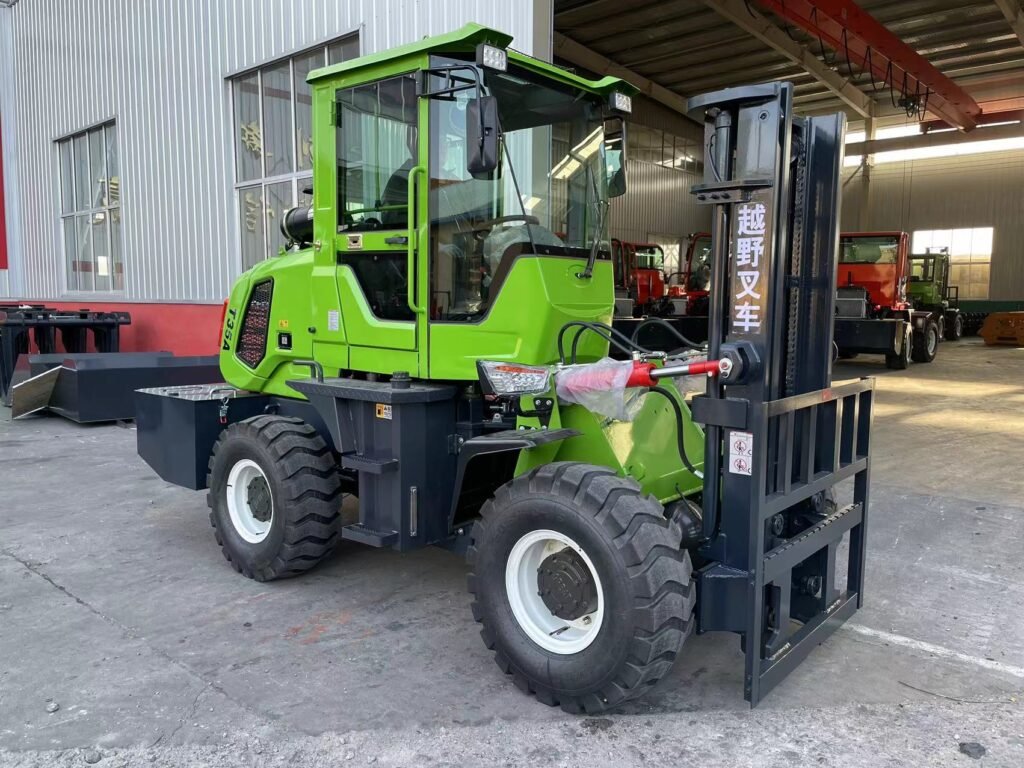
9. Common Mistakes Importers Make – And How to Avoid Them
Mistake 1 – Buying the cheapest machine without checking standards
Some low-cost forklifts are designed only for domestic use in developing markets, without reference to AS 2359 or equivalent. That can mean:
- No proper stability testing
- Weak overhead guard
- Poor brake performance
Fixing those issues in Australia is far more expensive than paying a bit more for a compliant machine at the start.
How to avoid: insist on compliance evidence and clear technical documentation; work with factories like Nicosail that already supply to regulated markets.
Mistake 2 – Ignoring biosecurity cleaning
New machines stored outdoors can still pick up mud and seeds. Used rough terrain forklifts are almost always dirty underneath.
How to avoid:
- Build cleaning requirements into the contract.
- Ask for detailed cleaning photos before shipment.
- Use BICON and a broker to confirm any import permit or special cleaning requirement.
Mistake 3 – Misunderstanding GST and landed cost
Some new importers only budget for machine price + sea freight, then are surprised by GST, port charges and local transport.
How to avoid:
- Use the formula for VoTI and GST explained earlier.
- Get a written landed cost estimate from a customs broker before confirming purchase.
Mistake 4 – Poor communication with the factory
Small misunderstandings (wrong mast height, missing side shift, different tyre spec) can make a forklift unsuitable for the Australian job site.
How to avoid:
- Use clear Excel spec sheets and drawings with every order.
- Ask the factory for photos and videos of the exact unit before shipping.
- Work with suppliers that provide stable English communication – factories like Nicosail often have export teams used to dealing with overseas distributors and can coordinate technical changes more smoothly.
10. FAQ
Q1. Are Chinese rough terrain forklifts allowed to work in Australia?
Yes, as long as they:
- Meet relevant Australian safety expectations, especially AS 2359 series for powered industrial trucks.
- Comply with WHS laws that require imported plant to be without risks to health and safety.
- Clear biosecurity requirements and customs properly.
Many Australian businesses already operate Chinese-made forklifts; the key is choosing the right factory and managing compliance.
Q2. Is there import duty on Chinese forklifts?
For HS 8427 forklifts imported from China, Australia’s tariff schedule shows a 0% duty rate in many cases when FTA conditions are met.
However, HS classification and FTA eligibility depend on accurate documentation, so duty should always be confirmed with a customs broker.
Q3. How much GST will be charged?
GST is 10% of the Value of Taxable Importation (VoTI), which includes: customs value of the forklift, plus freight and insurance to Australia, plus any duty.
So GST is effectively 10% of the landed CIF value plus duty, not just 10% of the machine price.
Q4. Are there special rules for used rough terrain forklifts?
Yes. Used machinery is treated as higher biosecurity risk and usually must:
- Be thoroughly cleaned before shipment
- Possibly be accompanied by evidence of cleaning or import permits
- Be ready for extra cleaning at an Australian quarantine facility if DAFF is not satisfied
If the used forklift has modifications or unusual attachments, plant design registration requirements may also apply in some states.
Q5. Does every forklift need design registration?
Not every forklift, but some plant types and certain uses do require design registration, depending on state regulations and how the equipment is used (e.g. with work platforms, on mine sites).
It is safest to check with the relevant state or territory regulator before commissioning a new model or using unusual attachments.
Q6. Can a Chinese factory like Nicosail put an Australian dealer’s own brand on the forklift?
Yes. Many Chinese OEM factories, including Nicosail, are set up to:
- Paint machines in a dealer’s brand colours
- Fit custom decals and logos
- Use dealer-specific model codes
This lets Australian distributors sell under their own brand while still relying on the factory’s engineering, production and test systems.
Q7. What documents are essential for customs clearance?
For a typical shipment of rough terrain forklifts, the importer or broker will need at least:
- Commercial invoice (in English)
- Packing list
- Bill of Lading
- Certificate of Origin (for FTA duty benefits, if applicable)
- Any DAFF import permits or biosecurity documentation
- For used machinery: proof of cleaning if required
11. Final Summary
Importing Chinese rough terrain forklifts into Australia can be very profitable for dealers, rental fleets and large contractors – but only when the rules and costs are understood up front.
The key points are:
- Forklifts are regulated as industrial lift trucks under WHS law, and importers share responsibility for safety. Standards like AS 2359 are the benchmark.
- Australia enforces zero-tolerance biosecurity on imported machinery. Soil or seed contamination can lead to costly cleaning or re-export.
- With the China–Australia FTA, many forklifts under HS 8427 attract 0% duty, but 10% GST is still charged on the total VoTI including freight and any duty.
- A structured process – from defining specs and checking BICON, to locking in technical requirements and working with a customs broker – avoids surprises at the port.
- Choosing a solid Chinese factory, such as Nicosail, that already builds equipment for tough job sites and export markets is usually more valuable than saving the last few dollars with an unknown supplier.
When the compliance, paperwork and real landed cost are under control, Chinese rough terrain forklifts can give Australian businesses a strong price-performance advantage – with reliable machines working on farms, construction sites and yards across the country for many years.