1) The Quick Answer (When Each Wins)
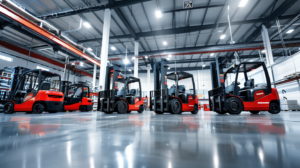
Choose a Chinese off-road forklift if the job is mostly “move pallets around on rough ground”—think unloading bricks, block, bagged cement, rebar bundles, and shifting materials around a muddy site. It’s simpler, usually cheaper to buy and maintain, and easy for most forklift operators to jump on.
Choose a telehandler if the job is “place materials up and out”—like lifting drywall to upper floors, placing roof trusses, feeding scaffolding, setting HVAC units, or reaching over obstacles. A telehandler’s boom reach is the whole point, and on many sites it replaces a small crane for lighter lifts.
A clean way to say it:
- Off-road forklift = horizontal logistics
- Telehandler = vertical + forward placement
If the site regularly needs reach (forward and upward), the telehandler usually wins even if it costs more—because it saves labor and time every single day.
2) What an Off-Road Forklift Really Is on a Jobsite
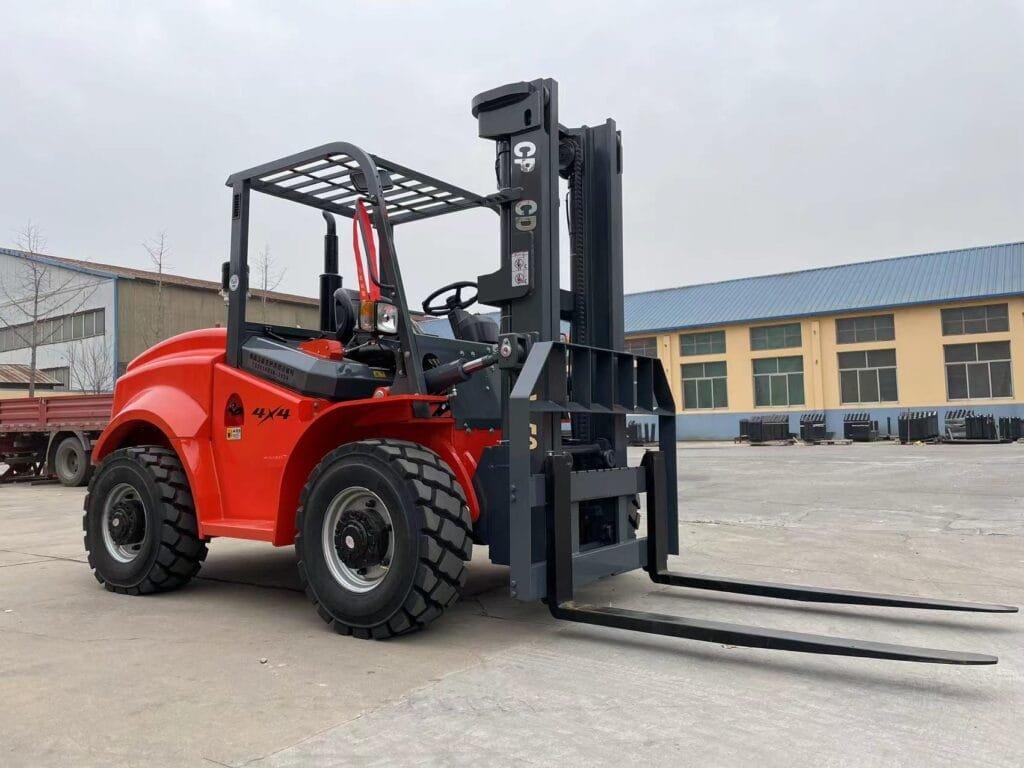
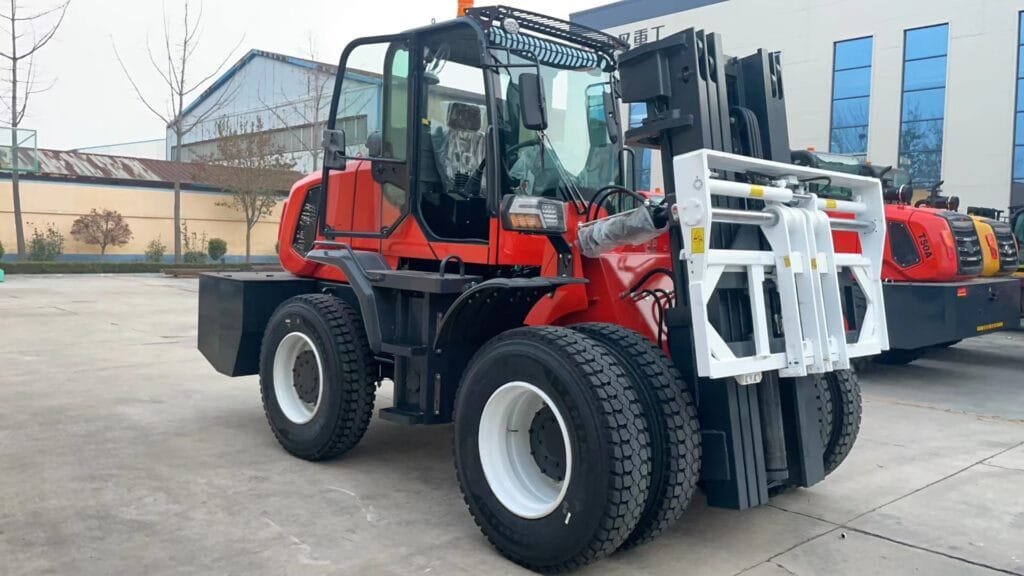
A construction off-road forklift is basically a forklift built to survive uneven terrain:
- Larger tires (often pneumatic)
- Higher ground clearance
- Stronger mast and chassis than warehouse forklifts
- Often 2WD or 4WD, sometimes with differential lock
What it’s great at
- Unloading pallets from trucks
- Moving heavy palletized material quickly
- Short-distance hauling around the site
- Working in tighter spaces than a telehandler (often)
What it’s not great at
- Reaching forward (you only have the mast tilt and maybe small reach via carriage)
- Placing loads onto upper floors or over obstacles
- Handling big moment loads (long loads that act like a lever)
A forklift is happiest when:
- The load stays close to the mast
- The travel path is reasonably predictable
- The operator is doing repeated, simple cycles
3) What a Telehandler Really Is on a Jobsite
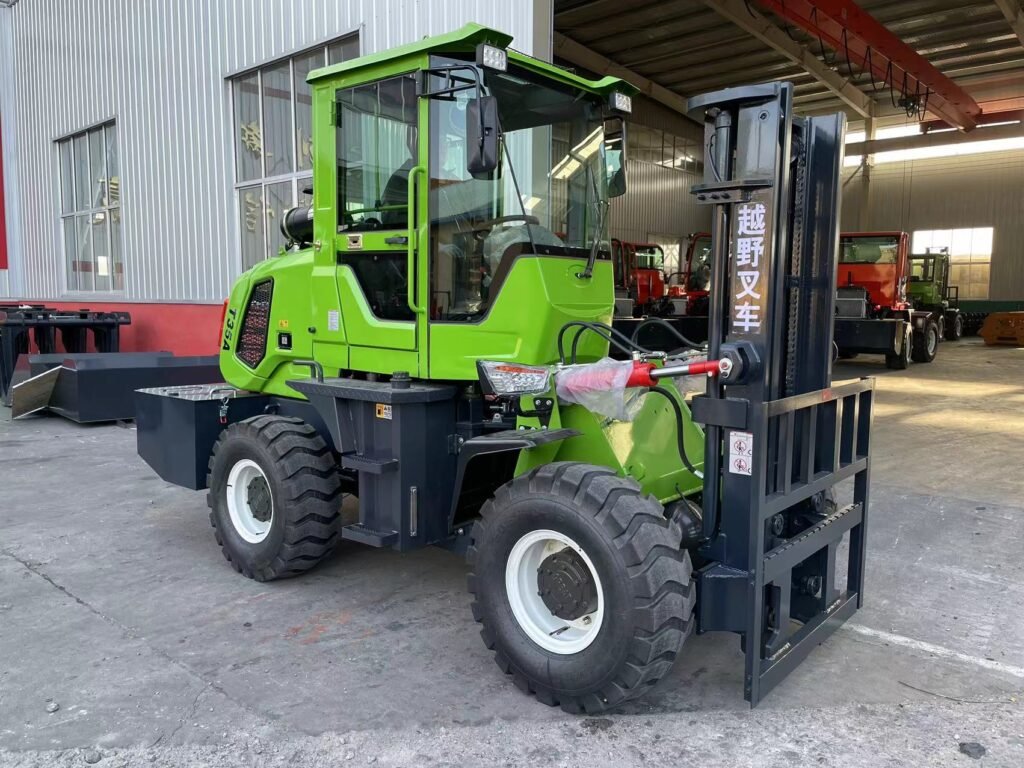
A telehandler (telescopic handler) is a boom machine that lifts like a small crane but carries like a forklift:
- Telescopic boom extends outward and upward
- Load chart changes as reach changes (this matters a lot)
- Often 4WD and designed for uneven terrain
- Supports a big attachment ecosystem
What it’s great at
- Placing loads at height
- Reaching over trenches, materials, or site obstacles
- Doing multiple jobs with attachments (forks, bucket, jib, work platform, etc.)
- Reducing manpower (one operator can place what would take 2–4 workers)
What it’s not great at
- Cheap parts and simple maintenance (more hydraulics, more wear points)
- Narrow spaces (boom machines can be longer and need swing/clearance)
- “Forklift-speed” repetitive pallet moves (it can do it, but it’s not always the fastest or most economical)
A telehandler is happiest when:
- The site has vertical placement needs
- The plan is organized (spotters, stable ground, proper load chart use)
- Attachments are used to replace multiple machines
4) Side-by-Side Comparison: Reach, Stability, Terrain, Speed, and Versatility
A) Reach and height
- Off-road forklift: limited by mast height. Good for stacking and unloading. Not designed for reaching forward.
- Telehandler: designed for forward reach + height. Can place loads onto slabs, into buildings, or onto scaffolding areas.
Real-world takeaway: If the job says “place,” “feed,” “set,” “lift to floor,” or “reach over,” telehandler advantage is huge.
B) Stability and “feels safe”
- Forklift: stable when loads stay close. Simple stability triangle. Operators understand it.
- Telehandler: stability changes with boom angle and extension. The machine can feel stable… right until the boom goes out and the load chart drops fast.
Real-world takeaway: Telehandlers demand better training and stricter discipline. A forklift can still tip, but telehandler incidents often come from ignoring load charts and ground conditions.
C) Terrain performance
- Off-road forklift: strong traction and clearance, especially in 4WD versions. Often very capable in mud and gravel.
- Telehandler: also strong in terrain, but the longer wheelbase and boom behavior can make it feel different. On very soft ground, you’ll still need mats/planning.
Real-world takeaway: Both can work on rough ground, but the decision is usually made by reach needs, not traction.
D) Cycle speed for pallet logistics
- Forklift: usually faster and more efficient for simple pallet moves.
- Telehandler: can do it, but more machine weight, turning radius, and boom operation may slow repetitive cycles.
Real-world takeaway: For high-frequency pallet handling all day, forklifts often win on productivity per dollar.
E) Attachments and “one machine replaces many”
- Forklift: mostly forks, maybe a jib or simple clamp depending on carriage.
- Telehandler: forks, bucket, truss boom, jib, winch hook, work platform, pipe grapples, etc.
Real-world takeaway: On mixed construction sites, telehandlers often become the “Swiss army knife,” which is why contractors love them.
5) The “Invisible” Reliability Points That Decide the Winner
A lot of buyers compare only rated capacity and lift height. On construction sites, reliability is decided by things that don’t show up in the brochure.
A) Hydraulics: heat, leakage, and valve feel
Construction work is dusty, hot, and continuous. The main pain points:
- Hydraulic oil overheating (especially on telehandlers)
- Hose routing rubbing and leaking
- Cheap seals hardening and sweating oil
- Jerky boom control (telehandlers) or mast drift
What to look for (both machines):
- Clean hose routing with clamps and protection sleeves
- Proper radiator + oil cooler sizing, not “just enough”
- Smooth valve control (test under load, not empty)
- Leak control: cylinder rod finish quality and seal brand consistency
B) Chassis and weld fatigue
Off-road forklifts take shock loads through the mast and frame.
Telehandlers take bending loads through the boom and chassis.
What to look for:
- Clean weld beads at high stress joints
- Reinforcement plates where loads concentrate
- No undercut, no blowholes, no sloppy grinding “cosmetics”
- Pins and bushings that are hardened and greasable
If sourcing from China, this is where factory discipline matters most—because cosmetic paint can hide a lot.
C) Axles, steering, and brakes (jobsite killers)
A machine can have a strong engine and still fail because:
- axle seals leak
- steering cylinder or orbitrol leaks
- brake components wear fast in mud/water
- wheel bearings fail under shock loading
Look for:
- Proven axle suppliers or documented endurance testing
- Service access (can seals be replaced without removing half the machine?)
- Brake protection and sensible routing
D) “Rated capacity” vs “usable capacity”
This is the most common mistake—especially with telehandlers.
- Forklift ratings are generally straightforward: capacity at a certain load center.
- Telehandler capacity depends on boom extension and angle: the load chart is the truth.
Buyer rule: If the job needs to place 1.5 tons at 8 meters forward reach, the machine rating “3.5 ton” might be meaningless. Check the chart.
6) Cost of Ownership: Fuel, Tires, Hydraulics, and Downtime
Off-road forklift cost profile
- Typically lower purchase price
- Simpler maintenance
- Fewer specialized wear parts
- Lower training burden
Main cost drivers:
- tires (punctures and wear)
- mast rollers/chains
- axle/steering seals
- abuse damage from high-speed rough travel
Telehandler cost profile
- Usually higher purchase price
- More complex hydraulics and boom wear points
- Attachments add cost (but also add value)
- Training, safety program, and load-chart discipline matter
Main cost drivers:
- boom wear pads, pins, bushings
- hydraulic hoses/cylinders (more of them)
- attachment maintenance
- downtime from improper operation (overload, side load, poor ground support)
Simple ROI reality: Telehandlers often cost more, but they also replace labor and sometimes replace a second machine. If that substitution happens often, the telehandler “pays back” faster than people expect.
7) Safety and Compliance: What Buyers Should Check (Especially for China Sourcing)
This section matters a lot for importers, distributors, and rental fleets. Safety and compliance issues are where profits disappear.
Non-negotiables for both machine types
- ROPS/FOPS protection where applicable
- Seatbelt + seat switch logic that actually works
- Proper lighting and audible alarms
- Clear operator manual and safety decals
- Stable braking performance under load
- Emergency stop / shutdown logic (where applicable)
Telehandler-specific must-check items
- Load chart supplied and accurate
- Working load moment indicator / display (if included)
- Boom wear and extension control smoothness
- Outriggers (if equipped) stability and interlocks
- Attachment compatibility and locking safety
- Platform use rules if using man baskets (local regulations differ)
Certificate and documentation discipline (importer pain point)
For buyers sourcing from China, paperwork must be treated like a technical component:
- engine emissions documentation (if needed in target market)
- conformity declarations and traceable serial numbers
- consistent nameplate data matching the actual configuration
- manuals in local language requirements (varies by market)
Practical tip: A reputable supplier should provide a full documentation pack and allow verification. If documentation changes each time it’s requested, that’s a warning sign.
8) Common Construction Scenarios and the Best Pick
Scenario 1: Unloading pallets of blocks, cement, and tile all day
Winner: Off-road forklift
- Fast cycle time
- Simple operation
- Great for “truck → laydown yard → near work area”
Scenario 2: Feeding materials to upper floors (drywall, studs, insulation)
Winner: Telehandler
- Reach and height save multiple workers
- Less manual carrying, fewer injuries, faster progress
Scenario 3: Roof trusses and long loads
Winner: Telehandler (usually)
- Can lift, extend, and place with control
- Forklift can struggle with long lever loads and placement precision
Scenario 4: Tight site with narrow access and short lifts
Often winner: Off-road forklift
- Smaller footprint (depending on model)
- Good for repeated short cycles
Scenario 5: Mixed jobsite where one machine must do many tasks
Winner: Telehandler
- Attachments make it flexible
- The machine becomes a daily problem-solver
Scenario 6: Soft ground, muddy season, unprepared roads
Depends
- A strong 4WD off-road forklift can be very capable
- A telehandler is also capable but needs more planning when lifting at reach
- If ground conditions are truly bad, ground mats and proper site prep matter more than brand or type
9) Buying Tips for Chinese Machines: Avoid Spec Tricks and Certificate Headaches
“Chinese off-road forklift” and “Chinese telehandler” can be great value—if the buying process is disciplined. The biggest risk is not that China can’t build good machines. The risk is inconsistency between batches and weak validation.
A) Ask for the “jobsite truth” test, not just a brochure
Request evidence of:
- full-load lifting tests
- temperature stability after continuous cycles
- leak inspection standards (what’s acceptable, what’s rejected)
- end-of-line inspection checklist
- weld process control (WPS discipline)
If a supplier can’t explain testing in a clear and repeatable way, that’s a red flag.
B) Demand the correct load chart and define the attachment
For telehandlers:
- The chart must match the exact boom + counterweight + axle configuration
- Fork carriage and attachments change effective capacity
- Tire type and stabilizer configuration also matter
For forklifts:
- Confirm the load center used for the rating
- Ask about mast type, free lift, and real max fork height
C) Parts availability and after-sales response plan
A smart importer asks:
- what parts ship with the first container (filters, belts, hoses, seal kits)
- lead time for axles, pumps, and cylinders
- whether parts are standard brands or fully proprietary
- whether manuals and parts books are consistent and well translated
D) Factory consistency beats “best single sample”
One perfect demo machine is not enough. Ask for:
- serial number traceability
- incoming inspection discipline
- photos/videos of production lines and QC stations
- references in markets with similar regulation levels
E) Where Nicosail fits naturally
For buyers building a compact construction fleet, it’s common to pair material-handling machines with compact earthmoving machines. Brands like Nicosail are worth considering on the compact side (mini excavators, compact tracked loaders, skid steers), especially when the priority is stable quality control, clear communication, and customization that helps distributors build their own branded lineup—without turning the purchase into a paperwork gamble. The best suppliers in any category share the same habits: consistent QC, honest documentation, and fast parts support.
10) Rental and Distributor View: Which Unit Pays Back Faster?
For rental companies and distributors, the question is not “which is better,” but “which earns faster and breaks less.”
Off-road forklift rental logic
- High utilization on basic sites
- Lower training barrier
- Lower maintenance complexity
- Strong demand where pallet logistics are constant
Risk: customers overload, drive too fast on rough ground, and destroy tires/axle seals.
Telehandler rental logic
- Higher daily rental rate (in many markets)
- High demand on vertical build sites
- Attachments create add-on revenue
- Often becomes essential equipment on larger sites
Risk: misuse of boom extension and side loading. If operator discipline is weak, repairs get expensive fast.
Rental takeaway: If the customer base is professional and safety-aware, telehandlers can be top earners. If the customer base is mixed and training is minimal, forklifts are often safer for margins.
11) A Simple Selection Checklist (Fast and Practical)
Step 1: Write the top 3 daily tasks
- Mostly moving pallets on rough ground → Off-road forklift
- Mostly placing materials at height or forward reach → Telehandler
- Mixed tasks + attachment needs → Telehandler
Step 2: Check site constraints
- Tight access, frequent turns, short travel → often forklift
- Need to reach over obstacles / into buildings → telehandler
Step 3: Capacity reality check
- Forklift: confirm load center rating
- Telehandler: match load chart to the required reach/height with the intended attachment
Step 4: Workforce and safety maturity
- Limited operator skill pool → forklift tends to be easier
- Strong training culture → telehandler benefits can be fully unlocked
Step 5: After-sales and parts plan (especially for imports)
- Decide which spare parts must arrive with the first shipment
- Confirm documentation is stable and verifiable
- Confirm response time for technical support
12) FAQ
Q1: Is a telehandler always better than an off-road forklift for construction?
No. If the job is mostly unloading and moving pallets across rough ground, an off-road forklift is usually more cost-effective and faster for repetitive cycles. Telehandlers win when reach and placement matter daily.
Q2: Which one is safer?
Both can be safe when operated correctly. In practice, forklifts are simpler and more familiar. Telehandlers require strict load-chart discipline because stability changes dramatically with boom extension and angle.
Q3: Do Chinese telehandlers and off-road forklifts hold up well on tough sites?
They can—if the supplier has consistent QC, proper testing, and reliable parts support. The weak point is usually inconsistency between batches and poor documentation discipline, not the country itself.
Q4: What’s the biggest “hidden” problem to check before buying?
For forklifts: axle/seal durability, mast chain/roller quality, and hose routing protection.
For telehandlers: boom wear pads/pins, smooth hydraulics under load, and a correct load chart matched to the exact configuration.
Q5: How to compare “3.5 ton forklift” vs “3.5 ton telehandler”?
They are not equivalent. Forklift capacity is usually rated at a defined load center close to the mast. Telehandler capacity depends on boom extension and angle—at reach, usable capacity can drop a lot. Always check the load chart.
Q6: Which one is better for a rental fleet?
If customers are mixed and training is light, off-road forklifts often protect margins better. If customers are professional and projects are vertical, telehandlers often earn more per day and can deliver higher ROI—assuming misuse is controlled.
Q7: What complementary machines make a construction fleet more complete?
Many contractors pair material handling (forklift/telehandler) with compact earthmoving and site cleanup machines. That’s where compact equipment brands like Nicosail (mini excavators, compact tracked loaders, skid steers) fit naturally—helping contractors and distributors cover more jobsite tasks without juggling too many suppliers.
13) Final Summary
For construction sites, the decision is less about brand and more about work type:
- Chinese Off-Road Forklift is the practical pick for fast pallet logistics on rough ground—simple, efficient, and usually cheaper to own.
- Telehandler is the stronger pick when the site needs reach and placement—feeding upper floors, reaching over obstacles, and doing multi-role work with attachments.
The smartest buying move is to treat “invisible reliability” as the real spec: hydraulics heat control, hose routing, weld quality, axle durability, and (for telehandlers) a truthful load chart that matches the exact configuration. For importers and distributors, documentation consistency and parts support are just as important as lift capacity.