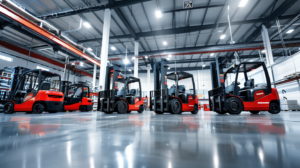
1. What farms really need from a forklift
A farm forklift lives a harder life than a warehouse forklift. The same machine may unload a container in the morning, carry feed pallets through a muddy yard at noon, and work inside a barn in the afternoon. That mix creates four “farm realities”:
- Ground is rarely perfect. Gravel, ruts, soft soil, and slopes are normal. That’s why “rough-terrain” and “outdoor-capable electric” matter more than fancy screen features.
- Loads are awkward. Seed totes, fertilizer bags, hay bales, bulk boxes, and palletized feed are often tall and unstable. Stability and visibility are a big deal.
- Dust and chaff are everywhere. Radiators clog, air filters load up fast, and electric connectors hate constant grime if sealing is weak.
- Seasonal urgency is real. When it’s harvest season, downtime is not “inconvenient”—it’s expensive.
So the “best” Chinese forklift for a farm is the one that matches terrain + load type + indoor/outdoor time + service support—not just the cheapest spec sheet.
2. “All-terrain” on a farm: rough-terrain forklift vs telehandler
Before comparing brands, it helps to define “all-terrain.”
Rough-terrain forklift (RT forklift)
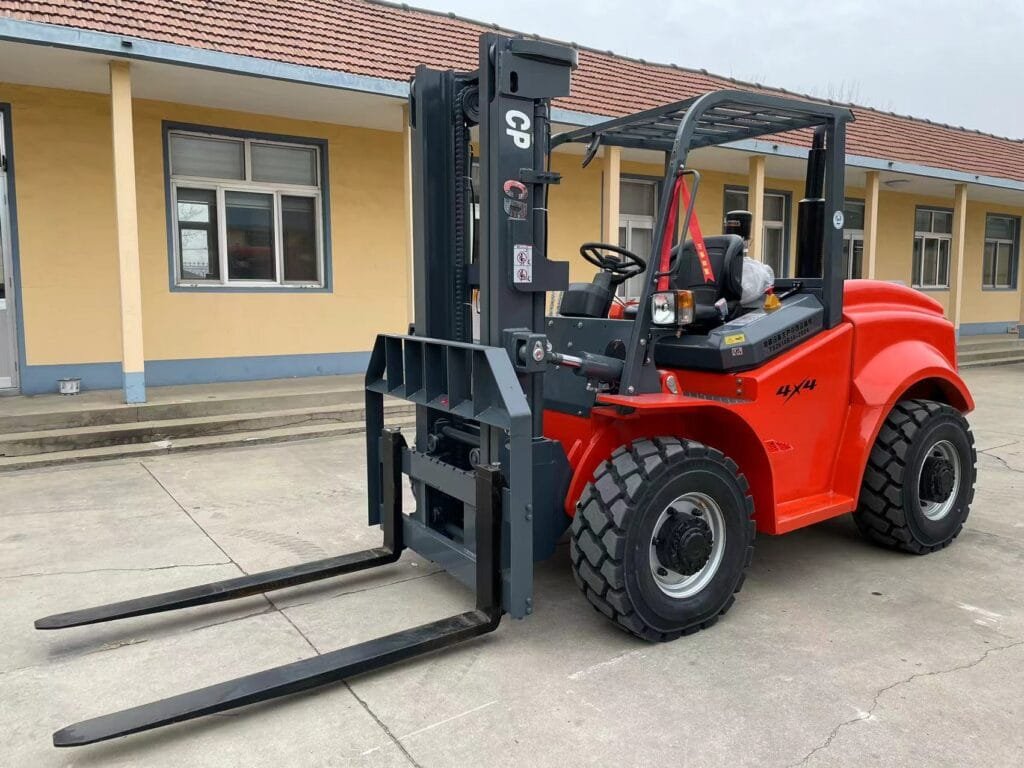
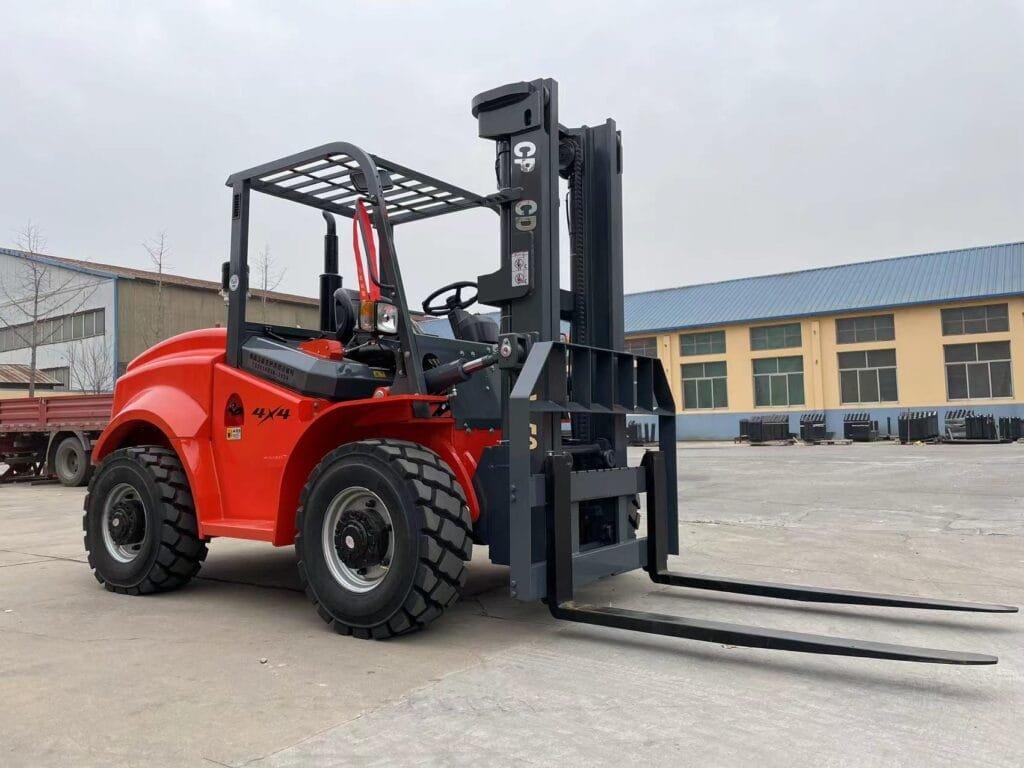
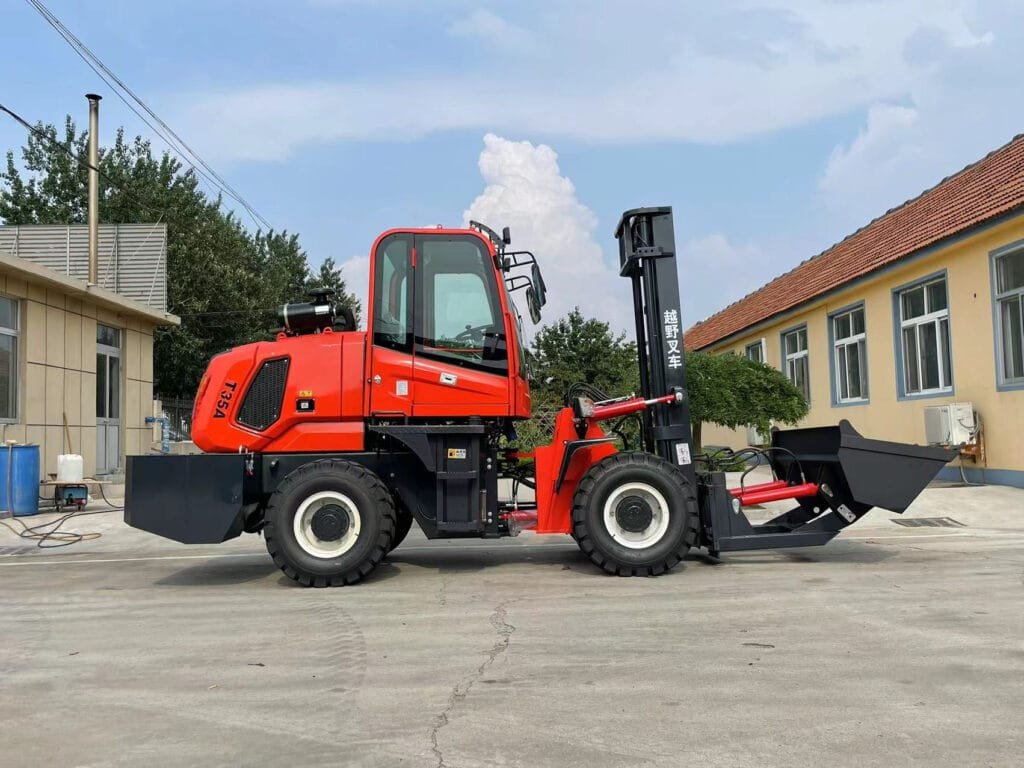
This is the classic farm yard choice: big pneumatic tires, higher ground clearance, stronger traction, and often 2WD or 4WD. Many Chinese manufacturers offer RT lines designed specifically for uneven ground. Hangcha lists dedicated rough-terrain truck families (including larger 5–10 ton classes).
HELI also sells IC rough-terrain models in common farm sizes like 2–3.5t and offers 2WD/4WD versions.
Telehandler (telescopic handler)
If the job involves stacking high, reaching over a trailer side, or loading from one side of a ditch, a telehandler can be a better “farm all-terrain” tool than a standard forklift. XCMG markets telehandlers (telescopic boom rough-terrain handlers) that fit this role.
Simple rule:
- Mostly yard + pallets + moderate stacking → rough-terrain forklift
- Lots of reach + high stacking + uneven ground + loading over obstacles → telehandler
3. Best Chinese rough-terrain forklift brands for farms
These are commonly shortlisted Chinese choices, with the “farm logic” behind each.
Option A: Hangcha rough-terrain forklifts (strong “mainstream” choice)
Hangcha offers multiple rough-terrain ranges, including heavier capacities (5–10t) and versions built for rugged job sites and slippery conditions.
Some regional lines highlight practical farm-friendly details like 4WD and well-known engine pairings (for example, Kubota on certain North American offerings).
Hangcha also publishes rough-terrain brochures that reference compliance/management system standards (helpful when a buyer wants documentation discipline, not just claims).
Best for farms that:
- Need a proven RT platform with common parts availability through dealers
- Work on gravel yards, mixed soil, and moderate slopes
- Want a wide model spread (so the machine can match the farm, not the other way around)
Watch-outs (farm reality):
- Make sure the exact configuration is quoted: tire type, 2WD/4WD, mast height, side-shift, and cold-weather starting package if needed.
Option B: HELI rough-terrain forklifts (value + broad range)
HELI lists IC rough-terrain forklifts in popular farm capacities (2–3.5t) with 2WD/4WD options.
That “normal-size farm” segment is where RT forklifts often pay back fastest—big enough for real work, still maneuverable around barns and sheds.
Best for farms that:
- Want RT capability in the 2–5t practical range
- Care about service support and documentation consistency through established channels
Watch-outs:
- Confirm ground clearance, tire sizing, and cooling package. Farms are “radiator torture tests.”
Option C: XCMG off-road forklifts / rough-terrain handling (when the job is closer to construction)
XCMG appears in the rough-terrain space through off-road forklift and handler listings, plus telehandlers aimed at outdoor material handling.
Best for farms that:
- Need more “site machine” behavior than warehouse behavior
- Are considering telehandler-style work (reach + height)
Watch-outs:
- Focus on dealer support and parts pipeline first. A strong machine with weak support still loses money.
4. Best Chinese electric forklifts for farms (lithium focus)
Electric on farms used to mean “indoor-only.” That has changed fast, mainly because lithium forklifts can be built with better weather resistance, faster charging, and less daily battery maintenance.
Lithium types (quick and practical)
- Lead-acid: cheaper upfront, but needs watering/ventilation habits and longer charging downtime.
- Lithium (often LFP / LiFePO₄): higher upfront cost, usually faster charging and less daily maintenance.
Option D: BYD lithium electric forklifts (LFP focus)
BYD positions its forklifts around lithium iron phosphate battery technology (LFP), emphasizing safety, integration (forklift + battery + charger), and operational efficiency.
BYD’s forklift sites repeatedly highlight LFP chemistry as a key design feature.
Best for farms that:
- Run indoor + outdoor work and want a “charge fast, work more” pattern
- Prefer lithium chemistry associated with stability and safety characteristics (especially compared with older lithium chemistries)
Watch-outs:
- Plan charging realistically: power supply, plug type, and where the machine will live in winter.
Option E: EP Equipment lithium forklifts (electric that tries to replace diesel yard trucks)
EP’s EFL series is designed as a practical “diesel replacement” idea. The EFL201 page highlights an 80V lithium setup, higher ground clearance (120 mm), and a water-resistant design—exactly the kind of detail farm buyers should care about.
Other EFL descriptions also frame the product as a diesel yard-truck replacement with a tough chassis concept.
Best for farms that:
- Want electric but still work outside on imperfect ground
- Value simple uptime: opportunity charging, fewer daily battery chores
Watch-outs:
- Tire choice matters a lot. “Outdoor-capable electric” still needs the right tires for mud and slopes.
Option F: Hangcha lithium electric forklifts (wide lithium lineup)
Hangcha lists dedicated lithium electric truck series across multiple capacity ranges (including 1.5–3.8t and larger classes in listings).
Hangcha also markets higher-voltage lithium forklift series aimed at stronger IC-like performance with lower emissions and lower operating costs.
Best for farms that:
- Want a mainstream brand with a broad lithium catalog
- Need a specific size (small barn machine or bigger yard machine)
Watch-outs:
- Confirm charging compatibility and winter performance package if operating in cold regions.
Option G: LiuGong electric forklifts (some markets show lithium specs clearly)
LiuGong’s regional forklift pages show electric forklift listings with lithium battery specs in certain markets (helpful when checking the “real product” versus marketing).
Best for farms that:
- Already run LiuGong equipment and prefer supplier consistency
- Want to compare lithium configurations on paper before talking price
5. Quick comparison: rough-terrain diesel vs lithium electric (farm edition)
Choose a rough-terrain diesel forklift when:
- The yard is muddy/soft for long periods
- The forklift is far from power (no easy charging)
- Work is continuous all day with no natural charging breaks
- Towing and heavy pushing happens (some farms treat forklifts like tractors—electric usually hates that)
Choose a lithium electric forklift when:
- Work is inside barns + near people/animals (noise and fumes matter)
- The farm can support reliable charging
- Typical use is short bursts, with time to plug in between tasks
- The farm wants less daily maintenance and less fuel handling
A very common “farm sweet spot” is:
- One rough-terrain diesel for heavy outdoor yard work
- One smaller lithium electric for indoor barns/sheds and clean handling
6. Farm options that matter (don’t skip these)
These options decide whether the forklift feels “great” or “dangerous and annoying.”
Tires
- Pneumatic (air-filled): best traction/comfort, more puncture risk
- Foam-filled pneumatic: good compromise for farms (less puncture downtime)
- Solid: tough, but can be harsh and slippery on wet ground
2WD vs 4WD
If the farm has mud, slopes, or winter snow, 4WD becomes a “stress reducer,” not a luxury. Many RT lines offer both.
Mast and height
- Barn doors and low roofs: overall height matters more than lift height
- Container unloading: free-lift and visibility matter (common on some yard-focused setups)
Must-have attachments for farms
- Side shift: saves time and avoids tire rutting from constant repositioning
- Fork positioner: great for mixed pallet sizes
- Bale clamp / paper roll clamp: depends on crop and packaging style
- Load backrest: cheap insurance for tall, unstable loads
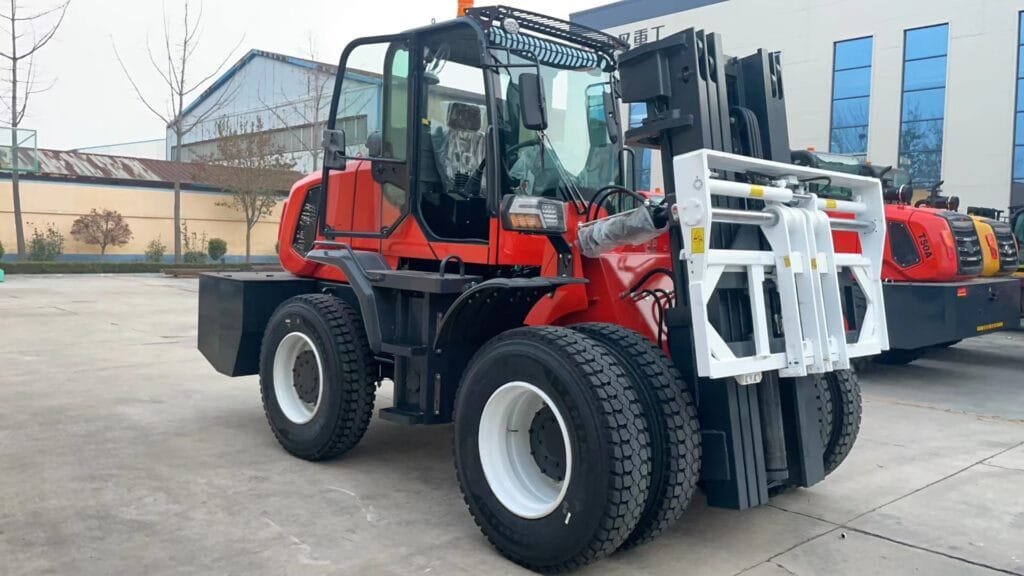
Cab and protection
- Open cab is fine until wind, rain, and dust become daily life
- Ask for proper guarding, lights, and easy-clean radiators
7. The “invisible reliability” checklist (what usually fails first on farms)
This is where many “cheap forklift deals” turn into expensive downtime.
Cooling system protection
Chaff and dust clog radiators fast. A forklift that’s easy to clean (and doesn’t require an hour of disassembly) wins on farms.
Sealing and water resistance (electric especially)
Outdoor electric forklifts should clearly describe water resistance or weather design intent (some do).
If a sales quote avoids this topic, that’s a red flag.
Steering axle and kingpins
Farm yards cause constant small shocks. If greasing points are neglected (or hard to access), wear accelerates.
Mast chains and rollers
Farm loads are often tall and “swingy.” Chains, rollers, and tilt cylinder condition should be treated like a routine inspection item, not a “someday” thing.
Brakes + mud
Mud is basically sandpaper. Make sure the brake setup is suited to frequent outdoor contamination and that daily cleaning is realistic.
8. Running cost and ROI: the honest way to compare
A practical farm ROI comparison is not “diesel vs electric” in theory. It’s:
- Downtime cost during peak season
- Fuel/energy cost where the farm is located
- Maintenance habits (does anyone actually do watering/greasing on time?)
- Service response time (local dealer matters more than brochure claims)
Lithium forklifts often win when:
- There’s reliable power
- The farm can do opportunity charging
- The machine runs many short tasks instead of one long continuous shift
Diesel rough-terrain often wins when:
- The forklift lives far from power
- The ground is consistently soft
- The job is long, heavy, and nonstop
9. Buying from China with fewer surprises (certs, lead time, parts)
This is the part that protects buyers from the most common overseas-purchase pain points.
Certification: verify, don’t assume
If the forklift is going into Europe, North America, or Australia, documentation matters. Ask for:
- Full machine nameplate photo + serial number format explanation
- Test reports and certificate copies and the issuing body details
- A clear statement of what the certificate covers (model series + configuration)
Certificate fraud usually succeeds because buyers only check the PDF—not the issuing source. Verification should be part of the purchasing routine.
Pre-shipment inspection: what to check
- Cold start + full warm run
- Drive on uneven ground (listen for axle noise)
- Lift full rated load (or at least a meaningful test load)
- Check hydraulic leaks, mast smoothness, and steering response
- Confirm every option on the quote is physically installed
Parts and support
A farm forklift needs fast spares:
- Filters, belts, hoses, seals
- Mast rollers, chains, bearings
- Contactors/sensors (electric)
- Tires (and the correct size)
Even the “best brand” becomes a problem if spare parts take 6 weeks during harvest.
10. When a forklift is the wrong tool (and what to use instead)
Some farms buy a forklift, then discover the ground is too soft half the year. In that case, a compact tracked loader (CTL) with pallet forks can outperform a forklift because tracks float better on soft soil.
This is also where a brand like Nicosail can fit naturally: Nicosail focuses on compact tracked loaders, skid steer loaders, and mini excavators—machines that many farms already use for dirt work, feeding, and general handling. For farms fighting mud and needing one machine to do more than just lift pallets, a CTL with forks (and the right counterweight/attachment setup) can be a smarter purchase than forcing a forklift into tractor territory.
FAQs
1) What lifting capacity is “enough” for a typical farm?
Many farms land in the 2.5–3.5 ton range for general pallets and feed. If big tote bags, heavy attachments, or large bales are common, sizing up reduces stress and improves stability.
2) Is a rough-terrain forklift safe on slopes?
Safer than a standard forklift, but slopes are still risky. The real limit depends on load height, tire grip, and operator habits. If slopes are frequent, consider 4WD, wider tires, and a lower lift plan.
3) Can a lithium electric forklift work outdoors in rain?
Some models are designed for outdoor use and may describe water resistance features (for example, certain EP models mention waterproof design intent).
Still, “outdoor use” should be confirmed in writing for the exact model.
4) What’s the biggest mistake when buying a farm forklift?
Buying for rated capacity only, ignoring ground conditions, tire type, and service support. Farms break “warehouse assumptions” quickly.
5) Rough-terrain forklift or telehandler for farms?
If reach and height are frequent needs, telehandlers can be better. If it’s mostly pallet work around the yard, rough-terrain forklifts are simpler and often cheaper to run.
6) Is BYD really different in electric forklifts?
BYD heavily emphasizes LFP battery technology and system integration (forklift + battery + charger) across its forklift positioning.
7) Are Chinese forklifts reliable enough for peak season work?
They can be—if the configuration matches the job and the buyer treats inspection, documentation, and parts planning as part of the deal (not an afterthought).
8) What options are “must-have” for farm efficiency?
Side shift, proper lights, correct tires, and a mast height that fits barn doors and storage needs. Fork positioners are a big upgrade if pallet sizes vary.
9) What should be included in a spare parts starter kit?
Filters, belts, common hoses, a seal kit, brake wear items, and key electrical spares for electric models (as advised by the supplier). Also include tire plan (or foam fill) to avoid puncture downtime.
10) If the yard is always muddy, should a forklift be skipped?
Often yes. A tracked machine with pallet forks may deliver better uptime. That’s where compact tracked loaders (like Nicosail’s lineup) can be the practical alternative.
Summary
The “best Chinese forklift for farms” depends on how the farm actually works day to day:
- For mud, ruts, and outdoor yard lifting, Chinese rough-terrain forklifts from brands like Hangcha and HELI are commonly strong fits, with clear RT product lines and 2WD/4WD configurations.
- For barn work, low noise, and lower routine maintenance, lithium electric forklifts from brands like BYD, EP, and Hangcha can be excellent—especially when outdoor capability and charging planning are treated seriously.
- If the farm’s biggest enemy is soft ground, it’s worth reconsidering the tool entirely: a compact tracked loader with pallet forks can beat a forklift on uptime and versatility—one reason brands like Nicosail are often relevant in farm handling discussions without needing to force a forklift into the wrong job.
If a shortlist (2–3 exact sizes + indoor/outdoor split + typical load types) is shared, a more precise “buy this category, avoid that category” recommendation can be mapped out quickly.