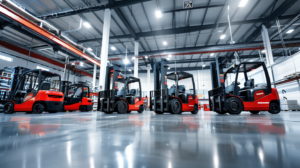
1. Why This Comparison Matters for Buyers
Many buyers start with one simple question:
“Should this job use an all-terrain forklift or a telehandler?”
On paper, both machines lift pallets. Both handle rough ground. Both are common on construction sites, farms, and industrial yards.
But in real use, they behave very differently.
Many wrong purchases happen because buyers look only at:
- Maximum lifting height
- Maximum capacity
- Cheapest price
And skip the stability curve, load position, and operator skill requirement.
This article breaks those things down in plain language, without marketing noise.
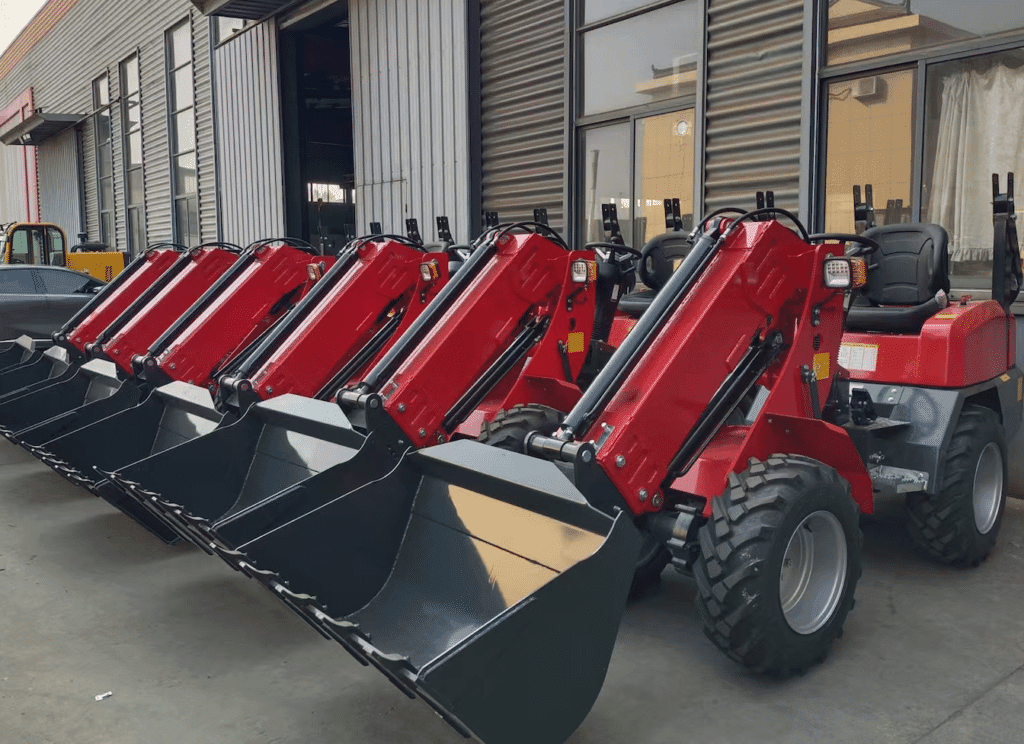
2. What Is a Chinese All-Terrain Forklift?
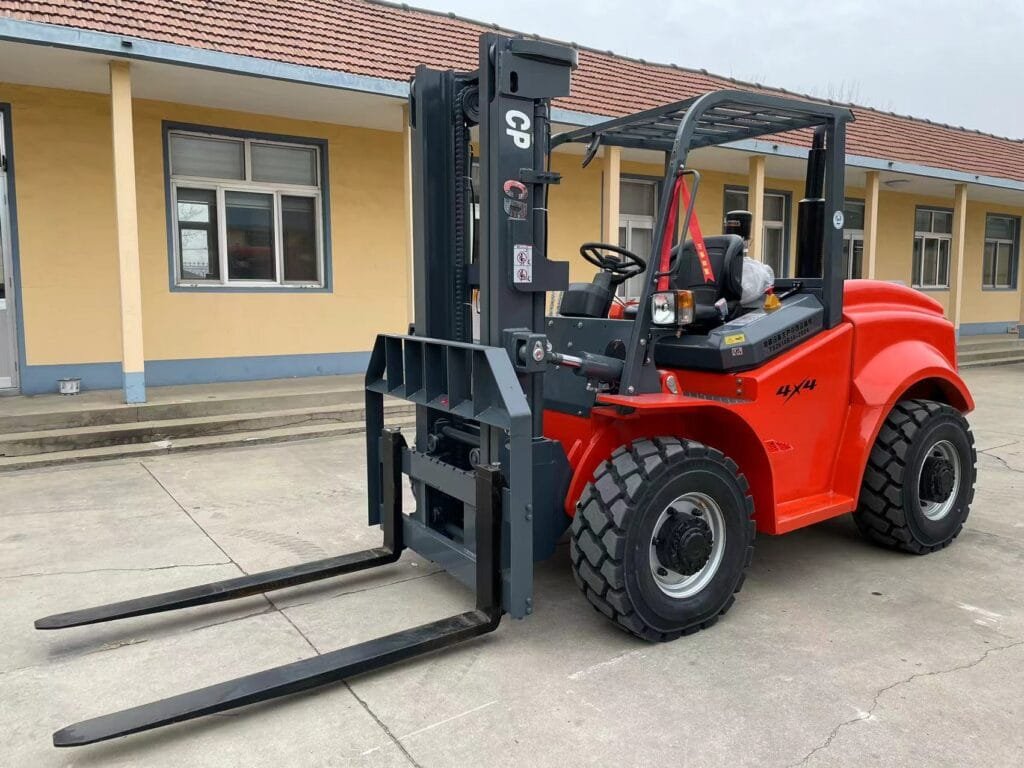
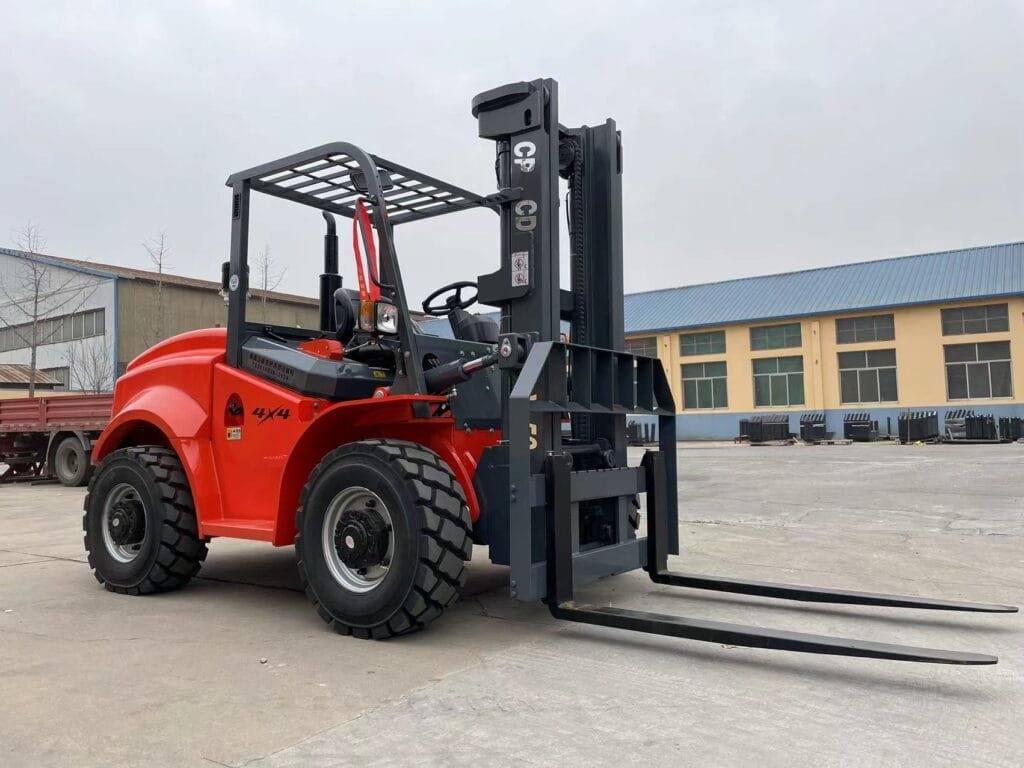
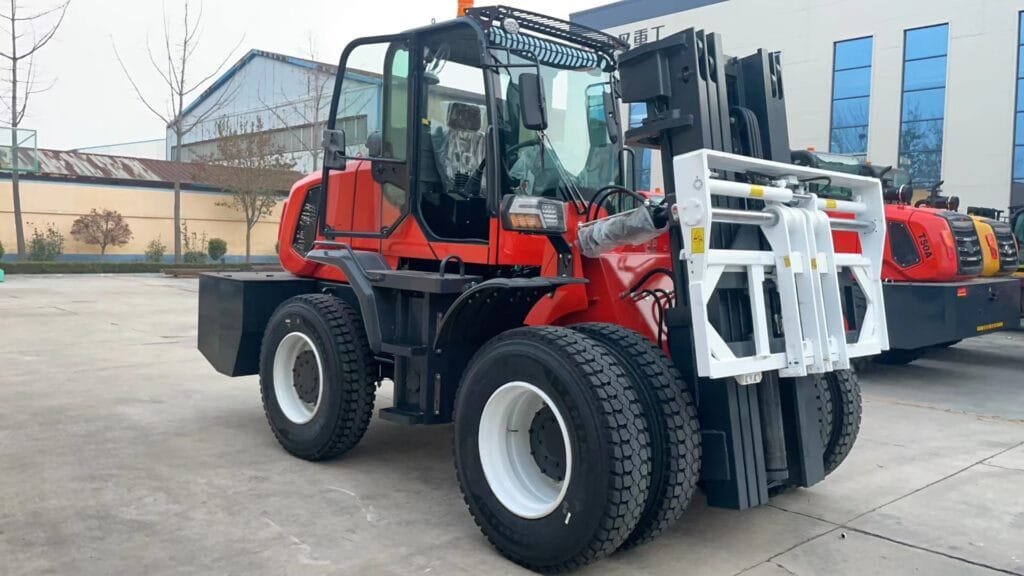
A Chinese all-terrain forklift is basically:
- A traditional forklift
- Mounted on large pneumatic tires
- With higher ground clearance
- Often 2WD or 4WD
Typical Features
- Lifting height: 3–6 meters
- Capacity: 2–5 tons
- Mast-type lifting (vertical only)
- Simple hydraulic system
- Mechanical or hydraulic transmission
Where It’s Commonly Used
- Brick yards
- Lumber yards
- Farms and feed mills
- Container loading yards
- Construction material storage
This machine lifts straight up and down, and that’s its biggest strength.
3. What Is a Telehandler (Telescopic Handler)?
A telehandler is a boom machine, not a mast machine.
It lifts loads:
- Up
- Forward
- Outward
Typical Features
- Telescopic boom
- Lifting height: 6–18 meters
- Capacity: 2–5 tons (but not at full extension)
- Multiple attachments: forks, buckets, platforms
Telehandlers are common on:
- Large construction sites
- Steel structure buildings
- Warehouses with high racking
- Jobs needing forward reach
But this flexibility comes with trade-offs.
4. Lifting Height: Numbers vs Real Use
All-Terrain Forklift
- Rated lifting height is usable full height
- If it says 4 meters, it lifts full load at 4 meters
- Load stays close to the machine
Telehandler
- Advertised height looks impressive
- But maximum height ≠ usable height with full load
- At full boom extension, capacity drops sharply
Real Example
A telehandler rated:
- 3,000 kg capacity
- 12 m lifting height
Actual safe load:
- At 3 m: ~3,000 kg
- At 8 m: ~1,500 kg
- At 12 m: ~800–1,000 kg
This surprises many buyers.
All-terrain forklifts are honest machines.
Telehandlers are flexible machines — but only if operators understand the chart.
5. Load Capacity: Rated Capacity vs Safe Working Load
Forklift Capacity
- Rated capacity is stable and repeatable
- Load center is fixed
- Easier to train operators
- Less risk of tipping
Telehandler Capacity
- Depends on:
- Boom angle
- Extension length
- Ground level
- Requires constant awareness
Many accidents happen because:
“It lifted that load yesterday, so it should lift today.”
That logic works with forklifts.
It does not work with telehandlers.
6. Stability: Where Accidents Really Come From
Forklift Stability
- Low center of gravity
- Counterweight at rear
- Load stays close
- Predictable behavior
Even on rough ground, the forklift gives warning before tipping.
Telehandler Stability
- High center of gravity
- Load moves forward as boom extends
- Sudden tipping possible if:
- Ground is soft
- Load shifts
- Operator overreaches
That’s why telehandlers often require:
- Certified operators
- Load charts in cab
- Strict site rules
7. Ground Conditions: Tires, Weight, and Center of Gravity
All-Terrain Forklift
- Wider stance
- Heavier base
- Better on:
- Muddy yards
- Gravel
- Uneven soil
Telehandler
- Better forward reach
- But more sensitive to ground softness
- Outriggers help, but slow the job
For farms, lumber yards, and open yards, forklifts usually win.
8. Operating Skill & Training Requirements
This is often ignored during purchase.
Forklift
- Easier to train
- Familiar controls
- Faster learning curve
- Lower operator turnover risk
Telehandler
- Requires skilled operator
- Needs understanding of:
- Load charts
- Boom angles
- Stability zones
For rental companies, this matters a lot.
9. Cost, Maintenance, and Spare Parts Reality
Purchase Cost
- All-terrain forklift: lower
- Telehandler: 30–60% higher
Maintenance
- Forklift:
- Simple hydraulics
- Fewer wear points
- Cheaper spare parts
- Telehandler:
- Boom wear
- More hydraulic lines
- Sensors and safety systems
Spare Parts (China Market Advantage)
Chinese all-terrain forklifts are:
- Easier to support
- Faster parts delivery
- More interchangeable components
This is where brands like Nicosail are often chosen — not because of advertising, but because:
- Parts match common Chinese standards
- Structure is simple and repair-friendly
- Machines are designed for overseas rough use, not showroom specs
10. Which One Should You Choose? (Clear Scenarios)
Choose an All-Terrain Forklift If:
- Lifting height under 6 meters
- Heavy pallets
- Uneven outdoor ground
- Operators change often
- Maintenance budget is limited
Choose a Telehandler If:
- You need forward reach
- Working above 6 meters regularly
- Site has trained operators
- Safety management is strict
- Budget allows higher cost
11. Where Chinese Machines Fit in This Market
Chinese-made all-terrain forklifts have improved a lot in:
- Steel thickness
- Axle quality
- Hydraulic reliability
For buyers focused on:
- Practical lifting
- Long service life
- Easy maintenance
- Competitive landed cost
Machines from manufacturers like Nicosail are often selected because they:
- Focus on real working conditions
- Avoid unnecessary electronics
- Balance price and durability
Not flashy — but dependable.
12. Final Summary: Don’t Buy the Bigger Machine Blindly
Bigger reach doesn’t always mean better productivity.
In many real jobs:
- Loads are heavy
- Ground is rough
- Operators are average, not experts
In these cases, an all-terrain forklift often:
- Works faster
- Costs less
- Breaks less
- Causes fewer accidents
Telehandlers are powerful tools — when used for the right job.
Choosing correctly means:
- Fewer breakdowns
- Lower risk
- Better ROI
13. FAQ: What Buyers Ask Before Placing Orders
Q1: Can an all-terrain forklift replace a telehandler?
For lifting pallets vertically — yes.
For forward reach or roof-level placement — no.
Q2: Is telehandler capacity misleading?
Not misleading, but misunderstood.
Capacity drops as the boom extends.
Q3: Which machine is safer for untrained operators?
All-terrain forklift.
Q4: Which one is better for rental business?
Forklifts are easier to rent out safely.
Telehandlers need stricter controls.
Q5: Are Chinese all-terrain forklifts reliable long-term?
Yes, when built with proper axles, mast steel, and hydraulic components. That’s why buyers focus more on factory background than brand name alone.
Final Thought
Choosing between a Chinese all-terrain forklift and a telehandler isn’t about which one looks stronger.
It’s about:
- How high
- How heavy
- How stable
- Who is operating
- What happens after 3 years of use
Make the choice based on the job — not the brochure.