1) What “All-Terrain Forklift” Really Means (and why it matters)
In buyer conversations, “all-terrain forklift” is usually a casual label, not a strict technical category. Depending on country and dealer habits, it may refer to:
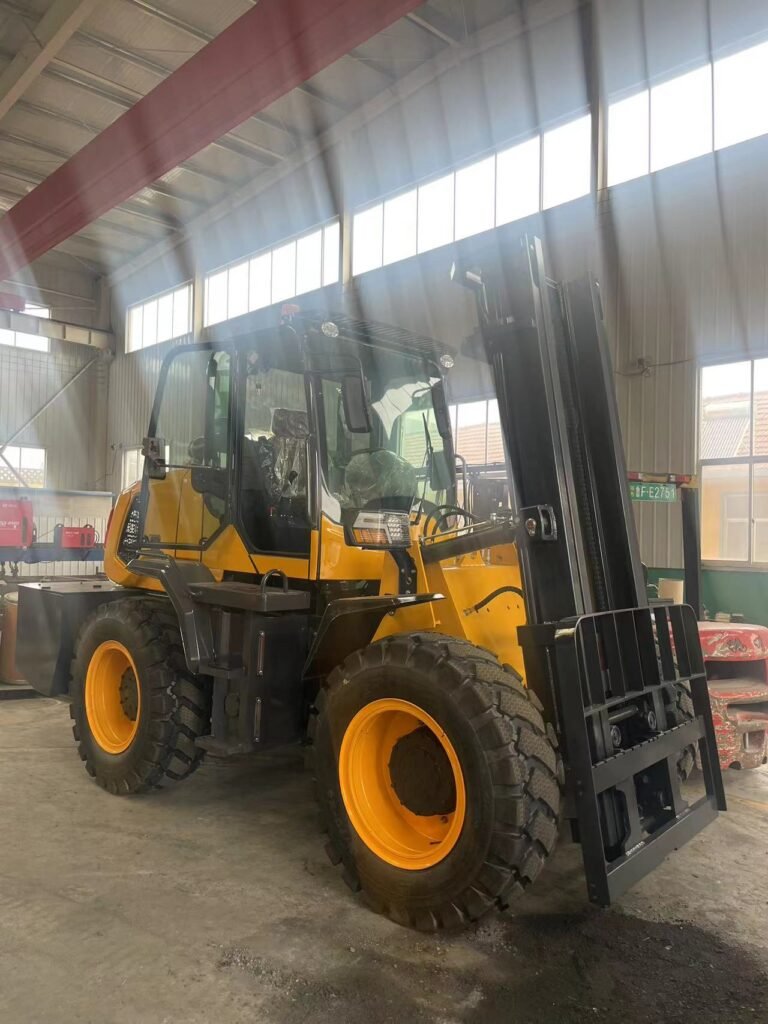
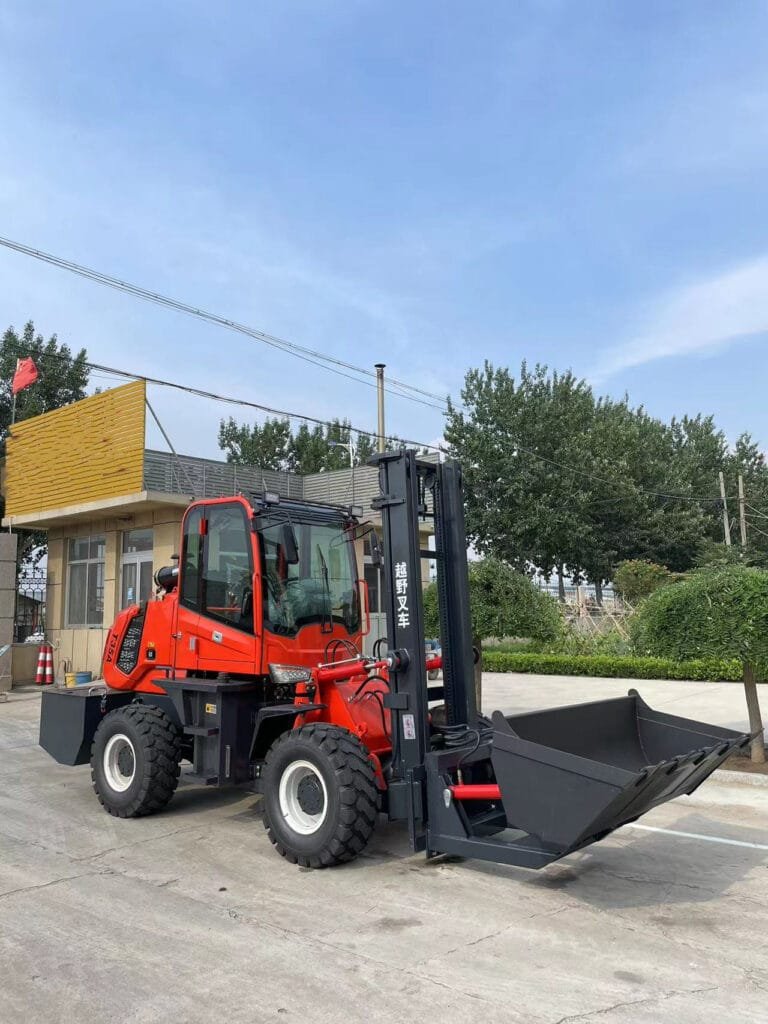
- Rough-terrain forklift (RT forklift): the classic construction/farm unit with big tires and a vertical mast
- Telehandler (variable-reach rough-terrain truck): telescopic boom + forks (and many attachments)
- Large pneumatic-tire forklift: more like a yard forklift with big tires, but not truly “off-road”
This matters because capacity, stability, and legal requirements change across these types. RT forklifts are commonly described as machines intended for unimproved natural terrain and disturbed construction surfaces.
2) Rough-Terrain Forklift vs Telehandler vs Big Pneumatic Forklift
Here’s the plain-English difference:
Rough-Terrain Forklift (mast type)
Best when: moving pallets, blocks, feed, fertilizer, and materials up and down, on uneven ground.
Strengths: simple, tough, usually faster to learn, great visibility forward, strong “carry” behavior.
Limitations: no forward reach; loading over a fence or into a truck from one side is harder.
Telehandler (variable reach)
Best when: lifting up and out—roof trusses, hay bales to a loft, placing materials over obstacles.
In Europe, telehandlers fall under EN 1459 family standards (variable-reach rough-terrain trucks).
Trade-off: more capability, but more training, more stability rules, more “load chart discipline.”
Big Pneumatic-Tire Forklift
Best when: hard yards, lumber yards, ports, recycling yards—still outdoors but relatively improved surfaces.
Trade-off: can be heavy and strong, but may not like mud, ruts, and slopes the way an RT forklift does.
If the job is construction sites + farms, most buyers are truly choosing between RT forklift vs telehandler.
3) Start Here: The 7 Questions That Prevent a Bad Purchase
Before looking at paint color, start with these:
- What’s the heaviest load actually lifted most days? (Not “maximum once a year.”)
- What’s the load shape and center of gravity? Pallet vs round bale vs stone vs long pipe.
- What’s the lift height you really need? Highest shelf? Truck bed? Barn loft?
- How rough is the ground—mud, gravel, slope, ruts?
- How tight is the work area? Turning radius and overall length become expensive mistakes.
- What attachments are required now (and later)? Forks only vs bucket vs jib vs bale clamp.
- Who will service it and how fast can parts arrive? This is where “cheap” becomes “costly.”
A solid spec comes from work reality, not from guessing capacity.
4) Capacity Isn’t the Real Number (Load center + load chart explained simply)
Many buyers get burned here.
4.1 The number on the sticker is tied to a “standard” load
Forklifts are rated at a specific load center (often 500 mm / 24 in). If the load sticks out farther—like big bales, long pallets, pipe bundles—the real safe capacity drops.
4.2 Load chart discipline (especially for telehandlers)
Telehandlers (and some RT models with higher lift) rely heavily on load charts. A machine might lift 3.5 tons close in, but much less at full height or forward reach.
Practical buyer rule:
- If loads are always compact pallets: rating is closer to reality.
- If loads are bales, long lumber, stone cages, or anything “bulky”: buy more capacity than the math suggests.
4.3 Don’t forget attachment weight
A side-shift, fork positioner, bale clamp, or bucket is not “free.” It reduces net lifting capacity.
What to request from any supplier:
- Rated capacity at your real load center
- Load chart or capacity table (mast type)
- Fork length and carriage class
- Attachment weight + derated capacity
5) Lift Height, Mast Type, and Visibility: What fits job sites vs farms
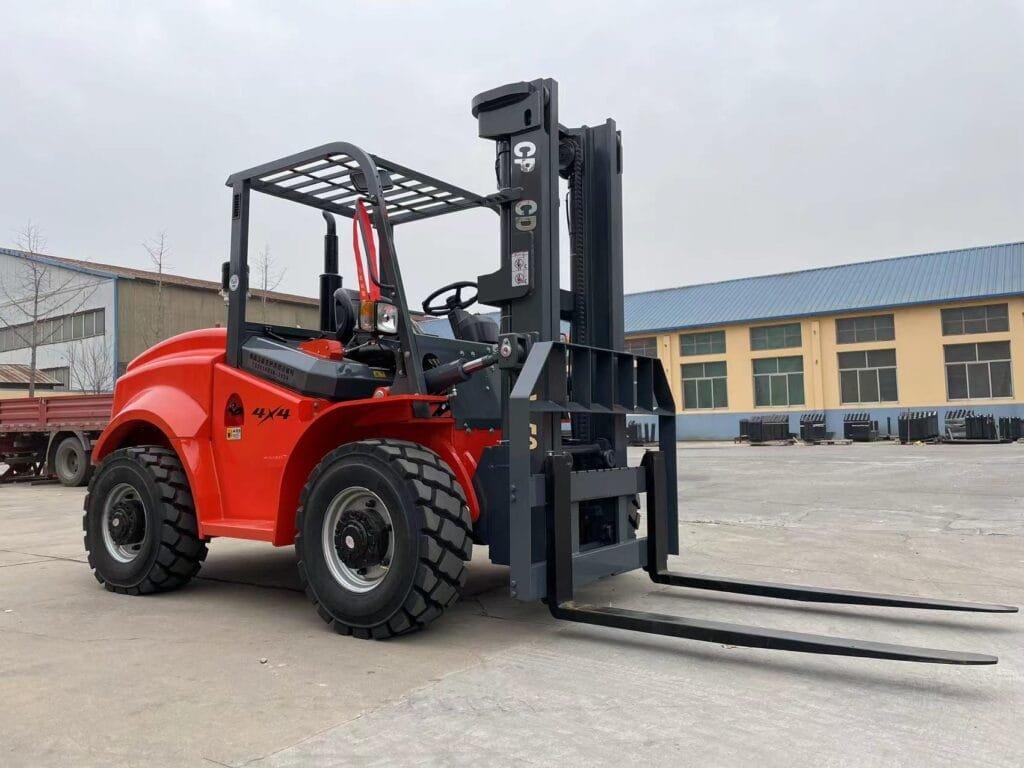
5.1 Mast selection (RT forklift)
Common mast types:
- Duplex (two-stage): good balance, often lower cost
- Triplex (three-stage): higher lift, better when working under low roofs because it can have lower collapsed height
Construction tip: higher lift is useful for loading trucks, stacking blocks, and placing materials on scaffolding areas.
Farm tip: barn doors and low beams punish tall collapsed mast height—triplex often helps.
5.2 Visibility is productivity
On uneven ground, operators naturally drive slower. Anything that worsens visibility (big cylinders, poor mast design, tall counterweight) reduces real output and increases risk.
Buyer check: sit in the cab and look:
- Can fork tips be seen at ground level?
- Is the right-front wheel visible?
- Are mirrors and lighting actually usable, not decorative?
6) Terrain Package: Tires, ground clearance, axle, and 2WD vs 4WD
Rough-terrain forklifts are typically described as having features like all-wheel drive and large flotation tires for disturbed outdoor surfaces.
6.1 2WD vs 4WD
- 2WD: cheaper, simpler, fine for flat gravel yards and dry farms
- 4WD: the safer bet for construction mud, slopes, wet grass, and ruts
If the machine will ever work on slopes with loads, 4WD + good tires is usually cheaper than stuck machines and bent forks.
6.2 Tire choices (what dealers don’t explain enough)
- Deep-tread pneumatic: best traction, softer ride
- Foam-filled pneumatic: puncture resistant, heavier, a bit harsher ride
- Solid tires: rarely right for real rough terrain; traction and comfort suffer
Many industry descriptions note that rough-terrain forklifts commonly use deep-tread pneumatic tires and may use foam-filled options for puncture resistance.
6.3 Ground clearance + approach angle
A machine that drags its belly over a ridge is not “all-terrain,” no matter what the brochure says. Ask for:
- Ground clearance (loaded and unloaded if possible)
- Approach/departure angles (or at least bumper height)
6.4 Axle and articulation feel
Some designs “hop” on rocks; others stay planted. Test drive on uneven ground with a moderate load—stability feel matters.
7) Hydraulics & Reliability: The stuff that decides uptime
This is where many Chinese machines can be either surprisingly good or painfully inconsistent, depending on factory discipline.
7.1 Pump + valve matching (smoothness and heat)
A forklift that lifts fine for 20 minutes but becomes sluggish and hot later often has:
- weak cooling layout, or
- mismatch between pump flow/pressure and valve settings, or
- poor filtration / contamination control
Buyer symptom checklist:
- Jerky mast lift at low throttle
- Slow tilt + noisy relief valve (constant bypass heat)
- “Fine when cold, weak when hot” (oil overheating or internal leakage)
7.2 Hose routing and leak control
On rough terrain, hoses see vibration and abrasion. A reliable machine usually has:
- proper clamps every reasonable interval
- abrasion sleeves near sharp edges
- predictable routing with service access
- quality fittings (and correct torque)
A small leak becomes a big bill because hydraulic oil attracts dirt, and dirt destroys seals.
7.3 Filtration: boring but critical
Ask for:
- hydraulic return filter spec
- suction strainer design
- whether there is a clog indicator
- recommended oil grade for your climate
It’s not about “brand names” only—it’s about the whole cleanliness culture.
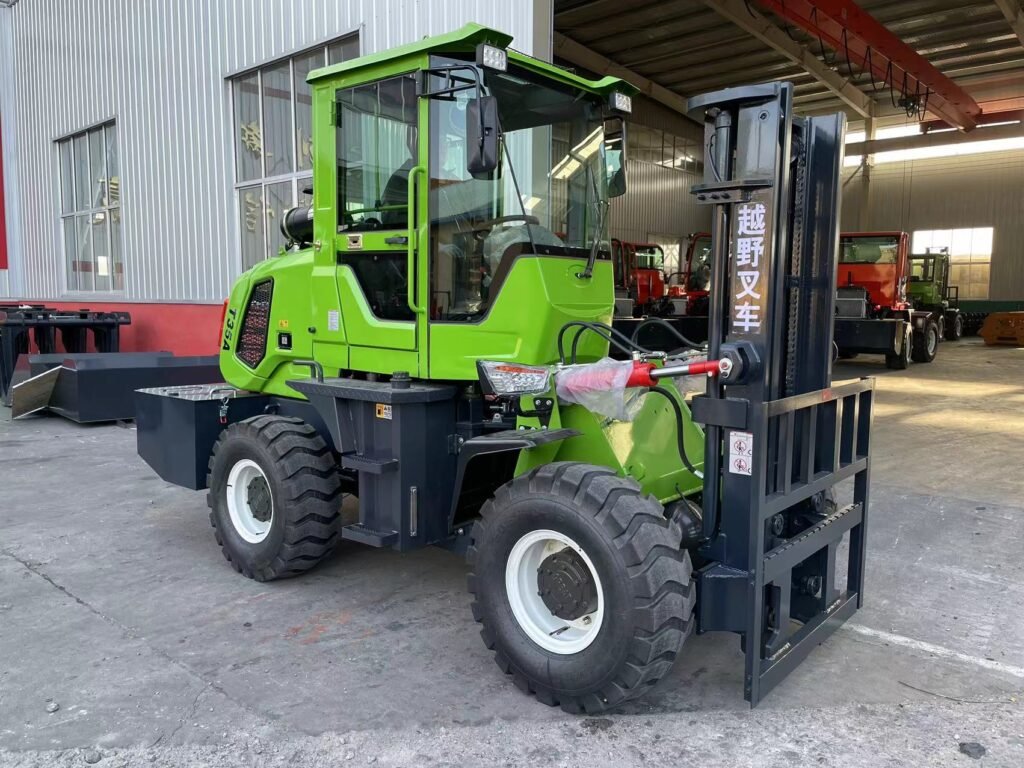
8) Powertrain, Cooling, and Emissions: avoiding “works in winter, overheats in summer”
8.1 Cooling package is not optional
Construction sites in summer + low travel speed + constant hydraulics = heat. A good cooling system includes:
- enough radiator and oil cooler area
- clean airflow path (no “hot air recirculation”)
- dust management (screens, easy cleaning access)
8.2 Transmission and axles: test under load
A rough-terrain forklift that shifts nicely empty can still struggle under load on a slope.
Field test that reveals truth:
- drive up a moderate incline with a real load
- stop, then restart smoothly without harsh shock
- check for smells, temperature warnings, or “hunting” shifts
8.3 Emissions paperwork (if importing)
Rules vary by country. What matters for buyers is not arguing online about “Tier/Stage,” but ensuring:
- the engine configuration matches local import requirements
- the supplier provides consistent engine serials and documentation
- the machine label and documents match (no “certificate theater”)
9) Safety & Compliance: what buyers should ask for (US/EU basics)
This section is intentionally practical, not legal advice.
9.1 North America: design and training are separate issues
In the US, powered industrial truck requirements are addressed under OSHA 29 CFR 1910.178, including operator training and certification expectations.
For rough-terrain forklift truck safety standards, ANSI/ITSDF B56.6 is commonly referenced as the safety standard for rough-terrain forklift trucks.
Buyer takeaway: even if the machine is good, the user company still needs training and evaluation processes.
9.2 Europe/UK: telehandler standards matter
Telehandlers (variable-reach rough-terrain trucks) are covered by EN 1459 family standards for safety requirements.
Some guidance documents also highlight that telehandler design is covered by BS EN 1459 (UK context) and warn against improper man-basket use unless correctly designed/approved.
Buyer takeaway: do not treat a telehandler like a “forklift with a long arm.” Compliance and attachments matter.
9.3 Simple safety spec to request from suppliers
Ask if the machine includes:
- ROPS/FOPS cab or overhead guard (depending on configuration)
- seat belt + interlock (if offered)
- load backrest, fork locking, clear capacity plate
- alarms, lighting, reverse buzzer, mirrors/camera options
- clear operator manual in your language
10) Attachments for Construction and Agriculture (what’s worth paying for)
10.1 Construction favorites
- Fork positioner + side shift: huge time saver placing pallets precisely
- Jib boom hook: for lifting trusses, rebar cages, or big bundles
- Bucket (if designed for it): turning the forklift into a light material handler
10.2 Agriculture favorites
- Bale clamp or bale spear: depends on bale type and local practice
- Manure/utility bucket: handy, but only if the machine’s front end and hydraulics are intended for it
- Quick-attach carriage: makes a forklift more “farm flexible”
10.3 The “attachment trap”
If a supplier says “anything is possible,” that’s not always good news. The safe approach:
- match attachment flow/pressure
- confirm carriage class and locking method
- confirm capacity derating with attachment installed
- ensure hoses are protected and routed safely
11) Serviceability: parts, hose routing, grease points, and “downtime math”
A buyer can forgive a scratch. Buyers can’t forgive lost season.
11.1 Maintenance access
Look for:
- flip-up hood with room to work
- easy radiator cleaning
- grease points grouped and reachable
- clear hydraulic test ports (if available)
- standard filters (not strange one-off parts)
11.2 Spares package that actually makes sense
For a new import, a practical starter kit often includes:
- filter set (engine oil, fuel, air, hydraulic)
- common seals and hose kit (site-specific)
- spare forks pins/locks, bulbs/fuses, belts
- 1–2 critical sensors (if electronic controls are used)
This costs little compared to a machine sitting idle for two weeks.
12) Inspection Checklist for Chinese Suppliers (factory reality, not brochure words)
Many buyers worry about inconsistent quality and “certificate games.” Those fears are valid in the market. The solution is to inspect what matters.
12.1 What to verify before paying a deposit
- factory address matches documents
- production capability (not just a trading office)
- engine brand/model options are real and traceable
- capacity plate and spec sheet match a serial number format
12.2 What to verify during production (or before shipment)
- weld quality at mast frame, carriage, axle mounts
- hydraulic hose routing and clamp density
- paint prep quality (rust under paint is a future headache)
- functional test: cold start, hot run, lifting cycles, tilt, steering lock-to-lock
- leakage check after a warm run
12.3 Paperwork discipline
Insist that:
- machine serial number appears on documents
- engine serial appears where required
- manuals and parts books are included
- packing list matches the container reality
13) Buying Plan: spec sheet, contract, pre-shipment inspection, and spares package
A clean purchasing workflow reduces risk more than arguing about price.
Step 1: Build a one-page “job profile”
- load types + maximum + typical
- ground conditions + slope
- lift height target
- attachments list
- climate range (hot/cold/dust)
Step 2: Freeze the spec
- capacity at load center
- mast type + lift height
- 2WD/4WD + tires
- cab/open canopy
- lighting + safety options
- attachments + quick attach standard
Step 3: Put inspection points into the contract
- performance checks
- leakage criteria
- documentation list
- spare parts kit
Step 4: Do a pre-shipment inspection (PSI)
Even a simple checklist PSI catches the expensive surprises.
14) Where Nicosail Fits (without turning this into an ad)
When buyers look at Chinese all-terrain forklifts, the real question is usually: “Will it keep working when the season gets busy?”
A supplier like Nicosail tends to fit best when the buyer wants:
- a factory-managed build process (not random outsourcing)
- practical configuration options (tires, mast, cab, hydraulics, attachments)
- a clearer inspection and documentation workflow for export markets
The smart approach is to treat Nicosail the same way as any serious supplier: request the spec, request inspection criteria, and compare how clearly the supplier answers. A supplier that can explain hose routing, cooling layout, and parts support in plain language is often the one that causes fewer headaches later.
15) FAQ
Q1: Is a “rough-terrain forklift” the same as an “all-terrain forklift”?
Often yes in casual speech. Many people use “all-terrain” as a friendly term for rough-terrain forklifts, which are designed for unimproved and disturbed outdoor ground.
Q2: Should a farm buy a telehandler instead of a rough-terrain forklift?
If the job needs reach (up and out)—stacking high, loading lofts, placing bales over obstacles—a telehandler can be worth it. If most work is pallet handling and short lifts on rough ground, an RT forklift is often simpler and cheaper to maintain.
Q3: What’s the biggest buying mistake?
Buying based on rated capacity alone without checking load center, attachment weight, and real working conditions.
Q4: Do operators need special training?
In the US, OSHA requires powered industrial truck operators to be trained and evaluated, and it outlines training expectations in 29 CFR 1910.178(l). Other countries have their own rules, but training is always a good idea.
Q5: What documents should be demanded from an exporter?
At minimum: serial-matched invoice/packing list, operator manual, parts book, and any required compliance paperwork for the destination market. Also ensure engine details are consistent and traceable.
Q6: What options pay for themselves fastest?
Usually: 4WD (if ground is soft), foam-filled tires (if punctures are common), side shift/fork positioner (for construction handling), and a sensible spare parts kit.
Q7: How to compare Chinese suppliers fairly?
Use the same inspection checklist for all: weld zones, hose routing, cooling layout, hot-run test, leakage check, and documentation discipline. The clearest answers usually indicate the most stable quality system.
16) Summary
A Chinese all-terrain forklift can be a strong purchase for construction and agriculture—if the selection is driven by real job conditions and verified with simple, practical inspection steps. The key decisions are not paint and decals; they’re load reality (load center), stability, tires/4WD, cooling, hydraulic cleanliness, service access, and documentation discipline. Narrow the machine type (RT forklift vs telehandler), lock the spec, require a pre-shipment inspection, and buy a smart spares kit. For buyers who want export-ready discipline with flexible configuration, brands like Nicosail are worth comparing—using the same hard checklist used for any serious supplier.