Introduction
A rough terrain forklift is built for places where a normal warehouse forklift should never work. Construction sites, farms, yards, road projects, timber areas, and material storage zones often have mud, gravel, slopes, holes, loose soil, and uneven ground. In these conditions, a rough terrain forklift can move pallets, blocks, pipes, bricks, feed, timber, and other heavy materials more efficiently than manual labor or small lifting tools.
But difficult terrain also brings real risk.
A forklift that works safely on flat concrete may become unstable on a muddy slope. A load that feels balanced on firm ground may shift when the machine crosses a rut. A small hole under one tire can change the machine’s balance quickly. In many accidents, the problem is not only the machine. The problem is poor ground judgment, wrong driving habits, overconfidence, or lack of daily inspection.
Operating a rough terrain forklift well is not about driving fast. It is about keeping control.
Good operators think about ground condition, load weight, tire grip, mast position, slope angle, turning space, visibility, and machine limits before every movement. Good buyers and rental companies also understand that safety depends on the machine’s structure, hydraulic condition, braking system, tire quality, parts support, and maintenance access.
This article explains practical best practices for operating a rough terrain forklift in difficult terrain. It is written for contractors, builders, farmers, landowners, rental users, and job-site teams who want better safety, longer machine life, and fewer costly mistakes.
Why Rough Terrain Forklifts Need Different Operating Habits
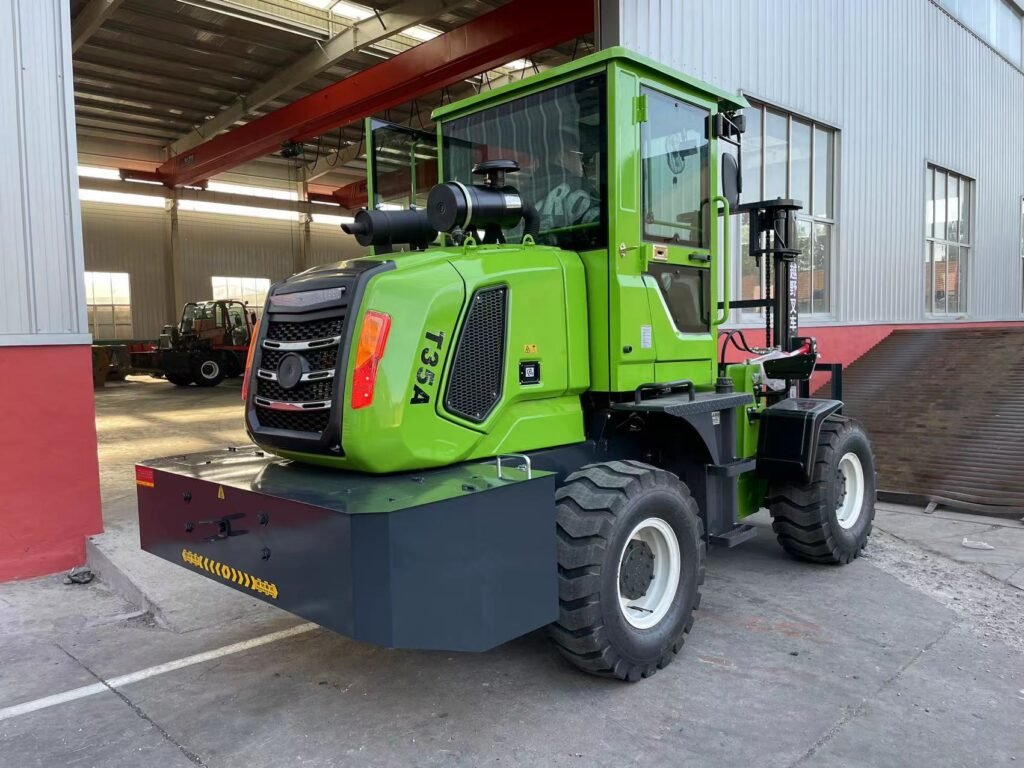
A rough terrain forklift is designed for outdoor lifting and transport. It usually has larger tires, higher ground clearance, stronger traction, and a more rugged structure than an indoor forklift. Some models use two-wheel drive, four-wheel drive, articulated steering, or telescopic boom design depending on the application.
However, “rough terrain” does not mean “no limit.”
Difficult ground changes machine behavior. The operator must adjust speed, turning, load height, braking, and route planning.
The Ground Is Part of the Lifting System
Many operators only think about the forklift and the load. In difficult terrain, the ground is just as important.
A forklift needs stable contact with the ground. If one tire sinks into mud or climbs onto a stone, the machine may tilt. If the ground is soft under one side, the load may lean. If the surface breaks under the front wheels, the forklift can lose balance.
Before lifting or traveling, the operator should ask:
- Is the ground firm enough?
- Is there hidden soft soil?
- Are there holes or ruts?
- Is the slope safe?
- Can the machine stop if needed?
- Is there enough turning space?
A powerful machine cannot fix weak ground. It can only make the problem happen faster if operated carelessly.
Outdoor Loads Are Often Less Predictable
On construction and farm sites, loads are not always neat warehouse pallets. Materials may be wet, uneven, loose, damaged, or stacked badly. Long pipes, bricks, stone, timber, and bags may shift during travel.
This means the operator must check the load before lifting. The forks must enter correctly, the load must sit against the backrest, and travel speed must stay low.
Stability Changes Quickly
Forklift stability depends on load weight, load center, lifting height, steering angle, ground condition, and movement. On rough terrain, these factors change constantly.
The safest habit is simple:
Keep the load low, drive slowly, turn gently, and avoid sudden movement.
That rule sounds basic, but it prevents many dangerous situations.
Know the Machine Before Entering Difficult Terrain
A rough terrain forklift may look simple, but every model has limits. Before operating, the user should understand the machine’s basic design and working range.
Understand Rated Capacity
Rated capacity is not just a number painted on the machine. It depends on load center, lifting height, attachment, and machine configuration.
A forklift may lift a certain weight at a standard load center on level ground. That does not mean it can safely lift the same load on a slope, with long forks, or with the mast raised high.
Operators should check the load chart or machine plate before lifting heavy materials. Rental companies should make sure users understand this before sending a machine to site.
Know the Machine’s Drive Type
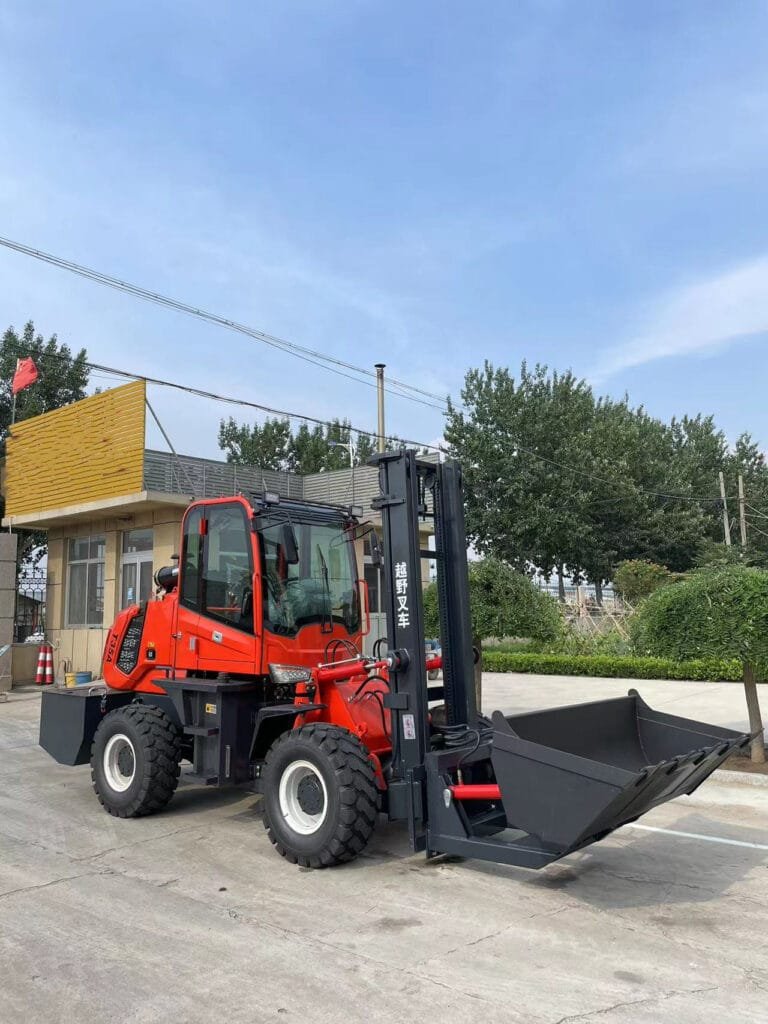
Different machines behave differently:
- Two-wheel drive rough terrain forklifts may work well on firm outdoor yards but can struggle in deep mud.
- Four-wheel drive models offer better traction in soft or uneven ground.
- Articulated or telescopic machines may provide better reach but require careful stability control.
- Compact machines are easier to move in narrow areas but may have lower lifting capacity.
The right driving habit depends on the machine type. A compact machine should not be treated like a heavy telehandler. A high-capacity machine should not be driven carelessly just because it feels strong.
Check Ground Clearance
Ground clearance helps the forklift pass over rough surfaces, but it does not make the machine unstoppable. High ground clearance also means the center of gravity may be higher than a low warehouse forklift.
When driving over ruts, stones, and uneven soil, the operator should move slowly. Hitting an obstacle at speed can cause bouncing, load movement, tire damage, or loss of control.
Understand Braking and Steering Response
On loose gravel or wet soil, braking distance increases. Steering may also feel delayed or lighter than on firm ground.
A good operator tests movement slowly in a safe area before entering the work zone. This is especially important when using a rental machine or a new machine.
Inspect the Ground Before Driving In
Many rough terrain forklift problems begin before the machine moves. The operator drives into a bad area without checking it first.
Ground inspection does not need to be complicated. It needs to be honest and practical.
Walk the Route First
Before carrying a load, walk the travel path when possible. Look for:
- Soft mud
- Deep ruts
- Loose stones
- Hidden holes
- Water-filled depressions
- Broken concrete
- Steep slopes
- Narrow turning points
- Overhead wires or low structures
- People working nearby
A few minutes of checking can prevent hours of recovery work if the forklift gets stuck or tips.
Identify Soft Ground
Soft ground is dangerous because it may look acceptable on the surface. A forklift carrying a load puts heavy pressure on the front tires. If the soil cannot support that pressure, the tires may sink.
Warning signs include standing water, fresh backfill, loose sand, wet clay, deep tire marks, and ground that moves under foot.
If soft ground cannot be avoided, use proper ground preparation such as compacted fill, steel plates, timber mats, or another approved method suitable for the site.
Watch for Edges and Trenches
Forklifts should stay away from trench edges, drainage ditches, pits, and unstable embankments. The ground near an edge can collapse under weight, especially after rain or excavation.
A rough terrain forklift may feel stable until the front tire breaks the edge. By then, recovery may be difficult and dangerous.
Plan the Turning Area
Turning is one of the most dangerous actions on rough ground. A forklift becomes less stable when turning, especially with a raised or heavy load.
The route should allow wide, slow turns. If the space is too tight, it may be safer to reposition materials, improve access, or use a different machine.
Pre-Operation Checks That Prevent Big Problems
A rough terrain forklift works in dust, mud, vibration, and impact. Daily inspection is not paperwork. It is protection for the operator, the machine, and the site.
Check Tires First
Tires are the machine’s contact with the ground. Poor tires reduce traction and stability.
Before operation, check:
- Tire pressure
- Tire cuts or cracks
- Uneven wear
- Missing tread blocks
- Stones stuck in tread
- Loose wheel nuts
- Sidewall damage
For pneumatic tires, wrong pressure can affect stability and tire life. For foam-filled or solid tires, damage should still be inspected carefully.
Check Brakes and Parking Brake
Brakes must work properly before the machine enters a slope or loaded travel path. The parking brake should hold the machine when stopped.
A weak brake on flat ground becomes a serious danger on a muddy incline.
Check Steering
Loose steering, delayed response, or unusual noise should not be ignored. On difficult terrain, small steering problems become larger because the operator already has less surface control.
Check Forks and Carriage
Forks carry the load directly. Check for cracks, bending, worn heels, damaged locking pins, and uneven fork height.
A damaged fork should not be used. It may fail under load without warning.
Check Hydraulic System
Hydraulic leaks, slow lifting, drifting mast, or unusual pump noise should be handled before work starts. A load that slowly drops or tilts during travel is dangerous.
For machines supplied for rental or export projects, hydraulic hose routing, sealing quality, and maintenance access are part of invisible reliability. Nicosail usually encourages buyers to confirm configuration and maintenance needs before shipment, especially when machines are used in outdoor material handling.
Check Lights, Horn, Alarm, and Mirrors
Difficult terrain often means busy sites with limited visibility. Warning devices matter. The horn, reverse alarm, lights, mirrors, and camera system, if equipped, should be working before operation.
Best Practices for Driving on Mud, Gravel, Sand, and Soft Soil
Different terrain needs different driving habits. The operator must adjust instead of using one style everywhere.
Operating on Mud
Mud reduces traction and can hide holes. The forklift may slide, sink, or lose steering control.
Best practices include:
- Keep speed low
- Avoid sudden acceleration
- Avoid sharp turns
- Keep the load low
- Use four-wheel drive if available
- Avoid deep mud with heavy loads
- Do not spin the tires aggressively
- Reverse carefully if traction is lost
Spinning tires may dig the machine deeper. If the forklift gets stuck, forcing it harder can damage tires, axles, transmission, or the ground. Stop early and use proper recovery methods.
Operating on Gravel
Loose gravel can make braking and steering less predictable. The surface may shift under the tires.
Drive slowly and leave more stopping distance. Avoid turning while braking. If carrying a heavy load, keep movement smooth and avoid sudden direction changes.
Operating on Sand
Sand can reduce traction and increase rolling resistance. A forklift may sink, especially with a front-heavy load.
Avoid soft sand when possible. Use prepared paths or ground mats for repeated travel. Keep the machine moving gently without sudden stops, but never drive fast. If the sand is too loose, another lifting method may be safer.
Operating on Wet Grass or Farm Ground
Wet grass can be slippery, especially on slopes. Farm ground may have hidden holes, soft patches, or buried debris.
Use low speed and avoid side-slope travel. Carry loads close to the ground. If the machine begins to slide, do not make sudden steering or braking movements.
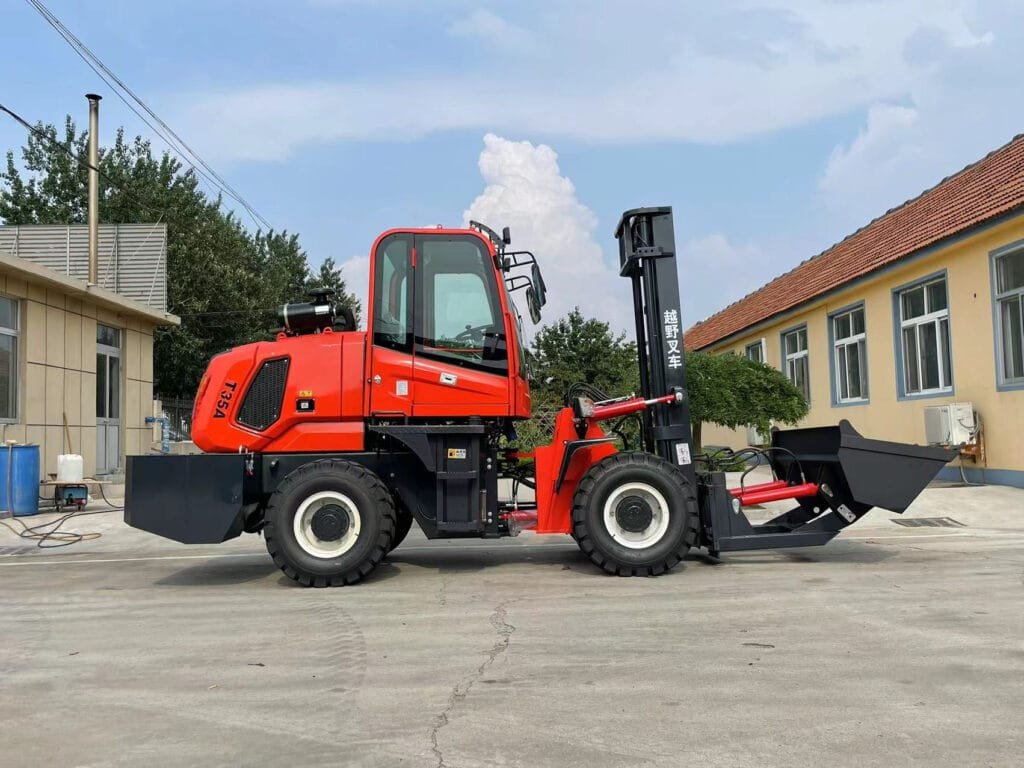
Operating on Broken Concrete or Demolition Areas
Broken concrete can damage tires and create sudden bumps. Sharp debris may puncture tires or hit the undercarriage.
Clear the route before travel. If the site cannot be cleared, drive slowly and avoid carrying loads higher than necessary.
Safe Operation on Slopes and Uneven Ground
Slopes are one of the most dangerous working conditions for a rough terrain forklift. Even a small slope can become risky with a heavy or raised load.
Keep the Load Facing Uphill
When traveling on a slope with a load, the load should generally face uphill. This helps keep the load on the uphill side and reduces the chance of forward tipping.
When traveling without a load, follow the machine manufacturer’s instructions. Different machines may have different recommendations.
Avoid Driving Across Slopes
Side slopes are dangerous because they increase rollover risk. If possible, drive straight up or straight down instead of across the slope.
If the job requires working near a side slope, the route should be improved or another machine should be considered.
Never Turn Sharply on a Slope
Turning changes the forklift’s stability. Turning on a slope is especially risky.
If direction must change, move to level ground first. Make the turn slowly, then continue.
Keep the Mast Low
A raised load increases the center of gravity. On a slope or uneven surface, this can quickly become dangerous.
Travel with the load low and tilted back slightly, according to safe operating practice and machine design.
Avoid Sudden Braking
Sudden braking can shift the load and reduce stability. On loose or wet ground, it can also cause sliding.
Plan the route so the forklift does not need emergency braking. Keep people and obstacles away from the travel path.
Load Handling Best Practices in Difficult Terrain
A rough terrain forklift is often used because materials are heavy and the site is not flat. This makes correct load handling very important.
Know the Weight Before Lifting
Guessing load weight is a common mistake. Wet materials, dense stone, steel parts, and packed bags can be heavier than they look.
Before lifting, confirm the approximate weight. If the weight is unknown and the load feels unstable, stop and check before continuing.
Respect Load Center
A long load places weight farther from the mast. This reduces safe lifting capacity. Long forks, fork extensions, or attachments can also change the load center.
Even if the total weight is within the machine’s rated capacity, the forklift may become unstable if the load center is too far forward.
Keep the Load Against the Backrest
The load should sit fully on the forks and close to the carriage. A load placed near the fork tips is much more dangerous.
If the forks cannot enter fully, use another method or adjust the load position. Do not travel over rough ground with a half-supported load.
Secure Loose Materials
Loose bricks, pipes, boards, and bags may shift when crossing bumps. Use proper pallets, straps, crates, or handling attachments when needed.
The operator should not rely only on careful driving if the load itself is unstable.
Lift Only When the Machine Is Stable
Do not lift high while the machine is on uneven or soft ground. High lifting should be done on firm, level ground whenever possible.
If the load must be placed at height, such as onto a truck or platform, level the machine position first and check surroundings carefully.
Do Not Carry People on Forks
Forks are for materials, not people. Carrying workers on forks is dangerous and should not be allowed. Use approved work platforms only when permitted by local rules and the machine setup.
Visibility, Communication, and Job-Site Control
Difficult terrain often comes with poor visibility. Dust, rain, stacked materials, parked vehicles, and busy workers can all increase risk.
Use a Spotter When Needed
When the operator cannot see clearly, a trained spotter should guide movement. The spotter should stand in a safe visible position and use clear signals.
The operator and spotter should agree on signals before work begins. If visual contact is lost, the forklift should stop.
Keep People Away from the Work Zone
No person should stand under a raised load or walk close to the forklift during movement. The work area should be marked or controlled, especially in public or shared job sites.
Travel in Reverse When Forward Visibility Is Blocked
If the load blocks forward view, travel in reverse when safe and practical. Use mirrors, alarms, and spotters where needed.
Never continue forward blindly because the travel distance is short. Many accidents happen during “only a few meters” of careless movement.
Control Dust and Noise
Dust can reduce visibility and damage machine components. On dry sites, route planning and surface preparation can reduce dust. Operators should also keep air filters and radiator areas clean.
Noise can make communication harder. In loud areas, hand signals or radios may be needed.
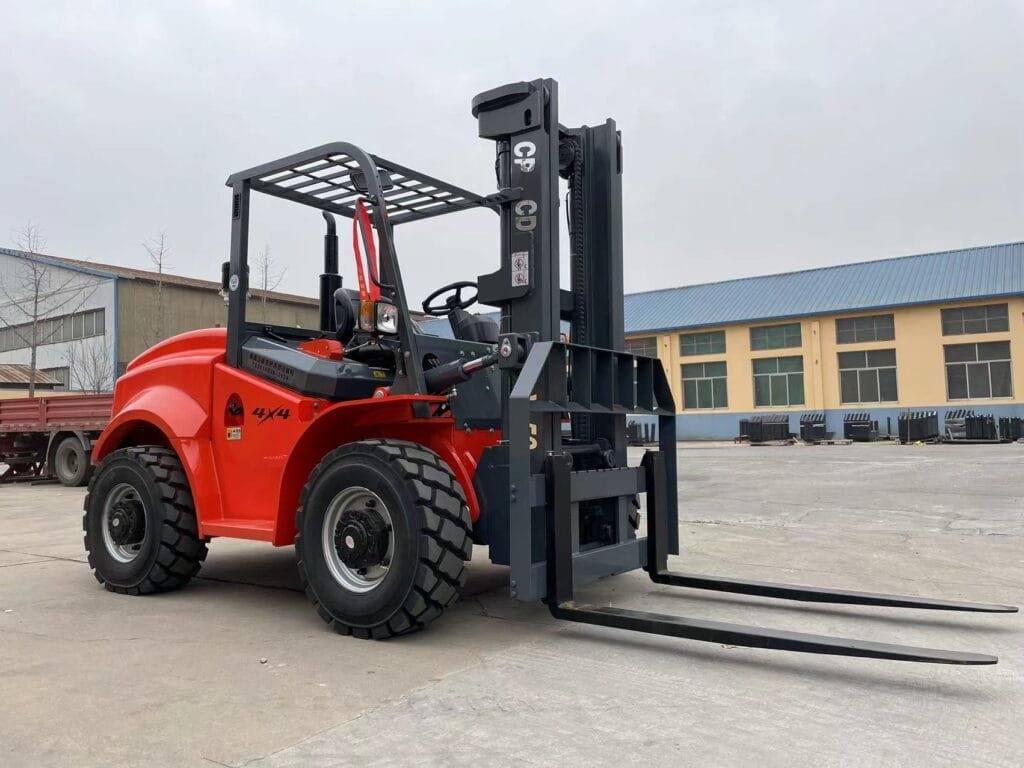
Common Operating Mistakes to Avoid
Mistake 1: Driving Too Fast
Speed is the enemy of control on difficult terrain. Fast driving increases bouncing, load movement, braking distance, and rollover risk.
A rough terrain forklift is a lifting machine, not a racing vehicle.
Mistake 2: Traveling with the Load Too High
A high load raises the center of gravity and reduces stability. This is dangerous on bumps, slopes, and turns.
Travel low. Lift high only when placing or picking the load.
Mistake 3: Turning on Uneven Ground
Sharp turning on uneven ground can make one side of the forklift lift or slide. Always slow down before turning and choose the flattest possible area.
Mistake 4: Ignoring Small Leaks or Noises
A small hydraulic leak, brake noise, or steering problem can become serious during loaded operation. Difficult terrain puts more stress on the machine.
Operators should report problems early. Owners should repair them before they cause downtime or safety issues.
Mistake 5: Overloading Because the Machine Feels Strong
Many rough terrain forklifts feel powerful. That does not mean they can ignore rated capacity.
Overloading damages the machine and increases tipping risk. It also reduces braking and steering control.
Mistake 6: Using the Wrong Attachment
Attachments change capacity and balance. Fork extensions, buckets, clamps, and lifting hooks must match the machine and job.
Using unapproved or badly matched attachments can create serious risk.
Maintenance Tips for Rough Terrain Forklift Reliability
Good operation and good maintenance must work together. A rough terrain forklift that works in mud and dust needs more careful service than a machine used only on clean concrete.
Clean the Machine After Muddy Work
Mud holds moisture and can hide damage. It can also block cooling areas and add weight around the undercarriage or wheels.
After muddy work, clean key areas such as tires, axles, brakes, radiator screens, steps, lights, and hydraulic hose zones.
Grease Moving Points Regularly
Rough terrain creates vibration and shock. Pins, bushings, mast rollers, steering joints, and lifting points need correct lubrication.
Poor greasing leads to wear, noise, loose movement, and expensive repairs.
Check Air Filters More Often in Dusty Areas
Dusty sites can clog air filters quickly. A clogged air filter affects engine performance and fuel efficiency.
Operators should follow service intervals, but in severe dust, inspection should be more frequent.
Inspect Hydraulic Hoses and Fittings
Hydraulic hoses work under pressure and movement. Rough terrain can cause rubbing, cracking, or impact damage.
Replace damaged hoses before failure. A burst hose can stop the job and create safety hazards.
Monitor Tire Condition
Tires affect traction, stability, ride comfort, and fuel use. Tire damage should be taken seriously.
For rental fleets, tire inspection is especially important because different users may operate in very different conditions.
Keep Spare Parts Ready
Common spare parts such as filters, hoses, seals, lights, switches, and tire-related parts should be available. Waiting too long for simple parts can stop the whole job.
For overseas buyers, parts preparation should be discussed before shipment. Nicosail can support buyers with configuration discussion and common spare parts planning based on machine use, which is useful for contractors, farms, and rental businesses.
Choosing the Right Machine and Supplier
Operating best practices start with the right machine. A forklift that is too small, poorly configured, or difficult to service will create problems even with a careful operator.
Match the Machine to the Job
Before purchasing or renting, consider:
- Maximum load weight
- Load size and shape
- Ground condition
- Slope condition
- Travel distance
- Lifting height
- Turning space
- Indoor and outdoor use
- Tire type
- Attachment needs
- Local service ability
The cheapest machine may not be the most economical. If it gets stuck often, lifts slowly, wears tires quickly, or cannot handle the load safely, the real cost becomes higher.
Check Build Details, Not Only Paint
Paint and decals are easy to see. Important reliability is often hidden.
Buyers should pay attention to:
- Frame strength
- Mast structure
- Fork quality
- Hydraulic smoothness
- Hose routing
- Brake system
- Cooling design
- Maintenance access
- Electrical protection
- Tire specification
This is “invisible reliability.” It is not always obvious in photos, but it decides how the machine performs after months of outdoor use.
Ask About Packaging and Shipping
For export buyers, shipping protection matters. Machines should be fixed properly for transport. Attachments, spare parts, and documents should be packed clearly.
Poor packaging can damage lights, mirrors, covers, hydraulic parts, or paint before the machine even reaches the buyer.
Confirm After-Sales Support
Good after-sales support does not mean every problem disappears. It means the supplier can communicate clearly, provide parts information, help identify issues, and support long-term use.
Nicosail, as a China-based factory supplier of compact construction machinery, focuses on practical communication before shipment, including configuration, customization, packaging, and spare parts discussion. For buyers in Europe, North America, Australia, and other markets, this preparation helps reduce purchase risk.
9. FAQ
Q1: Can a rough terrain forklift work safely in mud?
Yes, but only if the mud is not too deep or unstable. The operator should drive slowly, avoid sharp turns, keep the load low, and stop early if the machine starts to sink or lose traction.
Q2: Is four-wheel drive necessary for difficult terrain?
Four-wheel drive is very useful for muddy, soft, or uneven ground. However, it does not make the forklift safe in every condition. Ground inspection and correct operation are still necessary.
Q3: Should the load face uphill on a slope?
When traveling on a slope with a load, the load should generally face uphill. This helps improve stability. Operators should also follow the specific machine instructions and local safety rules.
Q4: What is the biggest mistake when operating a rough terrain forklift?
One of the biggest mistakes is driving too fast with the load raised. This greatly increases rollover risk, especially on uneven ground or slopes.
Q5: Can a rough terrain forklift lift the same weight on uneven ground as on flat ground?
Not always. Rated capacity is usually based on controlled conditions. Uneven ground, slopes, attachments, and long load centers can reduce safe working capacity.
Q6: How often should a rough terrain forklift be inspected?
A basic inspection should be done before each working shift. Tires, brakes, steering, forks, hydraulics, lights, and safety devices should be checked before operation.
Q7: Are rough terrain forklifts suitable for farms?
Yes, they can be very useful on farms for moving feed, pallets, materials, pipes, timber, and equipment. The machine should be selected according to ground condition, load weight, and working space.
Q8: What should buyers check before purchasing a rough terrain forklift?
Buyers should check lifting capacity, tire type, drive system, mast height, hydraulic performance, brake system, maintenance access, parts supply, packaging, and supplier communication.
10. Final Conclusion
A rough terrain forklift is a valuable machine for construction sites, farms, yards, and outdoor material handling. It can save labor, improve efficiency, and move heavy materials in places where ordinary forklifts cannot work.
But difficult terrain requires careful operation.
The safest and most efficient operators do not rely only on machine power. They inspect the ground, understand the load, keep the mast low during travel, avoid sudden movement, drive slowly on slopes, and stop when conditions become unsafe. They also report small machine problems before they become serious failures.
For owners, contractors, rental companies, and landowners, long-term reliability depends on both good operating habits and good machine selection. Tires, brakes, hydraulics, forks, cooling, parts support, and maintenance access all matter in real outdoor work.
A rough terrain forklift is most productive when the machine, operator, ground condition, and load plan all match each other. With the right practices, it can become a dependable partner for difficult job sites and heavy daily material handling.