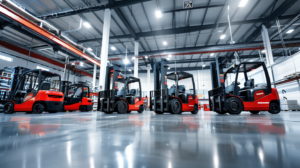
Rough terrain forklifts are built for places where normal forklifts struggle. Muddy yards, farms, stone yards, unfinished construction sites, timber areas, outdoor storage fields, and uneven ground are exactly where these machines earn their keep. They are strong, practical, and often the fastest way to move heavy materials where pavement is limited or the surface is simply too rough.
But there is another side to the story.
More buyers today are asking about environmental impact before placing an order. That is happening for a few simple reasons. Fuel costs are rising. Jobsite regulations are getting tighter. End customers care more about noise and emissions. Rental companies want machines that are easier to place in more markets. Importers want to avoid being stuck with equipment that looks cheap up front but causes trouble later.
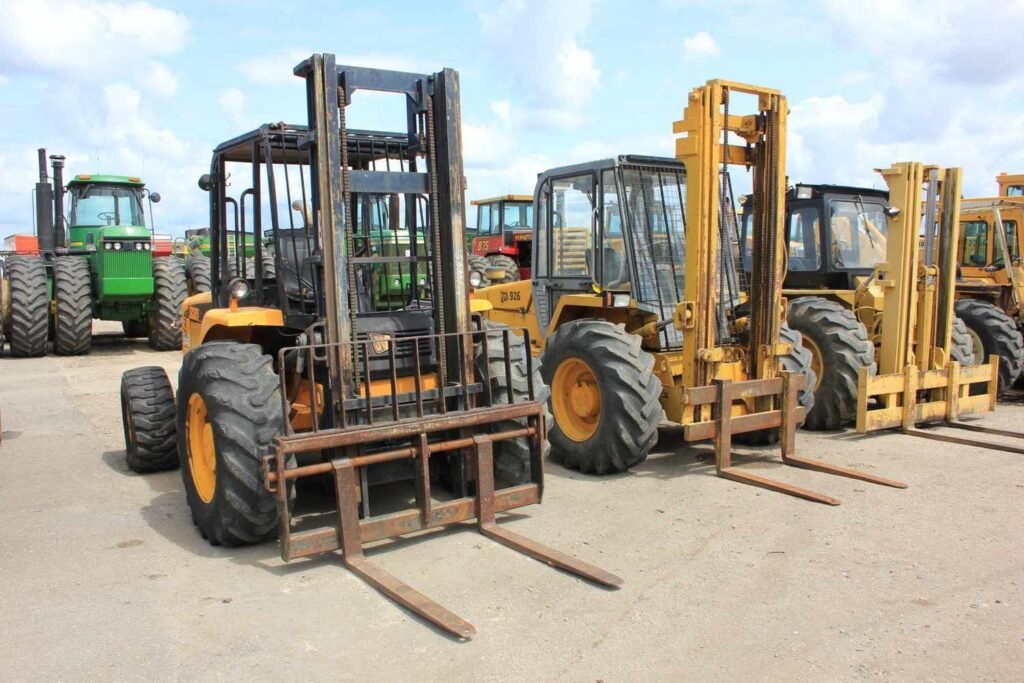
That is why the environmental impact of China rough terrain forklifts has become an important topic.
This is not only about “green marketing.” It is really about practical buying. A forklift that burns too much fuel, leaks oil, damages the ground, creates too much noise, or needs constant repair is not just bad for the environment. It is also bad for business.
The good news is this: the environmental impact of a rough terrain forklift is not decided by one single point. It is shaped by the engine, machine weight, tire setup, hydraulic system, operator habits, maintenance quality, and how well the machine matches the job.
That means buyers have room to make better decisions.
This guide breaks the subject down in plain English. It covers what really affects the environment, where Chinese-made rough terrain forklifts fit in the market, what buyers should watch out for, and how a brand like Nicosail can be part of a more practical and responsible equipment strategy.
Why Environmental Impact Now Matters More Than Ever
A few years ago, many buyers only looked at lifting capacity, price, and delivery time. Those three points still matter, of course. But now environmental impact has moved closer to the front of the conversation.
That is especially true for dealers, importers, rental businesses, contractors, farms, and building material companies working in Europe, North America, and Australia.
Why? Because the market is changing.
Customers are asking harder questions. They want to know how much fuel the machine uses. They want to know whether it can work near residential areas without creating too much noise. They want to know if it will tear up the ground. They want to know if there are cleaner engine options or better hydraulic designs.
And honestly, these are fair questions.
A rough terrain forklift is usually used outdoors in places where the machine has direct contact with soil, gravel, mud, water runoff areas, and open-air work zones. So its environmental effect is often more visible than a machine working quietly inside a warehouse.
For B2B buyers, this matters in another way too. A machine with lower environmental burden is often easier to resell, easier to rent out, and easier to place in projects where site rules are getting stricter.
So this topic is not just about compliance. It is also about long-term business sense.
What Rough Terrain Forklifts Are Really Used For
Before talking about environmental impact, it helps to understand where these forklifts are normally used.
A rough terrain forklift is not a warehouse truck with big tires. It is made for outdoor work where the ground is uneven, soft, wet, loose, or unstable. These machines are common in:
- construction sites
- brick and block yards
- farms and orchards
- timber and lumber yards
- stone and landscape material businesses
- equipment yards
- rural property development projects
- outdoor industrial handling work
They are chosen because they can carry loads over surfaces that would stop a normal forklift almost immediately.
That strength comes with trade-offs. Rough terrain forklifts are often heavier, use larger tires, have stronger drivetrains, and need more power to do their job. All of that can increase environmental impact if the machine is poorly designed or poorly managed.
So the question is not whether a rough terrain forklift has any impact. Of course it does. The real question is how much impact it has, and whether the buyer is choosing a machine that keeps that impact under control.
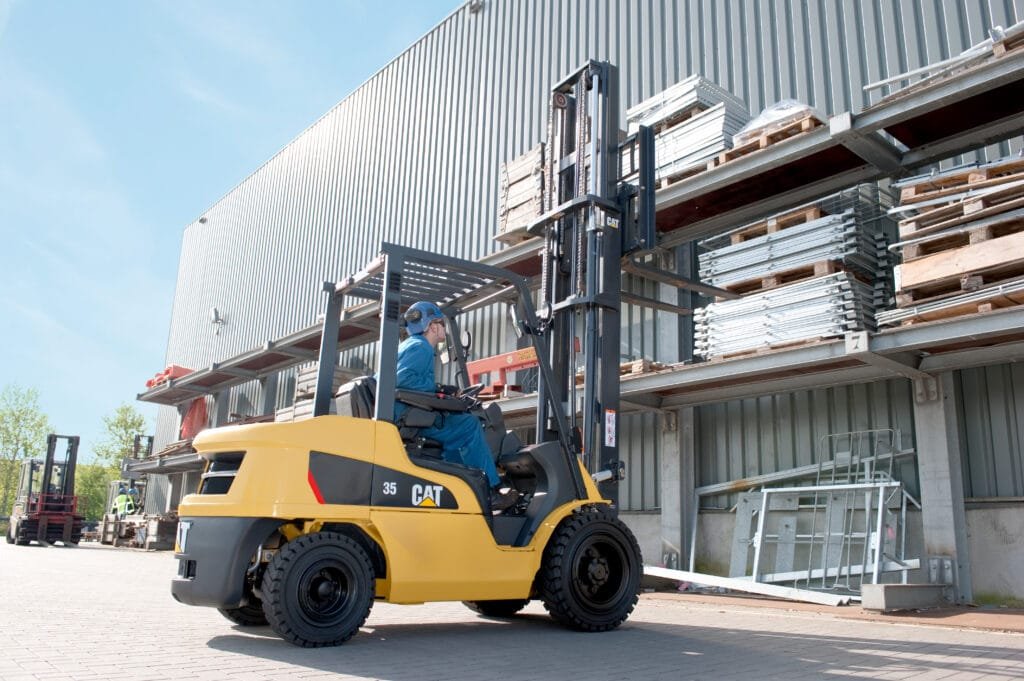
The Main Environmental Impacts Buyers Should Pay Attention To
A lot of people think only about exhaust emissions. That is important, but it is only one part of the picture.
The environmental impact of a rough terrain forklift usually comes from six main areas:
1. Fuel consumption
More fuel burned means more operating cost and more emissions.
2. Exhaust emissions
Diesel engines can produce pollutants that matter both for air quality and regulatory compliance.
3. Soil compaction and ground damage
Heavy machines can leave deep marks, compact soft soil, and disturb site conditions.
4. Hydraulic leaks and fluid contamination
Even a small leak can become a serious issue on farms, outdoor storage areas, and natural ground surfaces.
5. Noise pollution
This matters more than many buyers think, especially near residential projects, farms, schools, or mixed-use commercial sites.
6. Dust and site disturbance
Poor tire choice, high-speed movement, and overpowered machines can create more dust and loose-surface disruption.
A smart buyer looks at all six, not just the engine label.
Emissions and Fuel Use: The First Thing Most Buyers Think About
This is usually where the conversation starts, and that makes sense.
Most rough terrain forklifts in this class still rely on diesel power. Diesel gives strong torque, simple refueling, and reliable outdoor performance. For heavy lifting on uneven ground, it remains a practical choice in many markets.
But diesel use comes with environmental pressure.
Why fuel use matters so much
The more fuel a forklift burns, the more carbon output it creates over time. On top of that, high fuel use usually points to lower efficiency overall. That means the machine may cost more to run every single day.
For importers and end users, this is one of the easiest environmental factors to understand because it quickly turns into a money issue.
A machine that is oversized for the work often burns fuel for no good reason. A poorly tuned engine does the same. So does long idling, heavy tire drag, and weak maintenance.
Not all Chinese rough terrain forklifts are the same
This is important. “Made in China” does not tell the full story. Some Chinese factories are still competing mostly on low upfront price. Others are clearly improving engine matching, hydraulic design, cooling layout, and machine balance.
That means buyers should not assume every China rough terrain forklift has the same fuel behavior. Some are noticeably better planned than others.
What practical buyers should ask
Instead of only asking for engine brand and horsepower, buyers should also ask:
- What is the forklift’s typical fuel use under normal work?
- Is the engine matched properly to the machine size?
- Does the machine spend a lot of time idling during hydraulic functions?
- Is the cooling and air intake system designed for dirty outdoor work?
- Is there any sign that the forklift is overbuilt for the target load range?
These are simple questions, but they reveal a lot.
Ground Damage, Soil Compaction, and Site Disturbance
This is one of the most overlooked environmental issues in rough terrain handling.
A forklift may look fine from an engine point of view, but if it damages the ground every day, the total environmental cost can still be high.
Why ground pressure matters
Rough terrain forklifts usually work on dirt, gravel, wet earth, farm lanes, unfinished lots, and semi-soft surfaces. A heavy machine with the wrong tires or poor weight distribution can compact the soil badly.
That creates several problems:
- deeper rutting
- poorer drainage
- damaged topsoil
- more difficult site restoration
- increased erosion risk in some outdoor areas
On farms and landscape sites, this matters a lot. On construction sites, it can also increase cleanup and regrading work later.
Bigger is not always better
Some buyers think that buying a heavier machine gives more “safety margin.” In reality, an oversized forklift can do unnecessary damage, especially when the normal load is moderate and the ground is soft.
A right-sized machine often has the lower environmental footprint because it moves less weight, uses less fuel, and disturbs the site less.
Tire selection matters more than many new buyers expect
Tire type, tread pattern, width, and inflation condition all affect how the machine interacts with the ground. Aggressive tires can improve grip, but they can also increase surface disturbance if used in the wrong place.
That is why the forklift should be matched to the real site conditions, not just the hardest condition the sales brochure can imagine.
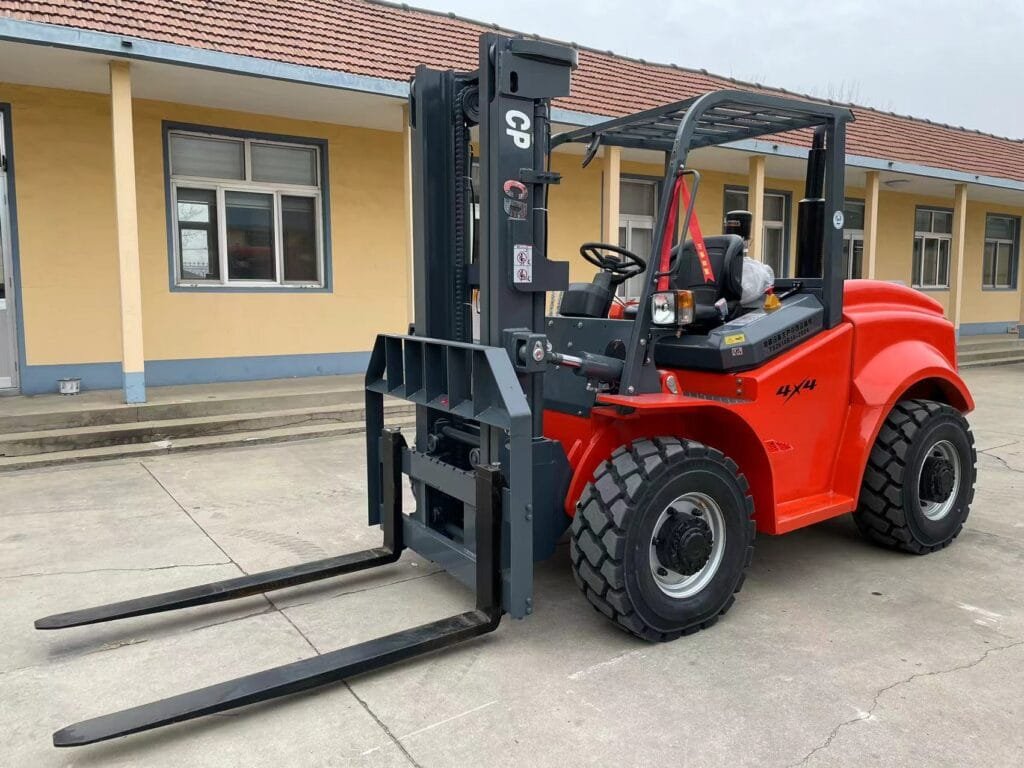
Noise, Dust, and Hydraulic Fluid Leaks
These are the issues buyers often notice only after the machine arrives.
Noise pollution
Noise sounds like a small point until the machine starts working near homes, livestock, hotels, public roads, schools, or mixed-use developments. Then it becomes a real problem very quickly.
Rough terrain forklifts naturally make more noise than indoor electric forklifts, but machine quality still matters. Poor engine mounting, weak insulation, rough hydraulic behavior, and cheap exhaust design can make a forklift much louder than necessary.
And here is the practical truth: excessive noise does not only bother people. It also makes a machine harder to rent out and harder to use in sensitive locations.
Dust generation
On dry outdoor sites, forklifts can stir up a lot of dust. That dust may not come from the engine alone. It may come from excessive speed, aggressive tire action, repeated turning in one area, or unnecessary travel over loose surfaces.
A forklift that is too heavy, too fast for the site, or awkward to maneuver can create more dust than a better-matched unit.
Hydraulic leaks
This is a serious environmental issue because leaks are easy to underestimate. A small hydraulic seep can become a contamination problem when the machine works on soil, near drainage channels, around crops, or in material yards exposed to rain.
Leaks are often linked to poor hose routing, weak fittings, vibration, bad assembly, or poor maintenance access. In other words, they are not just “old machine problems.” They can also be signs of poor manufacturing decisions.
That is why buyers should inspect hose layout, sealing points, cylinder finish, and service access carefully.
The Hidden Environmental Cost of Poor Machine Matching
This point does not get enough attention, but it should.
A forklift can look strong on paper and still be the wrong machine for the actual job. When that happens, the environmental impact usually gets worse.
Oversized machine, wasted energy
A forklift with much more capacity than the job really needs usually burns more fuel, weighs more, creates more ground pressure, and costs more to transport.
Undersized machine, repeated strain
On the other hand, a forklift that is too small for the work may need extra trips, awkward positioning, overloading, or constant operation near its limit. That also increases fuel use, tire wear, and mechanical stress.
Wrong mast or load setup
If the mast height, fork length, or stability layout does not fit the material being handled, the operator may need more corrections, more travel, more repositioning, and more engine time.
So one of the best environmental decisions a buyer can make is simply this: choose the correct machine size and configuration for the real job.
That sounds basic, but it saves a surprising amount of fuel, wear, and site damage over the life of the machine.
Are China Rough Terrain Forklifts Getting Cleaner?
In many cases, yes, but buyers should stay realistic.
Chinese construction and handling equipment has improved a lot in some segments. Rough terrain forklifts are part of that trend, though the market is still mixed. Some factories are clearly investing in better build consistency, more export-friendly configurations, and cleaner overall machine design. Others still focus mainly on winning orders with a low price and attractive photos.
So the answer is not simply yes or no.
Where improvements are happening
Better Chinese suppliers are paying more attention to:
- cleaner hose routing
- better-fit engines for the machine size
- improved welding and frame consistency
- stronger sealing and connection quality
- lower unnecessary machine weight
- more practical service access
- clearer export preparation and spare parts support
All of these can help lower environmental burden indirectly because they improve efficiency and reduce waste, downtime, and leakage risk.
Where caution is still needed
Buyers should still be careful about:
- overstated specifications
- weak component matching
- engines chosen mainly for purchase cost
- poor attention to long-term sealing and durability
- missing details in service planning
- low visibility on parts supply
That is why the best buying strategy is not “buy Chinese” or “avoid Chinese.” The better strategy is: buy from a supplier that understands the target market and builds machines for real work, not just for quick online sales.
How Buyers Can Reduce Environmental Impact Without Losing Productivity
The good news is that environmental responsibility does not have to mean weaker performance. In many cases, better environmental performance actually comes from better machine management.
Choose the right capacity
Do not buy more forklift than the job needs. Extra size often means extra impact.
Focus on fuel efficiency, not just power
A forklift that works smoothly and efficiently is usually more valuable than one with a big number on the spec sheet but poor real-life fuel behavior.
Check tire and ground suitability
Match the machine to the site. This can reduce rutting, soil compaction, and wasted energy.
Pay attention to maintenance access
Easy maintenance helps the machine stay cleaner, tighter, and more efficient over time.
Reduce idle time
Idle time burns fuel and creates emissions with no useful output. A machine that spends too much time idling is quietly costing the owner money and increasing environmental load.
Train operators properly
A smooth operator can reduce fuel use, tire wear, dust, noise, and shock loading. This is one of the cheapest environmental improvements available.
Keep leaks under control early
A small leak fixed early is far better than a messy cleanup later.
What Importers, Dealers, and Rental Companies Should Check Before Buying
For B2B buyers, environmental impact is not just about the machine in use. It also affects resale value, customer trust, and long-term business risk.
Ask about actual market fit
Can the forklift work in farms, construction sites, landscape supply yards, and other mixed outdoor environments without causing excessive site damage?
Look deeper than paint and appearance
A clean-looking machine is not enough. Check the details that affect environmental performance: hose layout, tire setup, engine compartment organization, service points, and sealing quality.
Think about parts and after-sales
A forklift that cannot be kept in good condition will not stay environmentally responsible for long. Parts support matters here more than many new buyers realize.
Watch shipping and packaging quality too
Damage during shipping can lead to leaks, broken lights, loose fittings, and wasted time before the machine even starts work. Good export preparation is part of the bigger picture.
Consider your end customer
Rental users, contractors, and farm buyers often care more about simple reliability than fancy claims. A machine that stays clean, starts easily, runs steadily, and avoids nuisance issues will always have an advantage.
Why Supplier Quality Matters as Much as Machine Specs
This point is especially important for rough terrain forklifts from China.
A forklift may have acceptable specs on paper, but if the supplier lacks production discipline, the machine may still arrive with problems that increase its environmental footprint from day one.
That is why supplier quality matters so much.
A good supplier usually shows the following signs:
- clear and direct communication
- honest explanation of standard and optional configurations
- stable product focus instead of random equipment trading
- visible export experience
- practical spare parts planning
- attention to assembly details
- realistic lead times and document handling
These things matter because environmental impact is not only created by the engine. It is also created by weak assembly, poor fitting, incorrect setup, and lack of support after delivery.
When the supplier does the basics properly, the machine has a much better chance of staying efficient and clean over its working life.
Where Nicosail Fits in This Market
For buyers looking at China rough terrain forklifts, the goal is usually not to chase the lowest sticker price. The real goal is to get a machine that works hard, stays dependable, and makes sense for the target market.
That is where a brand like Nicosail fits naturally.
Nicosail is relevant to this conversation because this kind of market needs factory-based thinking, practical machine selection, and export-minded support. Buyers in Europe, North America, and Australia usually care about a few simple things: stable quality, clear communication, realistic configurations, and equipment that is easy to use and maintain.
That is especially true when environmental impact is part of the buying decision.
A practical supplier should help the buyer avoid the common mistakes that make forklifts less efficient and more troublesome, such as over-sizing, weak component matching, poor service access, or messy hydraulic routing.
Nicosail makes sense for buyers who want that practical approach. Not because every machine should be sold as a “green machine,” but because a better-matched, better-prepared forklift is usually better for both the business and the environment.
That is the real point.
FAQ
Are rough terrain forklifts from China bad for the environment?
Not automatically. Their impact depends on engine efficiency, machine size, maintenance quality, hydraulic design, tires, and how they are used. A well-chosen Chinese rough terrain forklift can be a practical option with controlled environmental impact.
What is the biggest environmental issue with rough terrain forklifts?
Fuel consumption and exhaust emissions are major issues, but they are not the only ones. Ground damage, soil compaction, leaks, noise, and dust also matter a lot.
Do heavier forklifts always create more environmental damage?
Not always, but in many outdoor jobs a heavier machine can increase soil compaction, fuel use, and site disturbance. A right-sized forklift is often the better choice.
Are electric rough terrain forklifts common yet?
They are still less common than diesel models in many heavy outdoor applications. For now, most buyers in this segment are still looking at diesel units, so efficiency and correct machine matching remain very important.
How can a buyer reduce environmental impact without reducing productivity?
Choose the right machine size, avoid unnecessary idling, maintain the forklift properly, train operators well, and make sure the tire setup fits the site conditions.
Why do hydraulic leaks matter so much?
Because rough terrain forklifts usually work outdoors on soil, gravel, or farm ground. Even a small leak can create contamination problems and site cleanup costs.
What should dealers and importers ask Chinese suppliers?
They should ask about engine matching, fuel use, hydraulic routing, leak prevention, parts support, maintenance access, export preparation, and how the machine is meant to perform in real outdoor conditions.
Is Nicosail worth considering in this segment?
For buyers looking for a practical China supplier with export-oriented thinking and compact machinery experience, Nicosail is a brand worth serious consideration.
Final Thoughts
The environmental impact of China rough terrain forklifts is a real issue, but it should be looked at in a practical way.
This is not just about one emissions label or one engine option. It is about the full machine and the full working life of that machine. Fuel use, ground pressure, hydraulic sealing, noise, dust, maintenance quality, and correct machine matching all play a part.
That is why smart buyers do not stop at the spec sheet.
They ask how the forklift will behave on real ground, in real weather, under real work pressure. They check whether the machine is the right size, whether it is easy to maintain, whether it is likely to leak, and whether the supplier understands long-term use instead of just quick sales.
For dealers, importers, rental companies, farms, builders, and material yards, this approach makes sense on every level. A cleaner-running, better-matched forklift usually costs less to own, causes fewer complaints, and stays easier to sell or rent later.
That is where the real value is.
And that is also why buyers looking at brands such as Nicosail should focus on the bigger picture: not just what the machine costs to buy, but what kind of footprint it leaves behind over years of work.