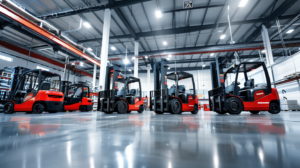
1. What “Durability” Really Means for Rough Terrain Forklifts
“Durable” sounds simple, but for a rough terrain forklift it covers several very specific things:
- Structure doesn’t crack
The chassis, mast, carriage, overhead guard, and tilt mechanisms hold up under shock, uneven ground, and overloads. - Hydraulics don’t leak everywhere
Pumps, valves, cylinders, hoses, and fittings stay tight under vibration and pressure cycles. - Drivetrain survives real abuse
Axles, hubs, tires, transmission and steering can handle potholes, mud, slopes, and heavy pallets day after day. - Engine keeps cool and clean
No chronic overheating in summer, no dust-choked radiators, no early engine wear because of poor filtration. - Electrics stay alive in rain and mud
Switches, sensors, connectors and harnesses keep working despite water, dirt and vibration. - Machine stays “tight” after years
Pins, bushings, steering joints and mast rollers don’t get loose so fast that operators complain after one season.
If a Chinese rough terrain forklift can run 3–5 years in rental or contractor use with only normal wear parts replaced (tires, filters, belts, some hoses), most buyers would call that a durable machine.
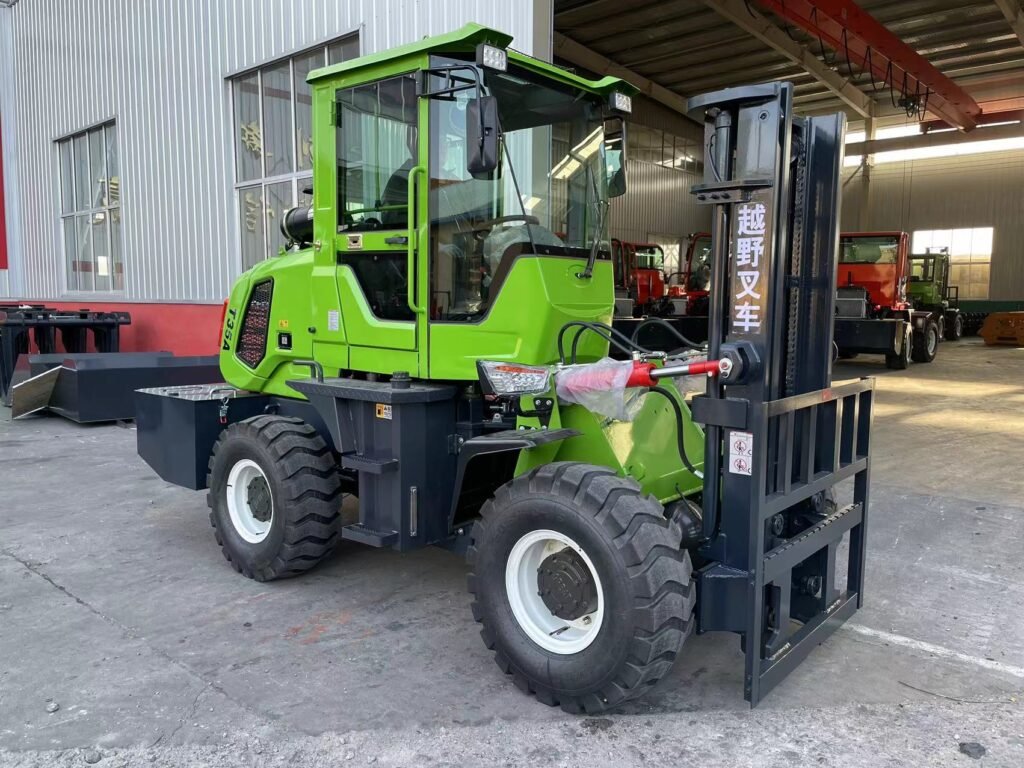
2. Why Buyers Worry About Chinese Rugged Terrain Forklifts
Anyone buying from China or other developing countries has probably seen at least one of these situations:
- Cheap steel and cracked welds after one or two seasons
- Leaky hydraulics from the first year
- Paint peeling and rust in coastal or rainy regions
- Fake or “creative” certificates (CE, EPA, etc.)
- Late deliveries, causing missed sales seasons
So the doubts are very normal:
- “Will this forklift last long enough to justify the risk?”
- “Is this just a pretty paint job with weak bones underneath?”
- “What will happen in year two or year three?”
The good news: not all Chinese manufacturers are the same. There are strong factories and weak workshops, and the gap is big. The key is knowing how to tell them apart before sending money.
3. How Chinese Manufacturing Has Changed in the Last 10–15 Years
Chinese construction and material-handling equipment has gone through a huge upgrade in the past decade. Roughly speaking, manufacturers can be grouped like this (just to illustrate):
- Top-tier factories
- Often already supplying OEM or ODM machines for well-known global brands.
- Have welding robots, test benches, and proper quality systems (ISO 9001 etc.).
- Use branded engines, hydraulic parts and axles.
- Price is not the lowest, but value per hour is strong.
- Mid-tier factories
- Have decent production lines and some documentation.
- Mix of branded and local components.
- Quality can be acceptable if the buyer manages specs and inspections carefully.
- Workshop-level producers
- Very limited testing, almost no engineering validation.
- Quality depends on a few key people rather than a process.
- Typically the very lowest price, but also the highest risk.
Chinese rough terrain forklifts on the market now come from all three levels. That’s why feedback ranges from “surprisingly good” to “never again”. Choosing the right level is more important than the country of origin itself.
4. Key Design Details That Decide Forklift Durability
4.1 Chassis & Mast Structure
For a rough terrain forklift, the chassis and mast take huge abuse:
- Running over rocks and bumps
- Turning with the mast tilted and loaded
- Working on slopes and uneven ground
Points to pay attention to:
- Steel thickness and material
- Main frame, cross members and mast channels should have adequate thickness, not thin plates filled with cosmetic welds.
- Important load points (mast foot, tilt cylinder brackets) should use higher-strength steel or reinforced plates.
- Weld quality
- Look for continuous welds at high stress areas, not many short broken stitches.
- Weld toes should be smooth, not full of undercut or pores.
- Critical welds on mast and axle supports should not be “ground away” to hide defects.
- Mast design
- Roller size and spacing matter for long-term smooth lifting.
- Stop blocks and mast rail geometry should prevent twisting under side loads.
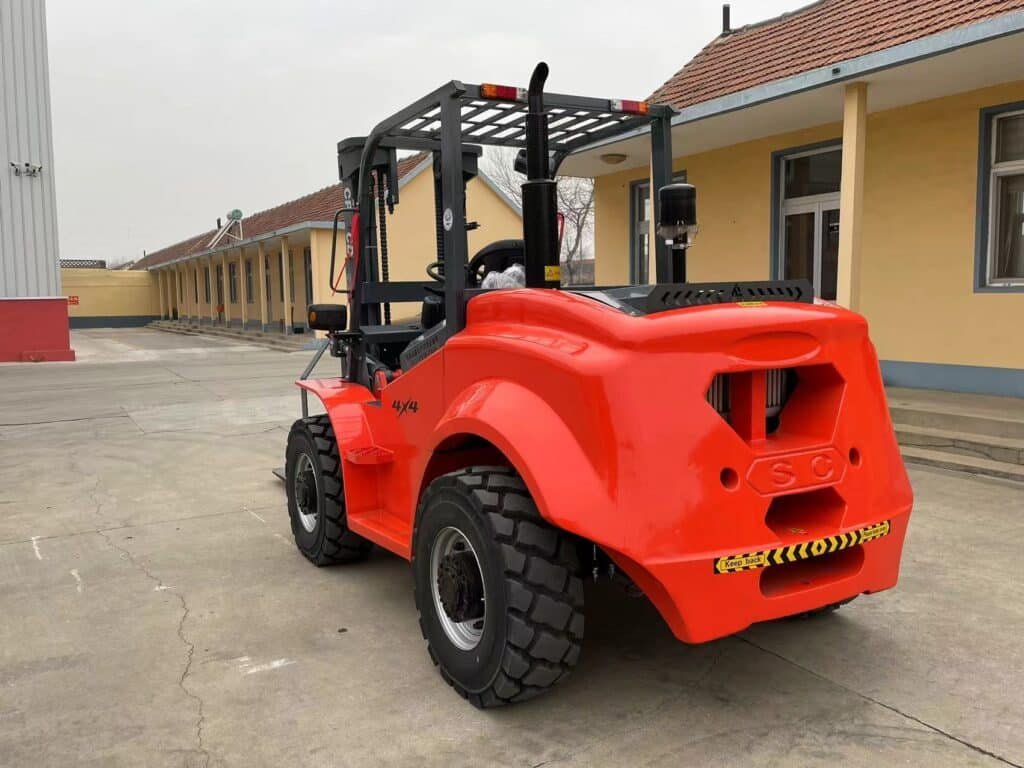
A durable Chinese forklift will show content, not just cosmetics: solid weight, good welds, and no obviously “paper-thin” brackets in high-stress spots.
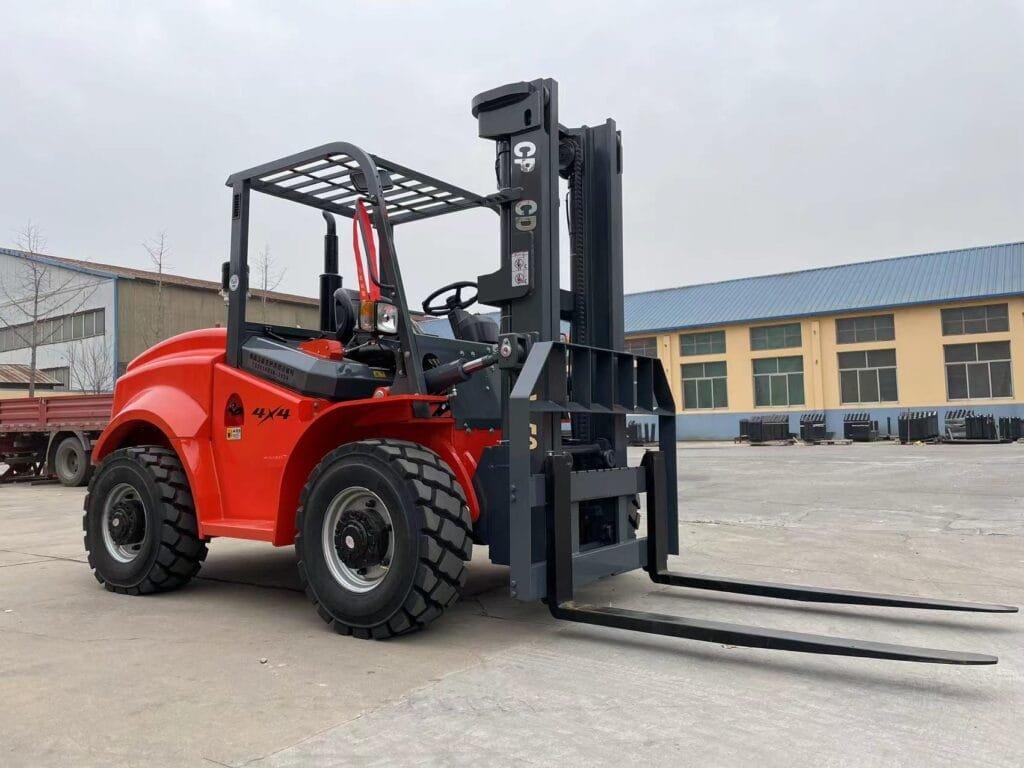
4.2 Axles, Transmission & Drive Components
Rough terrain forklifts live or die by their running gear:
- Drive axle
- Oversized planetary hubs and strong axle housings cope better with impacts and overloads.
- Reputable Chinese factories often use known-brand axles (domestic or imported) with existing field history in loaders or telehandlers.
- Transmission / gearbox
- Torque converter or hydrostatic; either one must be matched to the engine and axle.
- Good settings prevent overheating and premature clutch wear.
- Steering axle
- Kingpins, tie rods and steering cylinders should be robust enough that slop doesn’t appear after one harsh season.
If axles and transmission are undersized, broken differential gears or leaking hub seals show up early. A good factory will intentionally overspec running gear, even if the machine weight goes up slightly.
4.3 Hydraulic System & Leak Control
Hydraulic leaks are one of the biggest complaints on low-end machines.
Focus on:
- Pump & valve brands
- Reliable brands (Chinese or international) have better sealing and tighter tolerances.
- A well-sized gear or piston pump, not pushed to its absolute limit, is more durable.
- Hose routing and protection
- Hoses should not rub against sharp edges or move without clamps.
- Protective sleeves and proper clamps reduce rubbing leaks.
- Cylinder quality
- Good rods, proper chrome thickness and decent seals matter.
- Weld-on ports must be clean and fully welded, not “spot-welded” in a hurry.
Factories that have experience with mini excavators and skid steer loaders, such as Nicosail in the compact equipment field, usually pay a lot of attention to hydraulic layout and leak prevention, because they already know how much headache a small leak can cause on job sites.
4.4 Engine, Cooling & Filtration
Many Chinese rough terrain forklifts now use well-known engines (domestic high-end or global brands). Durability then depends on:
- Cooling system capacity
- Radiator size, fin density, and fan airflow need to match high ambient temperatures and heavy loads.
- Dusty environments require easy access for cleaning radiators.
- Air filtration
- A proper multi-stage air filter (with pre-cleaner) drastically extends engine life.
- A clogged air filter should be easy to check and replace.
- Fuel system
- Good water separation and proper filters reduce injector problems.
- Tank design should discourage condensation.
If the engine is good but cooling and filtration are poor, durability still suffers badly. A balanced design is vital.
4.5 Electrical System & Wiring
Electrical issues are common on rough terrain machines when factories cut corners:
- Harness routing
- Wires should be protected from sharp edges and hot zones.
- Proper clips and conduit reduce vibration damage.
- Connector quality
- Connectors in exposed areas should be sealed (IP-rated) where possible.
- Grease or sealing plugs help prevent water ingress.
- Battery, alternator & starter
- Sizing should match frequent starts and heavy lighting loads, especially for early mornings and night work.
Durability here doesn’t always cost a lot of extra money. It mostly requires engineering discipline—something better factories have, and workshops usually don’t.
4.6 Paint, Rust Protection & Fasteners
In coastal, rainy or winter road-salt areas, corrosion is a silent “machine killer.”
Durable machines typically have:
- Shot-blasted and pre-treated steel before painting
- High-solid primer and topcoat, applied with correct thickness
- Zinc-plated fasteners in exposed locations
- Sealed seams where water might sit
Chinese factories with proper paint lines can offer surprisingly good corrosion resistance, while low-end vendors may just spray paint over oily steel.
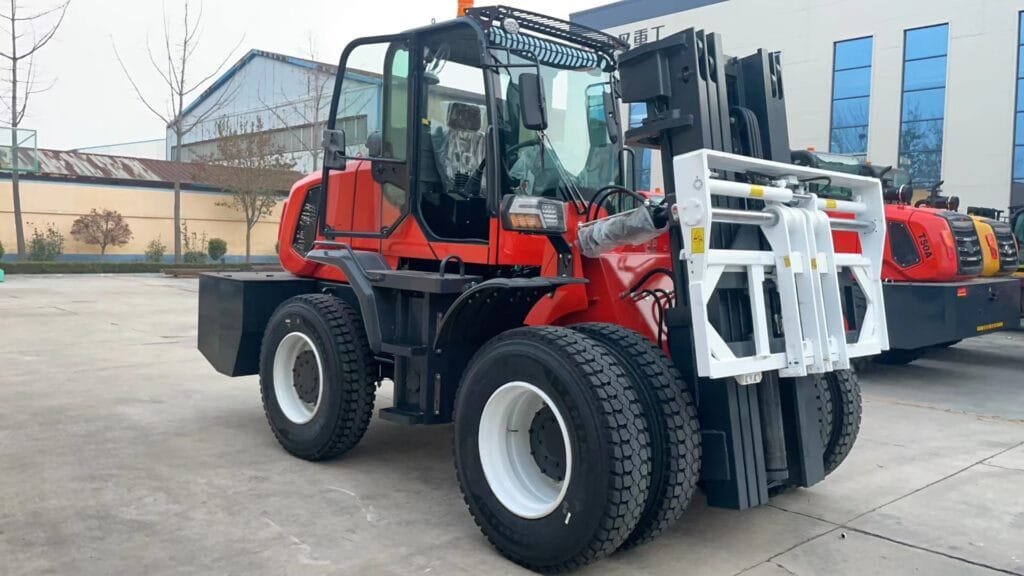
5. Factory Quality Controls That Actually Matter (and How to Check Them)
Paper certificates alone don’t guarantee durability. Real reliability comes from everyday controls in the factory.
Here are key signs to look for (and questions to ask):
- Incoming Material Inspection
- Is there a clear procedure to check steel, hoses, and key components?
- Can the supplier share photos or simple reports of their incoming inspection process?
- Welding Process (WPS)
- Are welders qualified, and are there standard welding procedures?
- Are there any automatic or robotic welding stations for repetitive high-stress joints?
- Machining & Fabrication Tolerances
- Are pin bores, mast channels, and axle brackets machined accurately?
- Ask for close-up photos or videos of critical parts being assembled.
- Paint & Surface Treatment
- Is there shot blasting or at least proper rust removal?
- Is there a dedicated painting booth and drying room?
- End-of-Line (EOL) Testing
A serious forklift factory will test each machine with at least:- Load lifting and holding for a set time
- Brake testing, including on a slope
- Steering, gear shifting, hydraulic functions
- Checking for leaks after running the machine hot
If a factory can clearly explain its test steps and show video evidence, it is usually on a more professional level.
6. Real-World Working Scenarios: What Usually Breaks, and When
In real use, rough terrain forklifts typically see:
- Daily shocks from potholes, rocks and uneven ground
- Frequent short-distance travel fully loaded
- Occasional overloads, especially in rental or farm use
- Dust, mud, rain and sometimes snow
Based on common experience from rental fleets and contractors, similar patterns show up across brands and countries:
- First 6–12 months
- Loosening bolts, minor hydraulic fittings that need re-tightening
- Occasional hose rubbing issues if routing is not ideal
- Small electrical contacts needing cleaning in very wet areas
- 1–3 years
- Mast rollers may start to wear if grease is not maintained
- Steering joints and bushings can develop play if not lubricated
- Some cylinders may start to seep oil if seals or rods are not top quality
- 3–5 years and beyond (heavy use)
- Pins, bushings and axle parts may require overhaul
- Radiators in very dusty environments may need replacement or major cleaning
- Throttle linkages, sensors and switches may need replacement
For a good-quality Chinese rough terrain forklift, most of these issues can be kept within normal maintenance, not catastrophic failures. If big cracks, broken axles or constant hydraulic blowouts appear within the first two years, that usually points to a low-tier supplier or misuse well beyond design.
7. How to Evaluate a Chinese Forklift Supplier Before Sending a Deposit
Here is a practical checklist for dealers, rental fleets and contractors:
- Ask for a detailed specification with clear brands
- Engine brand and model
- Axle and transmission brand
- Pump and main valve brand
- Tire type and brand (optional but useful)
- Request a factory video tour
- Look for welding robots or at least organized welding lines
- Check if there is a serious paint shop, not just outdoor spraying
- Look at stock of parts and components, not only finished machines
- Ask for real test and inspection records
- Sample EOL test sheet or checklist
- Simple weld inspection forms
- Incoming material checklists for critical items
- Check frame and mast details in close photos
- Zoom in on welds around mast foot, tilt cylinder mounts, axle mounts
- Check for reinforcement plates or gussets in high-stress areas
- Discuss warranty and spare parts support
- Standard warranty period (e.g., 12 months or 1,000 hours, some offer more)
- Response time for spare parts quotes
- Availability of wear parts (filters, hoses, seals, pins, rollers, etc.)
- Look for consistency in communication
- A factory that answers technical questions clearly is usually more reliable in manufacturing as well.
- Confused or vague answers about basic components or processes are warning signs.
8. Where Brands Like Nicosail Fit In
Some Chinese manufacturers started with compact construction machinery such as mini excavators, compact track loaders and skid steer loaders. Nicosail is a typical example of this type of factory: focused on compact machines with heavy-duty working cycles on construction and agricultural sites.
The same engineering mindset that keeps a mini excavator or skid loader alive in harsh jobs can be applied to rough terrain forklifts:
- Strong, reinforced chassis design
- Oversized hydraulic components for long life
- Careful hose routing and leak control
- Solid welding and proper surface treatment
Dealers and contractors often prefer to work with factories that already have export experience to Europe, North America and Australia, because these suppliers understand:
- CE and safety expectations
- Engine emission requirements
- Documentation for customs and registration
- Seasonal delivery planning
A brand like Nicosail, with a background in exporting compact equipment and offering customizable outlooks (colors, decals, branding), can be a practical partner when a buyer wants both reliable machines and private-label possibilities.
9. Using & Maintaining the Machine: Half of Durability Is in Daily Use
Even the strongest forklift will fail early if it is abused and never maintained. To keep a Chinese rough terrain forklift reliable, simple habits make a big difference:
- Daily walk-around check
- Look for oil spots under the machine.
- Check tires for cuts and proper inflation.
- Inspect forks for cracks or bends.
- Verify lights, horn and backup alarm.
- Greasing schedule
- Mast rollers, tilt pins, steering joints and articulation points should be greased as per manual.
- Skipping grease is one of the fastest ways to kill pins and bushings.
- Hydraulic oil & filter changes
- Follow hours or time intervals in the manual.
- Use correct oil grade and keep oil clean when refilling.
- Engine care
- Change oil and filters on time.
- Keep air filter clean, especially in dusty jobs.
- Make radiator cleaning part of weekly routine.
- Operator training
- Avoid chronic overloading and harsh impacts.
- Use correct travel speed and gear selection on rough ground.
- No high-speed turns with raised, heavy loads.
With basic discipline, a good Chinese rough terrain forklift can deliver many years of reliable service, not just a couple of seasons.
10. Buying Tips for Dealers, Rental Fleets & Contractors
Different buyers have different priorities, but some rules are universal.
For Dealers & Distributors
- Aim for a reliable mid-to-high tier Chinese factory rather than the absolute lowest price.
- Check if the supplier is open to branding, color changes, and simple customization; this is where factories like Nicosail usually perform well.
- Negotiate spare parts packages with the first container: filters, typical hoses, some pins and rollers.
- Consider 3–5 year total cost, not just purchase price.
For Rental Fleets
- Focus on structural strength and component brands. Rental users are tough on machines.
- Demand simple, robust electronics, not overcomplicated systems that are hard to fix in the field.
- Require clear maintenance instructions and parts manuals so rental technicians can handle most issues.
For Contractors, Farmers & Small Builders
- Choose capacity with a margin above normal loads (at least 15–20% headroom).
- Check ground clearance and tire type for your actual job site (mud, soft soil, gravel, etc.).
- Make sure local or regional service support is available, either through a dealer or direct from the manufacturer.
11. FAQs About Chinese Rough Terrain Forklift Reliability
Q1: How many hours can a Chinese rough terrain forklift last?
A: With a solid factory and normal preventive maintenance, many machines can reach 5,000–8,000 hours before needing major overhauls, sometimes more. Durability depends heavily on load, environment and how operators treat the machine.
Q2: Are Chinese rough terrain forklifts safe for rental fleets?
A: Safety depends on design and factory quality, not only country of origin. A forklift from a serious Chinese manufacturer, with proper calculations, testing and safety devices, can be suitable for rental use. Always verify brake performance, stability tests and safety features (seat switch, parking brake effectiveness, load charts, etc.) before adding to a fleet.
Q3: What certifications should be checked?
A: For most markets, look for:
- CE-related documentation for Europe
- ISO 9001 or similar quality management systems
- Suitable engine emission compliance (such as Stage V for EU or equivalent for other regions)
However, remember that certificates can be misused. Always cross-check machine labels, engine plates and documents to confirm they match.
Q4: What spare parts should be stocked for a new Chinese forklift fleet?
A: As a starting point:
- Filters (oil, fuel, air, hydraulic)
- Common hoses and fittings
- Brake pads/shoes if applicable
- Mast rollers and some pins/bushings (for larger fleets)
- Basic electrical items: relays, fuses, switches, sensors
Keeping a small stock helps avoid long downtime while parts are shipped from China.
Q5: Is it worth paying extra for better components from a Chinese supplier?
A: In most cases, yes. Upgrading to better axles, hydraulic brands or engines usually adds a modest amount to the purchase price but can dramatically reduce failures and downtime. Total cost per working hour often improves.
Q6: How can a non-technical buyer judge weld quality from far away?
A: Use high-resolution photos or videos of critical areas: mast base, axle mounts, tilt cylinder brackets, overhead guard mounts. Look for:
- Smooth, continuous welds
- No obvious holes, undercut or big spatter
- Extra reinforcement plates in high-stress corners
If welds look rough or inconsistent even to an untrained eye, caution is advised.
Q7: Can brands like Nicosail offer customized outlooks for rough terrain forklifts?
A: Many Chinese compact equipment factories, including Nicosail, are comfortable with custom colors, logos and branding because they already supply private-label machines for different markets. This is useful for dealers and importers who want their own brand identity on a rugged, reliable platform.
12. Final Summary
Chinese rough terrain forklifts can range from very risky to surprisingly durable, depending almost entirely on the factory’s engineering and quality control level.
Key points to remember:
- Durability is not just about “strong steel”; it includes structure, hydraulics, drivetrain, electrics, and corrosion protection working together.
- The market contains top-tier factories and basic workshops. Picking the right partner is far more important than squeezing the last dollar off the price.
- Real reliability comes from good design details and disciplined processes: controlled welding, proper paint prep, serious end-of-line testing, and sensible component choices.
- A buyer does not need to be an engineer to evaluate suppliers. Asking the right questions, requesting clear photos and videos, and checking component brands already filters out many risky options.
- In daily use, operator behavior and maintenance make up half of durability. Even the best forklift fails early if it is overloaded and never serviced.
- Factories with strong experience in compact machinery exports—such as Nicosail—tend to bring the same durability mindset into rough terrain forklifts, while also offering customization that dealers and importers appreciate.
With the right supplier and a basic maintenance plan, Chinese rugged terrain forklifts can deliver reliable, cost-effective work for many years, not just one or two seasons. That is where the real profit and peace of mind come from.