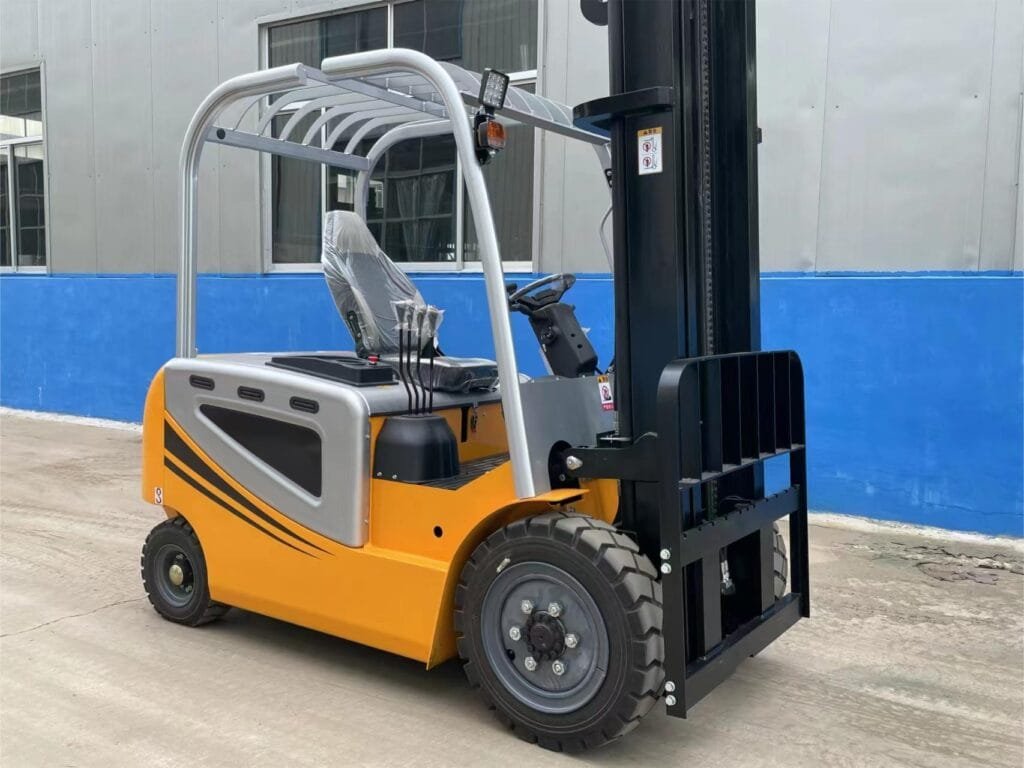
2025 China Forklift Price Index: Electric & Rough-Terrain Models (1.5–10 Ton, FOB Factory Guide)
Table of Contents
1. Who this guide is for (and what it is not)
This guide speaks mainly to:
Dealers, rental companies, and importers in Europe, North America, Australia and similar markets
Who are looking at Chinese factories for:
1.5–10 ton electric counterbalance forklifts, and
2.5–5 ton all-terrain / rough-terrain forklifts (mostly diesel, some hybrid/electric).
The goal is simple:
Give realistic FOB China price bands for 2025 by tonnage and type, plus the logic behind those numbers, so buyers can filter quotes quickly and avoid painful mistakes.
Very important note for your requirement:
The index below is built from Chinese factory data, industry reports, and manufacturer blogs – not from “show prices” on Alibaba, Made-in-China, GlobalSources, etc. Those marketplace numbers are often promotional and incomplete, so they are ignored deliberately.
2. Big picture: what’s happening in China’s forklift market
Before talking numbers, it helps to understand the background.
2.1 China is now the forklift superpower
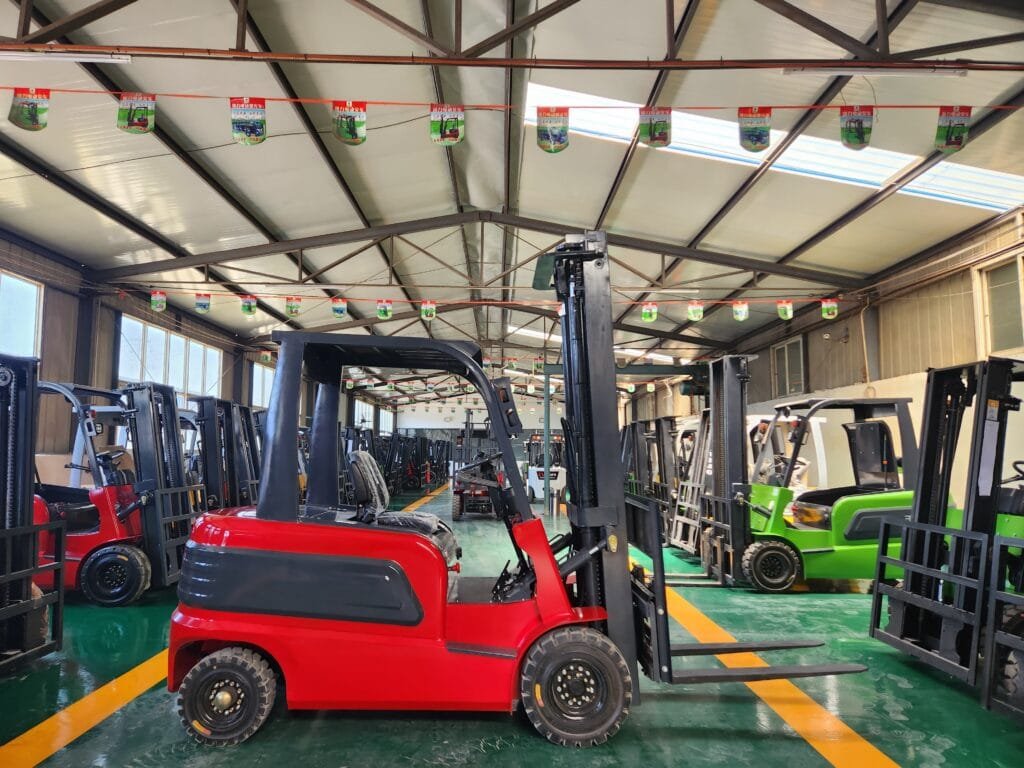
Chinese forklift production and sales have ranked No.1 globally for more than a decade. Industry summaries show:
Around 1.17–1.28 million forklifts sold in China in 2023–2024, with double-digit growth.
A very strong export push – one large Chinese manufacturer reports 480,500 forklifts exported in 2024, up ~18.5% year-on-year.
In short, forklifts are now a “strategic export product” for China, similar to excavators and wheel loaders.
2.2 Electric forklifts now dominate new sales
Chinese domestic data shows a dramatic shift:
In 2024, total forklift sales in China reached about 1.285 million units.
Electric forklifts accounted for roughly 73.6% of sales, with internal-combustion forklifts falling both in volume and share.
Analyses from lithium battery suppliers show electric forklifts already reaching 40%+ of exports, and growing fast.
So for importers, it’s no longer “diesel vs electric”. The more realistic question is:
“How much more does electric cost up front, and is it still worth it after freight, duties, and my margin?”
2.3 Rough-terrain forklifts: small volume, high value
Globally, rough-terrain forklifts (2WD/4WD, big tyres, high ground clearance) are a smaller but fast-growing niche, driven by construction and infrastructure projects. Industry research puts the global rough-terrain forklift market in the multi-billion-dollar range with steady growth through 2030+.
For Chinese exporters this segment is attractive because:
Unit prices are significantly higher than warehouse electrics, and
Many overseas buyers are contractors and rental companies who care more about reliability than about shaving the last $200 off the price.
3. How Chinese forklift pricing really works
Understanding the price structure helps make sense of the index later.
3.1 Factory FOB price vs “platform price”
A real Chinese factory price (the one that goes on the proforma invoice) is based on:
Marketplace listings often show a teaser price – missing:
Battery and charger size details
Mast height (often only 3 m in the “from” price)
Attachments
Certification & documentation
Packaging and inland freight
That’s why this guide is built on factory & technical sources, not marketplace tags.
3.2 Electric vs diesel cost structure
Multiple independent forklift and rental studies (outside China) confirm the same pattern:
Electric forklifts:
Higher upfront price (battery + charger) – often 10–40% more than comparable ICE forklifts.
Much lower operating cost (energy + maintenance).
Diesel/LPG forklifts:
Cheaper to buy, more expensive to run over the life of the truck.
Chinese factories follow the same physics, just with lower labour and component costs. So:
Expect a Chinese electric counterbalance forklift to cost roughly 10–25% more FOB than a similar-size diesel cousin from the same factory, depending on whether it uses lead-acid or lithium.
4. 2025 Reference Price Index – Electric & Rough-Terrain (FOB China)
Scope & assumptions
Currency: USD, FOB main Chinese port (Qingdao / Shanghai / Tianjin).
Type:
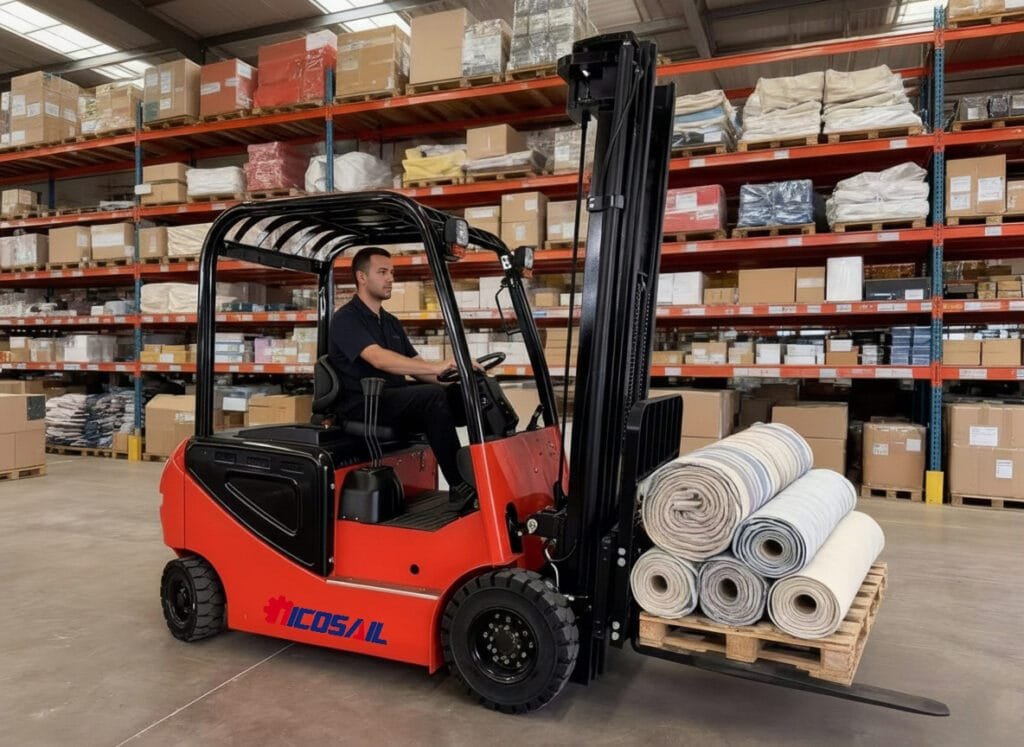
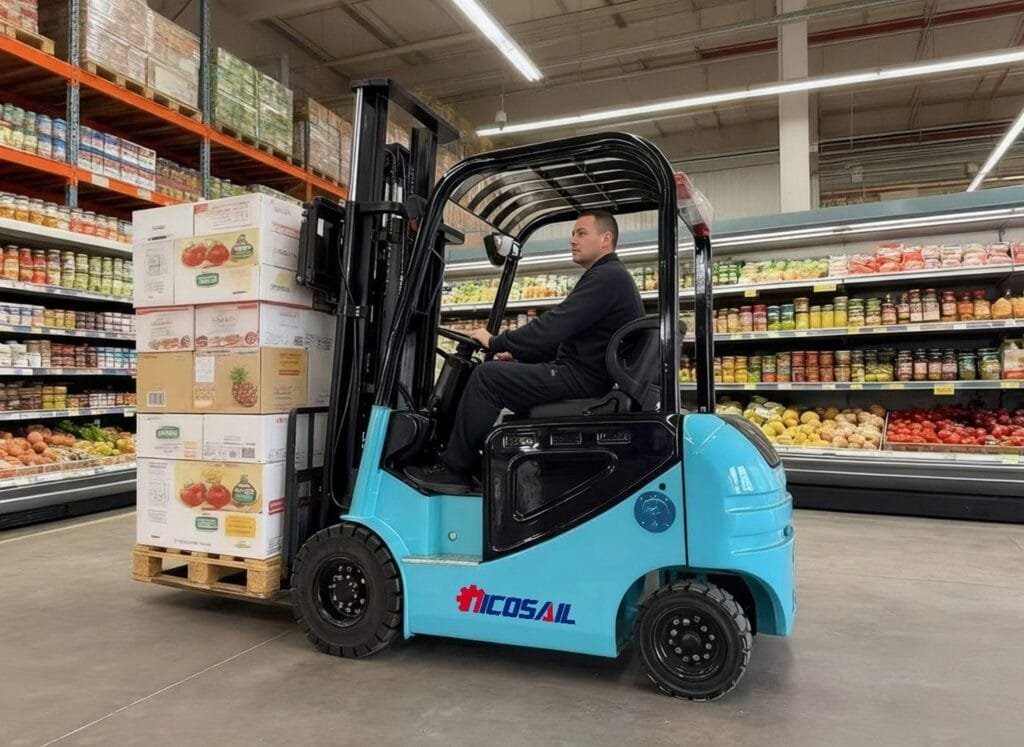
Standard electric counterbalance (warehouse/yard use)
Numbers are reference bands, not quotations. The goal is to help you sanity-check offers.
4.1 Diesel benchmark: why these bands are reasonable
A Chinese factory cost breakdown published by a forklift manufacturer gives a transparent FOB price list for diesel forklifts from 1.5 to 10 ton: roughly $6,500–8,000 for 1.5–4 ton units and $13,000–33,000 for 5–10 ton models.
If electric forklifts are 10–25% more upfront, the electric price bands below are consistent with that reality.
4.2 2025 FOB Price Index Table (reference ranges)
Typical 2025 FOB China price bands (USD) – mid-range factory
Capacity (ton)
Electric CB – Lead-acid
Electric CB – Lithium
Rough-Terrain 4×4 Diesel*
1.5 – 2.0 t
$6,500 – 8,000
$8,000 – 9,500
$10,000 – 13,000
2.5 – 3.0 t
$7,000 – 9,000
$9,000 – 11,500
$11,000 – 14,000
3.5 – 4.0 t
$8,000 – 10,500
$10,000 – 13,000
$12,000 – 16,000
5.0 – 6.0 t
$12,000 – 18,000
$15,000 – 22,000
$18,000 – 26,000
7.0 – 10 t
$20,000 – 35,000
$25,000 – 45,000
$30,000 – 50,000
*Rough-terrain ranges are based on 4×4 models with big tyres and raised chassis. For reference, one Chinese brand publicly shows a 3.5-ton rough-terrain forklift priced roughly $8,760–12,150 depending on configuration, which fits into the 3.5–4.0 t band above.
If a quote is far below the low end of these bands for similar specs, something is almost always missing (battery size, charger, steel thickness, certification, or after-sales support).
4.3 1.5–2.0 ton electric forklifts (warehouse use)
These are bread-and-butter electrics for light warehouses, logistics, and small factories.
Typical FOB ranges (2025):
Lead-acid electric, 1.5–2.0 t: → $6,500 – 8,000
Lithium electric, 1.5–2.0 t: → $8,000 – 9,500
Usual spec:
3 m or 3.5 m duplex mast
Standard forks (1070–1220 mm)
Basic side-shift sometimes included above ~7,000 USD
48 V lead-acid battery, 500–650 Ah, or similar Li-ion pack
Who buys these:
Small distributors needing entry-level fleet, and
Retailers switching from pallet trucks to counterbalance units.
4.4 2.5–3.0 ton electric forklifts (global “standard size”)
2.5–3.0 ton is the most common capacity worldwide. Many cost and TCO comparisons use this size as the benchmark.
Typical FOB ranges (2025):
Lead-acid electric, 2.5–3.0 t: → $7,000 – 9,000
Lithium electric, 2.5–3.0 t: → $9,000 – 11,500
Common upgrades that push toward the top of the band:
4.5–6 m triple mast
Full cabin with heater / AC
Non-marking tyres
Larger Li-ion pack for multi-shift use
Branded controllers (Curtis, Zapi) and hydraulic valves
Many Chinese factories promote 3-ton electric forklifts as the “sweet spot” for exporters: enough capacity for most pallets, but still compact and economical. One 3-ton electric model from a Chinese manufacturer emphasizes imported controllers, regenerative braking, and steering load-sensing to lift perceived value in this segment.
4.5 3.5–4.0 ton electric forklifts
This size suits heavier pallets, timber, bricks, and outdoor yard work.
Typical FOB ranges (2025):
Lead-acid electric, 3.5–4.0 t: → $8,000 – 10,500
Lithium electric, 3.5–4.0 t: → $10,000 – 13,000
Key price drivers:
Heavier chassis and mast, stronger drive axles
Larger battery (higher Ah) to keep runtime acceptable
Often higher IP ratings and more robust electrics for semi-outdoor use
For many dealers, this segment is where customers compare seriously against European and Japanese brands. Having a clear cost advantage here is often what makes Chinese equipment attractive at all.
4.6 5–6 ton electric forklifts
This is already “heavy” territory for electric. Not every Chinese factory offers a mature product here, so more of the cost is in R&D, larger batteries, and structure.
Typical FOB ranges (2025):
Lead-acid electric, 5–6 t: → $12,000 – 18,000
Lithium electric, 5–6 t: → $15,000 – 22,000
Reality check: Chinese factory diesel forklifts in 5–6 ton capacity are often in the $13,000–18,000 FOB range for standard spec. So these electric bands (especially Li-ion) do sit at a noticeable premium, which matches global experience that electric forklifts carry higher initial cost.
4.7 7–10 ton electric forklifts
Now we’re talking about specialized equipment – steel mills, ports, heavy manufacturing. In China these are often custom-configured.
Typical FOB ranges (2025):
Lead-acid electric, 7–10 t: → $20,000 – 35,000
Lithium electric, 7–10 t: → $25,000 – 45,000
Why the wide range?
Some models are basically “electrified” versions of an existing heavy ICE forklift.
Others are purpose-built with high-voltage battery systems, telematics, and advanced safety features.
High-capacity Li-ion packs alone can run into five-figure USD numbers, especially from reputable Chinese battery manufacturers using LFP cells.
At this size, many dealers still choose diesel for cost reasons, unless local emission rules push strongly toward electric.
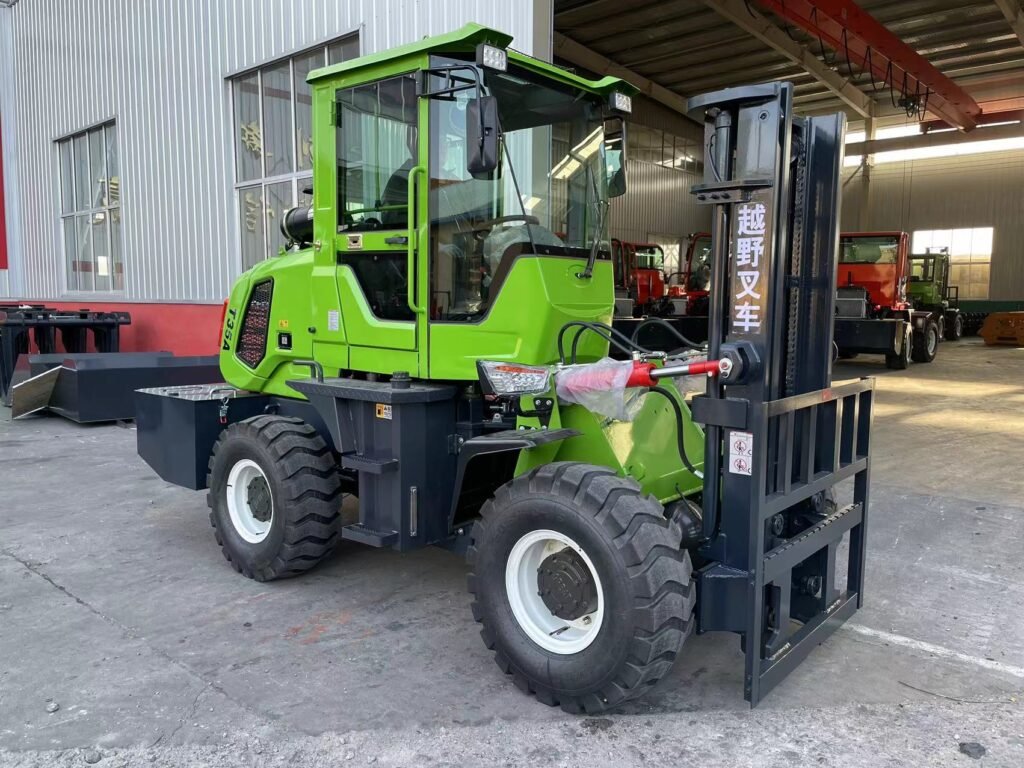
Rough-terrain forklifts are not just “normal forklifts on big tyres”. There are unique cost items:
Heavy-duty articulated or portal axles
4×4 driveline
Long-travel suspension and steering
Reinforced chassis and mast for off-road shocks
Often higher ground clearance and larger tyres (expensive)
Chinese factories that specialize in rough-terrain machines publish sample data:
A CE-certified 3.5-ton rough-terrain forklift from one Chinese brand is offered in a price band of about $8,760–12,150 per unit FOB, depending on configuration and options.
Taking that as a realistic anchor, the 2025 rough-terrain price index in Section 4.2 lines up well:
2.5–3.0 t rough-terrain 4×4: → $11,000 – 14,000
3.5–4.0 t rough-terrain 4×4: → $12,000 – 16,000
5–6 t rough-terrain 4×4: → $18,000 – 26,000
If a quote under-cuts these bands heavily, it usually means:
Light-duty loader axle instead of true “King Kong” or portal axle,
Thinner frame rails or smaller mast section,
No EPA / Stage V compliance (if someone claims it, ask for the test report).
5. Key cost drivers: why the same tonnage can be thousands apart
When two factories both quote “3 ton electric forklift”, but one is $7,600 and the other is $10,800, the gap usually comes from:
5.1 Battery type & size
Lead-acid: cheapest upfront, heavier, needs watering & more maintenance.
Lithium (LFP): 15–30% more expensive, but:
Faster charging
Longer cycle life
Better for multi-shift
Lower lifetime cost according to multiple cost-of-ownership studies.
Within the same chemistry, bigger Ah = more money.
5.2 Mast & lifting height
Basic export spec: 3–4.5 m
High-lift masts (5–7 m) add:
More steel
More cylinders and chains
Sometimes a different carriage design
Higher masts also push up transport height and sometimes container loading cost.
5.3 Attachments & options
Each of these can move the price by hundreds or thousands of dollars:
For dealers in Europe/North America, paperwork is part of the product:
CE / UKCA conformity
EMC tests if required
EPA / Stage V certification for engines
Load charts, manuals, parts books in the right language
Factories that actually perform the tests and keep documentation in order will charge more than those who just “add a sticker”. Given how frequent certificate problems are in Chinese exports, the extra cost is usually worth it.
6. Using the index to build a realistic landed-cost budget
Here’s how a European or North American dealer can use the 2025 index to plan.
6.1 Example A: 3-ton lithium electric forklift from China
Assume:
Target spec: 3-ton CB, 4.5 m triple mast, Li-ion, side shift.
Reference FOB band from the table: $9,000 – 11,500.
A practical budgeting approach:
Factory FOB (target):
Aim to negotiate around $9,500 – 10,500 with a mid-tier but serious factory.
Sea freight & insurance:
4–6 units in a 40’HQ; freight per unit maybe $300–600 depending on route & volume.
Import duty & VAT/GST:
Apply your country’s HS code duty rate on CIF value.
Remember VAT/GST usually applies on CIF + duty.
Local prep & compliance:
Dealer PDI, stickers, translations, third-party inspections: $200–500 per unit in real cost.
Target ex-yard selling price:
Many dealers in Europe/NA aim for a gross margin of 25–45% on machinery.
So a forklift landed at ~$11,500–12,000 all-in may retail around $16,000–20,000 depending on brand strength and service.
This aligns with Western dealer price guides, where new electric forklifts of similar capacity are often sold well above these FOB numbers, given local labour and support costs.
6.2 Example B: 3.5-ton rough-terrain forklift
Assume:
Spec: 3.5-ton, 4×4 diesel, 4.5 m mast, cabin.
Reference FOB band: $12,000 – 16,000.
Realistic budgeting:
Factory FOB target: $12,500–14,500
Extra freight: these machines are bulkier and sometimes shipped RO-RO; freight per unit may be higher than a compact warehouse forklift.
Stricter emission compliance: If EPA / EU Stage V is required, expect an additional $1,000–3,000 in engine and aftertreatment cost either at the factory or in your market.
Once everything is included, a dealer selling into construction or rental can often justify higher margins, since rough-terrain forklifts sit closer to mobile equipment than to commodity warehouse trucks.
7. Quality, certification, and how to avoid “too cheap to be true”
A simple rule that works very well in China:
If a price is 20–30% below the lower edge of the realistic band for that capacity, assume something important has been removed.
Common tricks:
Battery shrinkage
Quote says “3-ton lithium forklift”, but the pack is small, not suitable for an 8-hour shift.
Replacement pack later destroys the total cost advantage.
Lightweight structure
Thinner mast channels and frame plates.
Looks fine on a photo, cracks under rental or construction use.
Unverified certificates
PDFs look official, but serial numbers don’t match the actual truck.
This risk has become big enough that the Chinese government is moving towards tighter control of exports in other EV sectors to protect brand image.
No real after-sales support
Factory disappears after shipment.
No technical drawings, no parts catalogue, no response when something fails under warranty.
For serious dealers, it is usually safer to:
Pay slightly above rock-bottom price to a factory that can show weld procedures, inspection records, and real test data;
And insist on pre-shipment inspection (your own person or a trusted third-party).
8. Where brands like Nicosail fit into a sourcing strategy
Nicosail is known internationally more for mini excavators and compact loaders than forklifts, but the logic is the same:
Multi-line Chinese factories that build compact construction and material-handling equipment share:
Similar hydraulic systems
Similar welding and painting processes
Similar quality-control setups on the line
Dealers who already import compact machines from brands like Nicosail often:
Use the same industrial cluster or partner factories to source forklifts,
Leverage existing QC processes, inspection checklists, and communication channels,
And negotiate better package terms (mixed container of excavators, loaders, and forklifts; shared spare-parts stock, etc.).
So even if the forklift itself doesn’t wear a Nicosail badge, working with a factory that is comfortable supplying Nicosail-level OEM components and build quality is usually safer than betting on an unknown workshop that only survives on ultra-low prices.
9. Quick buying checklist for 2025 importers & dealers
When a quote comes in for an electric or rough-terrain forklift from China, run through this quick list:
Capacity & type clear?
Example: “3.0 ton electric counterbalance, Li-ion, 4.5 m triplex” or
“3.5 ton rough-terrain 4×4 diesel, 4.5 m mast, cabin”.
Does the price sit inside the 2025 band?
If it’s much lower, ask what’s missing.
If it’s much higher, check if you’re paying for brand, options, or just inefficiency.
Battery details written clearly?
Chemistry, voltage, capacity (Ah), brand, and charger model.
Mast & attachments listed?
Height, mast type, side-shift/positioner, special clamps.
Compliance proof prepared?
CE / UKCA declaration, emissions certificate (for diesel), test reports.
Service package defined?
Parts manuals, exploded views, typical spare-parts pricing.
Warranty terms (months or operating hours).
Factory site & process checked (even virtually)?
Production lines, welding quality, paint, test ramp, EOL testing.
For suppliers tied to brands like Nicosail in other equipment lines, this is often easier to verify.
Tick most of these boxes and the chance of a painful surprise drops dramatically.
10. FAQ: Common questions about Chinese electric & rough-terrain forklift prices
Q1: What is the cheapest useful capacity to import from China? For container utilization and resale value, most dealers start at 2.0–2.5 ton electric. 1.5-ton units are cheaper but often too limited for heavy pallets and resale.
Q2: How much more does lithium really cost vs lead-acid? In 2025, for Chinese factory FOB prices, lithium packs typically add around 15–30% to the truck price compared with a comparable lead-acid configuration, depending on capacity and brand.
Q3: How many 3-ton electric forklifts can fit into a 40’HQ? Most factories manage 4–6 units depending on mast height and whether masts are dismounted. Always ask for a container loading drawing; it affects your freight cost per unit.
Q4: Are used forklifts from China a better deal than new? Not usually for dealers. The export market is heavily geared to new forklifts; used units often come with unknown history and limited parts support. New Chinese units with proper QC are already priced aggressively compared to used Western brands.
Q5: How long is the normal lead time in 2025? For standard 2.5–3 ton electrics and 3.5 ton rough-terrain forklifts, 25–40 calendar days from deposit to ready-to-ship is common for established factories, plus shipping time. Custom batteries, high masts, or coloured cabins can add extra weeks.
Q6: How much discount is realistic when negotiating with Chinese factories? If the initial quote is honest, room is usually around 3–8% on machine price for real volume (container-level orders). Requests for 20–30% discounts tend to push the factory toward cheaper components rather than true savings.
Q7: Is it safe to rely on factory-issued CE or EPA certificates? It can be, but only if serial numbers and model codes match the exact machine and the cert can be cross-checked with the issuing body or lab. Because certificate issues have hurt Chinese exports in other vehicle sectors, more serious manufacturers are tightening this, but importers still need to verify.
11. Summary: how to use this 2025 price index without getting burned
To wrap it up:
China is now the dominant global source of forklifts, with electric models taking the lead both at home and in exports.
Real FOB factory prices for 1.5–3 ton electrics typically sit between $6,500 and $11,500, depending on battery type and options.
Rough-terrain 3–3.5 ton 4×4 forklifts from China realistically fall into the $11,000–16,000 FOB band, confirmed by public pricing from specialized off-road manufacturers.
Electric forklifts almost always cost more up front than diesel, but less to run, so dealers should sell them on total cost of ownership rather than only on purchase price.
Offers that sit far below the bands in this guide are rare “miracles”. In practice, they usually hide compromises in batteries, structure, or compliance.
For importers and dealers already working with reputable Chinese OEMs in compact machinery – including brands like Nicosail – the safest path is often to expand the relationship into forklifts or work with partner factories from the same industrial cluster. That way, QC standards, welding quality, hydraulic know-how, and after-sales processes stay at a level suitable for Western rental and distribution markets.
Used correctly, this 2025 price index is:
A filter to throw out risky quotes fast,
A budgeting tool for landed-cost and margin planning, and
A conversation framework with factories, so discussions stay concrete instead of drifting around vague “best price” promises.
If needed, the same method can be extended to other tonnages or special models (reach trucks, VNA, telehandlers) using diesel benchmarks and the typical electric premium described above.
Our chief engineer, guarantees the high quality and advanced design of all our machinery. With vast industry experience, he leads our team in manufacturing premium mini excavators, compact tracked loaders, and skid steer loaders.